Etymology and urban geography.
The Question
On a school trip to the Kamakhya Temple, while her classmates took selfies and her teacher explained ancient history, a girl named Simanta asked a question that nobody expected.
"Why is Guwahati called Guwahati?"
Her teacher paused. The other children looked blank. A temple priest overheard and walked over, his saffron shawl bright against the grey stone.
"Now that," said the priest, "is the best question I've heard all week. Sit down and I'll tell you."
The Betel Nut Market
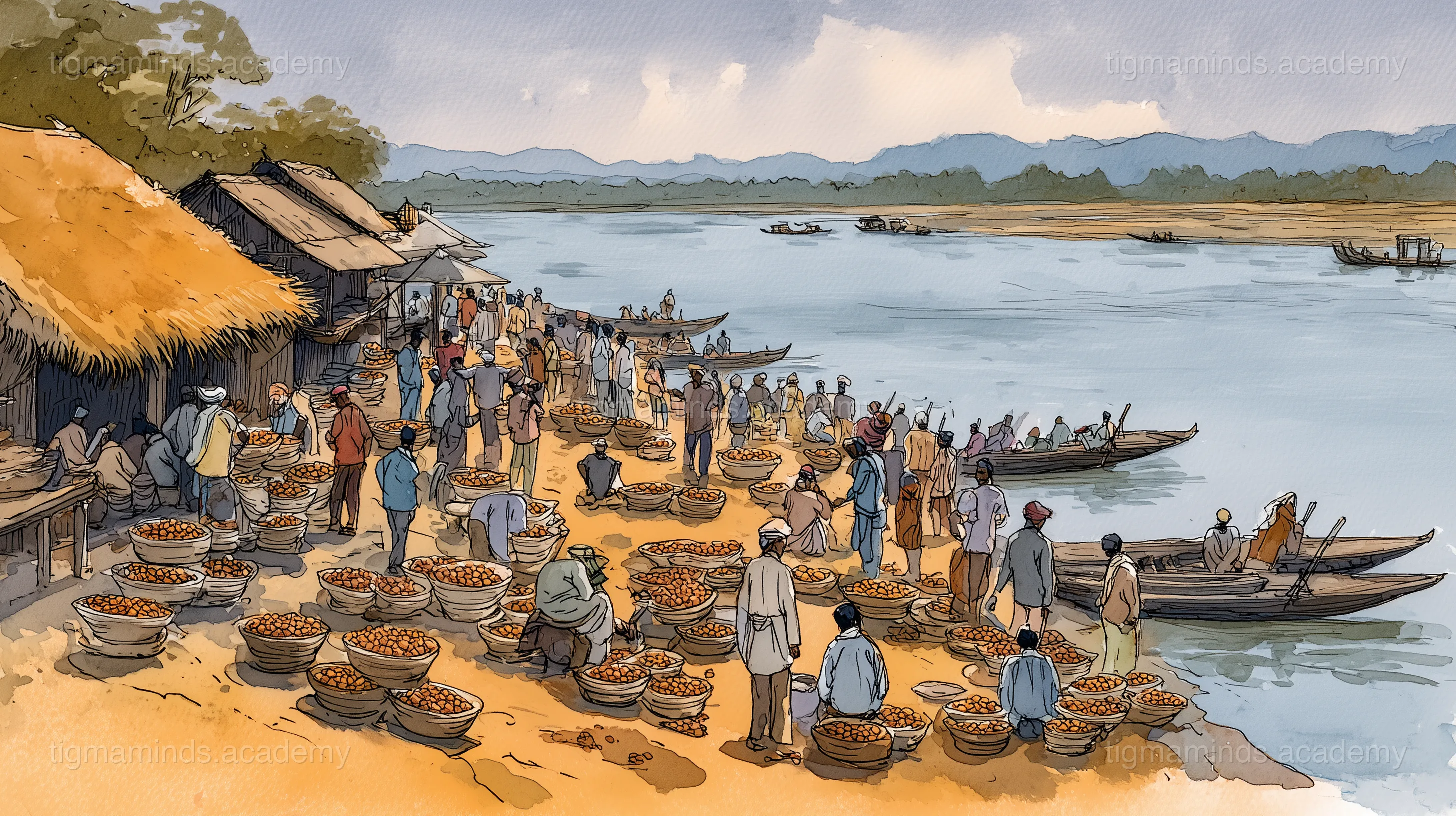
Long, long ago — before Guwahati had bridges and buildings and traffic jams — this place was a cluster of villages along the south bank of the Brahmaputra. The hills were thick with guwa trees — betel nut palms, their slender trunks crowned with green fronds and heavy with clusters of round, hard nuts.
The betel nut was precious. People of the region chewed it with lime and betel leaf as a mark of hospitality. No guest could be received without offering a tamul-paan — betel nut and leaf — and no festival was complete without baskets of guwa piled high on bamboo trays.
"And where there is something precious," said the priest, "there is always a market."
The villages set up a haat — an open-air market — on the banks of the river. People came from upstream and downstream, from the hills and the plains, to buy and sell guwa. They brought rice, they brought fish, they brought silk and spices. But the main attraction was always the betel nut.
Guwa + haat = Guwahati. The betel nut market.
The Child's City
Simanta listened, fascinated. She looked out from the temple hill at the sprawling city below — the white dome of the planetarium, the green ribbon of the river, the crowded streets of Fancy Bazaar and Pan Bazaar.
"So Guwahati is named after a market?" she said. "Not a king? Not a battle? Not a god?"
"Not a king," said the priest, smiling. "A market. A place where people came together to share what they had. Think about that. Most great cities are named after conquests or conquerors. Guwahati is named after a place where people traded — where they brought what they grew and exchanged it for what they needed."
Simanta thought about this all the way home on the school bus. A city built on sharing. A city named not for a sword but for a nut — a small, round, humble nut that meant welcome, sit down, let me offer you something.
The Haat That Grew
The priest had told her more. Over centuries, the little haat grew. Traders came from Bengal, from Myanmar, from Tibet. The market expanded from betel nuts to everything imaginable — silk from Sualkuchi, tea from the upper valley, oranges from the Khasi hills, fish from the Brahmaputra.
Around the market, houses appeared. Around the houses, temples. Around the temples, schools. Around the schools, roads. And around the roads, a city — one of the oldest in the Northeast, rising from the banks of the Brahmaputra like a tree rising from a seed.
And the seed was a betel nut.
The Name That Means Welcome
Simanta wrote an essay about it for school. Her teacher gave her full marks and read it aloud to the class. The last paragraph, which Simanta was most proud of, said this:
"Guwahati's name tells us who we are. We are not a city of conquerors. We are a city of shopkeepers and farmers and traders who said, Come, sit, have a betel nut, tell me what you need. Our city was built not on power but on hospitality. And every time someone offers a guest a tamul-paan, they are repeating the act that gave Guwahati its name — the simple, ancient act of sharing."
Among the people of Assam, a tamul-paan offered with both hands is still the warmest welcome you can receive. And Guwahati — the betel nut market — is still, at its heart, a city that says: come in, you are welcome here.
The end.
Choose your level. Everyone starts with the story — the code gets deeper as you go.
Here is a taste of what Level 1 looks like for this lesson:
import numpy as np
import matplotlib.pyplot as plt
# Your first data analysis with Python
data = [45, 52, 38, 67, 41, 55, 48] # measurements
mean = np.mean(data)
plt.bar(range(len(data)), data)
plt.axhline(mean, color='red', linestyle='--', label=f'Mean: {mean:.1f}')
plt.xlabel("Sample")
plt.ylabel("Value")
plt.title("Etymology & Urban Geography — Sample Data")
plt.legend()
plt.show()This is just the first of 6 coding exercises in Level 1. By Level 4, you will build: Map the Etymology of Local Place Names.
Free
Level 0: Listener
Stories, science concepts, diagrams, quizzes. No coding.
You are here
Level 0 is always free. Coding levels (1-4) are part of our 12-Month Curriculum.
Etymology and urban geography.
The big idea: "How Guwahati Got Its Name" teaches us about Etymology & Urban Geography — and you don't need to write a single line of code to understand it.
Phonetics is the study of the physical sounds of human speech — how they are produced by the vocal tract, how they travel through the air, and how they are perceived by the ear. Every spoken word in every language is built from a finite set of sounds called phones, which are classified by three properties: voicing (do the vocal cords vibrate?), place of articulation (where in the mouth is airflow obstructed?), and manner of articulation (how is it obstructed?).
The name "Guwahati" is phonetically rich. The initial /g/ is a voiced velar stop — the vocal cords vibrate (voiced), the back of the tongue touches the soft palate (velar), and airflow is completely blocked then released (stop). The /w/ is a voiced labial-velar approximant — both lips round and the tongue approaches the velum without full contact. The /h/ is a voiceless glottal fricative — air passes through a narrowed glottis without voicing.
The International Phonetic Alphabet (IPA) provides a symbol for every phone in every language, allowing linguists to transcribe any word unambiguously regardless of spelling conventions. "Guwahati" in IPA is approximately /ɡuwaˈɦaːtiː/ — with a breathy-voiced /ɦ/ rather than a plain /h/, reflecting the Assamese pronunciation. Understanding phonetics reveals why the same city name is spelled differently in different sources — each spelling tries to approximate sounds that English letters were not designed to represent.
Key idea: Phonetics classifies speech sounds by voicing, place, and manner of articulation — the IPA provides a universal transcription system that explains why place names are spelled differently across languages.
Languages, like species, evolve from common ancestors. A language family is a group of languages descended from a single ancestral language (proto-language). The methods for establishing this are the same as in biology: systematic comparison of shared features. If two languages share vocabulary, grammar patterns, and sound correspondences that cannot be explained by borrowing or coincidence, they likely share a common ancestor.
Assam sits at the intersection of at least four major language families: Indo-European (Assamese, Bengali, Hindi), Sino-Tibetan (Bodo, Mising, Karbi), Austroasiatic (Khasi, Munda), and Kra-Dai (Ahom, historically). This extraordinary linguistic diversity in a small region reflects waves of migration over millennia, each group bringing its own language that then evolved in relative isolation in the region's valleys and hills.
Historical linguists reconstruct proto-languages using the comparative method: identifying regular sound correspondences across descendant languages. For example, where Sanskrit has /p/, Persian has /f/ (pitar/pidar → father). These regular shifts, called sound laws, are as reliable as the laws of physics — they apply without exception across the vocabulary. This is how linguists know that English and Hindi are related (both Indo-European) even though they sound nothing alike today.
Key idea: Languages evolve from common ancestors into families — Assam uniquely sits at the junction of four major language families, reflecting millennia of migration and linguistic diversification.
Access all 130+ lessons, quizzes, interactive tools, and offline activities
**Toponymy** is the study of place names, and it is a window into history. "Guwahati" is believed to derive from the Assamese word *guwa* (areca nut/b...