
Materials science and structural engineering across 2,000 years of construction.
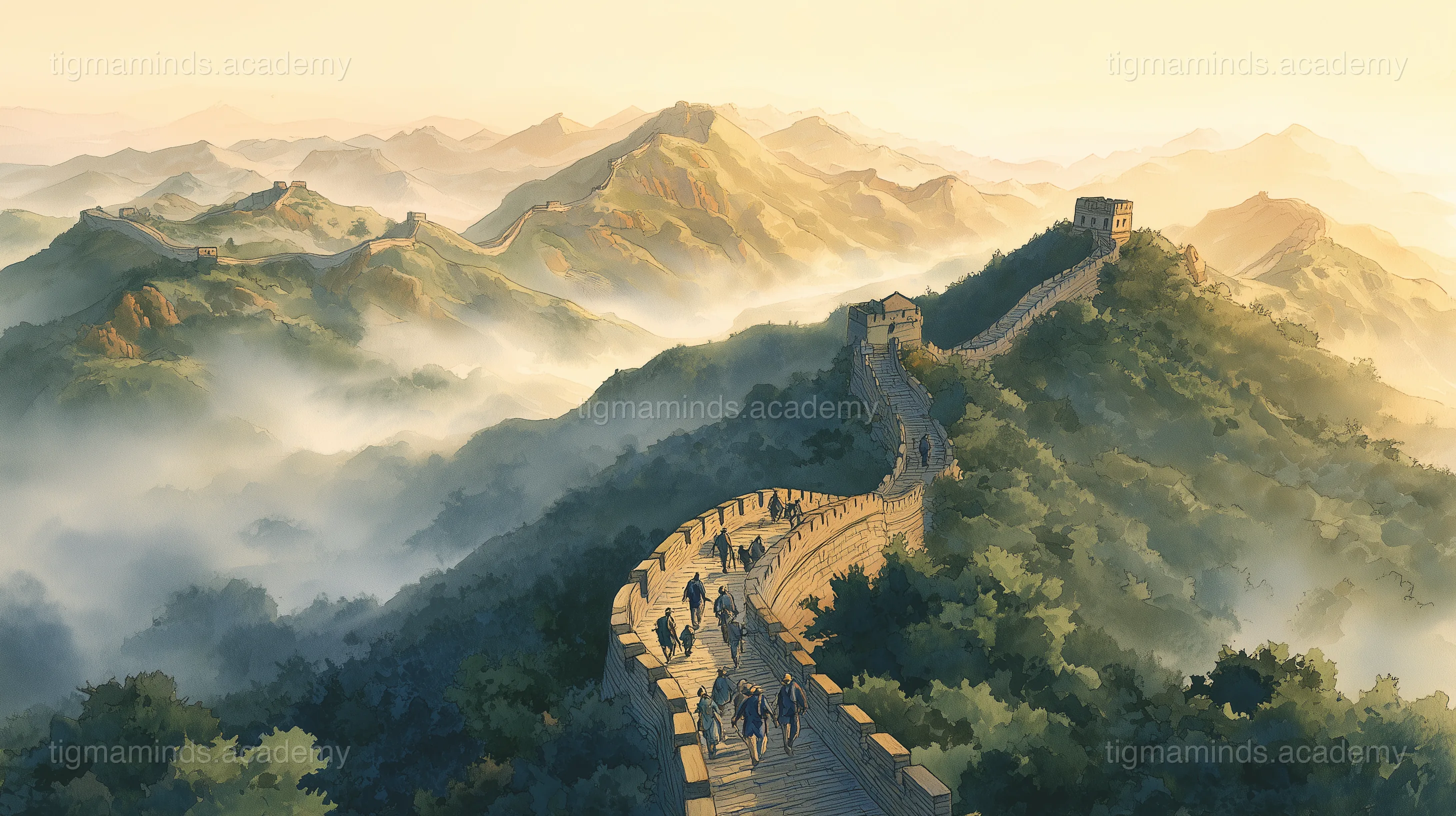
The Foreman's Problem
In the year 1474, during the reign of the Ming Dynasty, a foreman named Chen Wei stood on a mountain ridge in northern China and looked at the problem in front of him.
The wall was supposed to go there — straight across a gap between two peaks, eight hundred metres above the valley floor. The Emperor wanted it done in three years. The generals wanted it done in one. The mountain didn't care what anyone wanted.
Chen Wei had built walls before. He had built them across plains, across river valleys, across gentle hills. But this section of the Great Wall — the stretch near Jinshanling — was different. The terrain was so steep that pack animals couldn't climb it. The nearest kiln was forty kilometres away. And winter was coming, which meant the mortar would freeze before it set.
"We'll need a different approach," Chen Wei told his workers. "Forget what you know about building on flat ground."
Two Thousand Years of Walls
Chen Wei was not the first person to face this problem. The Great Wall was not one wall but hundreds of walls, built by dozens of dynasties over more than two thousand years.
The first emperor to attempt it was Qin Shi Huang in 221 BCE. His wall was made of rammed earth — layers of soil packed into wooden frames and pounded with heavy tampers until they were hard as stone. It worked on the plains of northern China, where soil was plentiful and the ground was flat. But rammed earth has a weakness: water. Rain seeps into the layers, freezes in winter, expands, and cracks the wall from the inside. Over centuries, most of Qin's wall crumbled back into the landscape.
The Han Dynasty (206 BCE – 220 CE) extended the wall westward into the Gobi Desert, where there was no soil at all. They used layers of reed and tamarisk branches mixed with gravel — a natural composite material, like ancient fibreglass. The reeds provided tensile strength; the gravel provided compression resistance. Some sections of this wall still stand today, two thousand years later, in one of the harshest environments on Earth.
But the wall that Chen Wei was building — the Ming Dynasty wall — was something entirely new. The Ming emperors wanted a wall that would last forever. They wanted brick and stone.
The Science of Brick
A brick seems like a simple thing. You dig up clay, shape it, dry it in the sun. But a sun-dried brick is weak — it crumbles under load, dissolves in rain, and shatters in frost. To make a brick that can hold up a wall for centuries, you need fire.
When clay is heated to 900–1100°C in a kiln, something remarkable happens at the molecular level. The water trapped between the clay particles evaporates. The silica and alumina in the clay begin to fuse — they literally melt together, forming a glassy matrix that bonds the particles into a single solid mass. This process is called sintering, and it transforms soft, crumbly clay into a material that is harder than most natural stone.
The Ming kilns produced bricks that could withstand compressive forces of 20–30 megapascals — strong enough to support a wall ten metres tall with watchtowers every few hundred metres. Each brick was stamped with the name of the kiln, the brickmaker, and the date — an ancient quality control system. If a brick failed, they could trace it back to the person who made it.
But here was Chen Wei's problem: those kilns were forty kilometres away, at the base of the mountains. Each brick weighed about 10 kilograms. The wall needed millions of bricks. And the only way to get them up the mountain was on human backs.
The Human Supply Chain
Chen Wei organized his workers into relay teams. Each man carried two bricks — twenty kilograms — up the mountain path. The path was so narrow in places that only one person could pass at a time. A single round trip took four hours.
To supply enough bricks for one metre of wall per day, Chen Wei needed 200 brick carriers working from dawn to dusk. But he also needed stonemasons to cut the foundation blocks, mortar mixers to prepare the lime-and-rice paste, and carpenters to build the scaffolding and watchtower frames.
The mortar itself was a Ming invention: sticky rice mortar. Ordinary lime mortar (calcium hydroxide) is strong in compression but brittle. The Ming builders discovered that adding amylopectin — the starch from sticky rice — to the lime created a mortar that was not only stronger but also more flexible and more waterproof. Modern analysis has shown that the amylopectin fills the microscopic gaps in the calcium carbonate crystals, creating a denser, more homogeneous material. Some Ming-era walls bonded with sticky rice mortar are so strong that modern demolition teams have difficulty breaking them apart.
Freeze-Thaw and the Mountain
Chen Wei's greatest enemy was not the Mongols — it was winter. At 800 metres elevation on the Jinshanling ridge, temperatures dropped to minus 20°C. Water expands by 9% when it freezes. Any water trapped in the mortar, in the bricks, or in the cracks between stones would expand, crack, and slowly destroy the wall from within.
The solution was twofold. First, the bricks were fired at high enough temperatures to minimize porosity — the fewer tiny holes in the brick, the less water could enter. Second, the wall was designed with a slight outward slope on both faces, so rainwater would run off rather than pool. The top of the wall was capped with a layer of larger bricks set at an angle, creating a roof-like drainage system.
The wall also had to handle thermal expansion. Stone and brick expand when heated and contract when cooled. Over the course of a single day in the mountains, the temperature might swing by 30°C. If the wall were built as one rigid structure, these daily expansions and contractions would eventually crack it apart. The Ming builders solved this by leaving small expansion gaps at regular intervals — joints filled with flexible mortar that could absorb the movement.
The Wall That Stands
Chen Wei finished his section of the wall in two years and four months. It was six metres tall, five metres wide at the base, and stretched for twelve kilometres across the Jinshanling ridge. It had forty-seven watchtowers, each one a self-contained fortress with its own water cistern, arrow slits, and signal-fire platform.
The wall he built still stands today, more than five hundred years later. Tourists walk on it. Photographers capture it. Engineers study it. It has survived earthquakes, wars, and five centuries of freeze-thaw cycles — because Chen Wei and the Ming builders understood something fundamental about materials science: a structure is only as strong as its weakest material, and its weakest material is determined by the environment it must survive.
The Great Wall of China is not one wall. It is a 21,000-kilometre textbook in materials science, structural engineering, and logistics — written in earth, reed, brick, stone, and sticky rice mortar over two thousand years.
The end.
Choose your level. Everyone starts with the story — the code gets deeper as you go.
Here is a taste of what Level 1 looks like for this lesson:
import numpy as np
import matplotlib.pyplot as plt
# Your first data analysis with Python
data = [45, 52, 38, 67, 41, 55, 48] # measurements
mean = np.mean(data)
plt.bar(range(len(data)), data)
plt.axhline(mean, color='red', linestyle='--', label=f'Mean: {mean:.1f}')
plt.xlabel("Sample")
plt.ylabel("Value")
plt.title("Materials Science & Structural Engineering — Sample Data")
plt.legend()
plt.show()This is just the first of 6 coding exercises in Level 1. By Level 4, you will build: Build a Materials Strength Simulator.
Free
Level 0: Listener
Stories, science concepts, diagrams, quizzes. No coding.
You are here
Level 0 is always free. Coding levels (1-4) are part of our 12-Month Curriculum.
The real science of building a wall across mountains, deserts, and 2,000 years — materials, forces, and freeze-thaw cycles.
The big idea: "The Great Wall of China" teaches us about Materials Science & Structural Engineering — and you don't need to write a single line of code to understand it.
Pick up a clump of dry mud from the ground. Squeeze it. It crumbles into powder. Now try the same with a brick from a building. The brick doesn't budge. Both started as the same raw material — clay and soil. So what changed?
The answer is heat. When clay is heated in a kiln to temperatures above 900°C, something extraordinary happens at the molecular level. The tiny particles of silica and alumina in the clay begin to fuse together — they partially melt and bond into a continuous, glassy matrix. This process is called sintering. It's the same thing that happens when you make pottery: soft, crumbly clay goes in; hard, ring-when-you-tap-it ceramic comes out.
Rammed earth — the material used in the earliest sections of the Great Wall — is just soil packed tightly. No heat, no sintering, no molecular bonding. The particles are held together only by friction and the pressure of the packing. Add water, and the particles slide apart. Add frost, and expanding ice crystals push them apart from the inside.
The Ming Dynasty builders understood this. They switched from rammed earth to fired brick, which resists water, frost, and compression far better. They were practicing materials science two thousand years before anyone used that phrase.
Check yourself: When you fire a clay pot in a kiln, it shrinks slightly. Why? (Hint: what happens to the spaces between particles when they fuse together?)
Key idea: Sintering — heating clay above 900°C — fuses silica and alumina particles into a glassy matrix, transforming soft clay into hard brick. Without heat, soil is held together only by friction and falls apart when wet or frozen.
Fill a glass bottle with water, seal it tightly, and put it in the freezer. In a few hours, the bottle will crack or shatter. Water is one of the very few substances that expands when it freezes — it grows by about 9% in volume. In a sealed container, that expansion creates enormous pressure — enough to burst glass, split rock, and crumble brick.
This is the freeze-thaw cycle, and it's the single biggest enemy of any building in a cold climate. During the day, rainwater seeps into tiny cracks and pores in the wall. At night, the temperature drops below 0°C and the water freezes. The expanding ice widens the crack. The next day, the ice melts, and more water flows into the now-wider crack. The next night, it freezes again and pushes the crack even further apart.
After hundreds of cycles — just one winter's worth — a hairline crack becomes a gap. After a few years, the gap becomes a hole. After a century, the wall collapses. This is how the earliest sections of the Great Wall were destroyed.
The Ming builders fought freeze-thaw in two ways. First, they used densely fired brick with very few pores — fewer pores means less water can enter. Second, they designed the wall with drainage — slightly sloped surfaces and capped tops that shed water rather than letting it pool.
Prediction: Imagine two identical brick walls in the same climate. One is painted with a waterproof sealant. The other is bare. After 50 winters, which wall will be in better condition? Why?
Key idea: Water expands 9% when it freezes. In porous materials, repeated freeze-thaw cycles progressively widen cracks, eventually destroying the structure. Reducing porosity (denser brick) and improving drainage are the primary defences.
Access all 130+ lessons, quizzes, interactive tools, and offline activities
Put a book on top of a cardboard box. The box holds it. Now stack ten books. The box starts to buckle. Keep adding books and the box collapses. You've...
You probably think of mortar as just grey cement that holds bricks together. But the Ming Dynasty builders used something far more interesting: **stic...