Grandmother's Pitha Stories
Food Science & Chemistry

Grandmother's Pitha Stories

Every pitha has a story — food science in every bite.
Food Science & Chemistry12-Month Curriculum 12h

The Story

The Kitchen That Was a Library

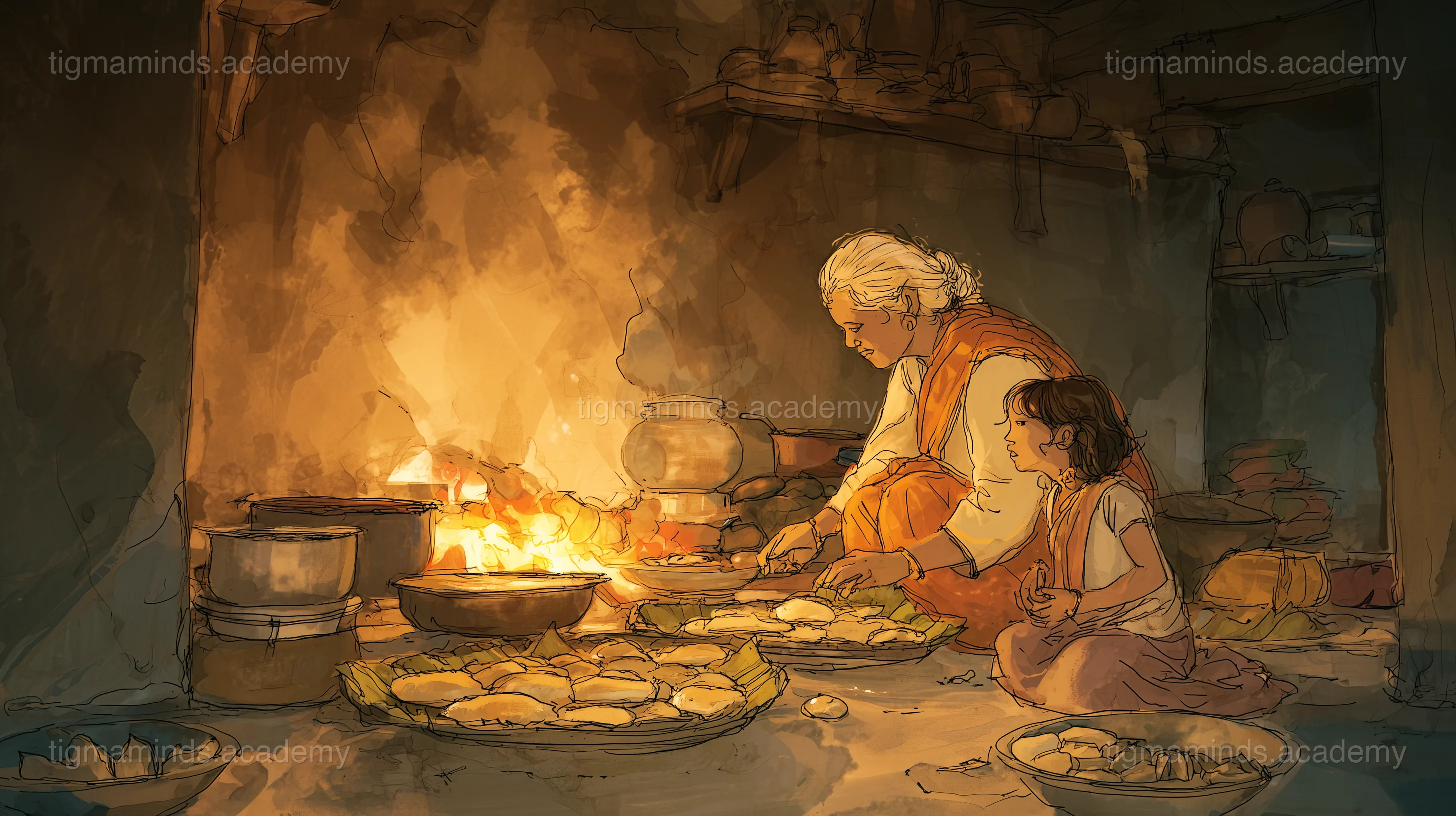
Aita — that's what everyone called her, the word for grandmother — had a kitchen that smelled like a library feels. Warm. Old. Full of stories waiting to be opened.

Every winter, when the mustard fields turned yellow and the mornings were cold enough to see your breath, Aita made pithas — the traditional rice cakes of Assam. And with every pitha, she told a story.

"Bring me the rice flour," she told her granddaughter Mrinmoyee. "And sit down. Today I'm making four kinds, so you get four stories."

The Til Pitha — A Story of Patience

Aita spread thin rice batter on a hot pan, sprinkled it with sesame seeds and jaggery, and rolled it into a tight cylinder.

"Til pitha," she said, "is the most patient pitha. You must spread the batter thin — too thick and it breaks. You must wait for the sesame to toast — too soon and it's raw, too late and it's bitter. Everything about til pitha is about timing."

"Long ago, a young bride came to her new home and tried to make til pitha for her in-laws. She was nervous and rushed, and every one broke. She cried. Her mother-in-law sat down beside her and said: 'Til pitha doesn't care about your hurry. It cares about your hands. Slow down. Let the batter tell you when it's ready.'"

"The bride slowed down. The next pitha was perfect. And so was every one after that."

Aita handed Mrinmoyee a warm til pitha. "Patience," she said, "is the secret ingredient in everything."

The Narikol Pitha — A Story of Sharing

Next, Aita stuffed rice-flour shells with grated coconut and jaggery, then steamed them over a pot of boiling water.

"Narikol pitha is the sharing pitha," said Aita. "You never make narikol pitha for one person. The recipe only works in large batches. If you try to make just one or two, the filling dries out and the dough cracks."

"Why?"

"Because some things in life only work when they're shared. A story told to no one dies. A song sung alone fades. A pitha made for one person is just food. A pitha made for many is a celebration."

Aita placed five steaming pithas on a banana leaf. "Take two to the neighbours," she said. "Narikol pitha demands it."

The Ghila Pitha — A Story of Mistakes

Aita dropped balls of rice-flour dough into hot oil, where they puffed and sizzled into golden ghila pithas — round and crispy on the outside, soft inside.

"Ghila pitha was invented by accident," said Aita. "A cook was making something else — nobody remembers what — and dropped the dough into the wrong pot. It fell into the oil instead of the water. She thought it was ruined. But when she fished it out, it was golden and crunchy and better than anything she'd planned."

"Is that true?" asked Mrinmoyee.

"Every good recipe was a mistake once," said Aita. "The person who made the first ghila pitha didn't plan it. She just didn't throw it away."

The Sunga Pitha — A Story of Home

Finally, Aita packed sticky rice and jaggery into a hollow bamboo tube and set it over the fire to roast slowly.

"Sunga pitha takes the longest," she said. "You have to roast the bamboo slowly, turning it, for almost an hour. It cannot be rushed."

"What's the story?"

"The story," said Aita, "is that sunga pitha tastes like bamboo and smoke and time. It tastes like the kitchen you grew up in. It tastes like winter mornings and grandfather's voice and the dog sleeping by the fire. It doesn't taste the same anywhere else. Only here."

Mrinmoyee bit into the sunga pitha. It was warm and sweet and smoky, and it tasted exactly like Aita's kitchen — which is to say, it tasted like home.

"That's four pithas and four stories," said Aita. "Come back tomorrow and I'll make four more."

The end.

Try It Yourself

Choose your level. Everyone starts with the story — the code gets deeper as you go.

Story Progress

0%

Ready to Start Coding?

Here is a taste of what Level 1 looks like for this lesson:

Level 1: Explorer — Python
import numpy as np
import matplotlib.pyplot as plt

# How temperature affects the Maillard reaction
temps = np.arange(100, 220, 5)
rate = np.where(temps >= 140,
    2 ** ((temps - 140) / 10), 0.1)

plt.fill_between(temps, rate, alpha=0.2, color="#d97706")
plt.plot(temps, rate, color="#d97706", linewidth=2)
plt.axvline(x=140, color="red", linestyle="--",
            label="140C: Maillard starts")
plt.xlabel("Temperature (C)")
plt.ylabel("Browning rate (relative)")
plt.title("Why Hot Pans Brown Food")
plt.legend()
plt.show()

This is just the first of 6 coding exercises in Level 1. By Level 4, you will build: Experiment With the Science of Baking.

By Level 4, enrolled students build: Experiment With the Science of Baking

Free

Level 0: Listener

Stories, science concepts, diagrams, quizzes. No coding.

You are here

Enrolled

Levels 1-4

Python, NumPy, Matplotlib, real projects, mentorship.

Sign Up Free

Stay Updated

Join Waitlist

Get notified when enrollment opens for your area.

Notify Me

Level 0 is always free. Coding levels (1-4) are part of our 12-Month Curriculum.