
Memory as technology — neuroscience of oral tradition.
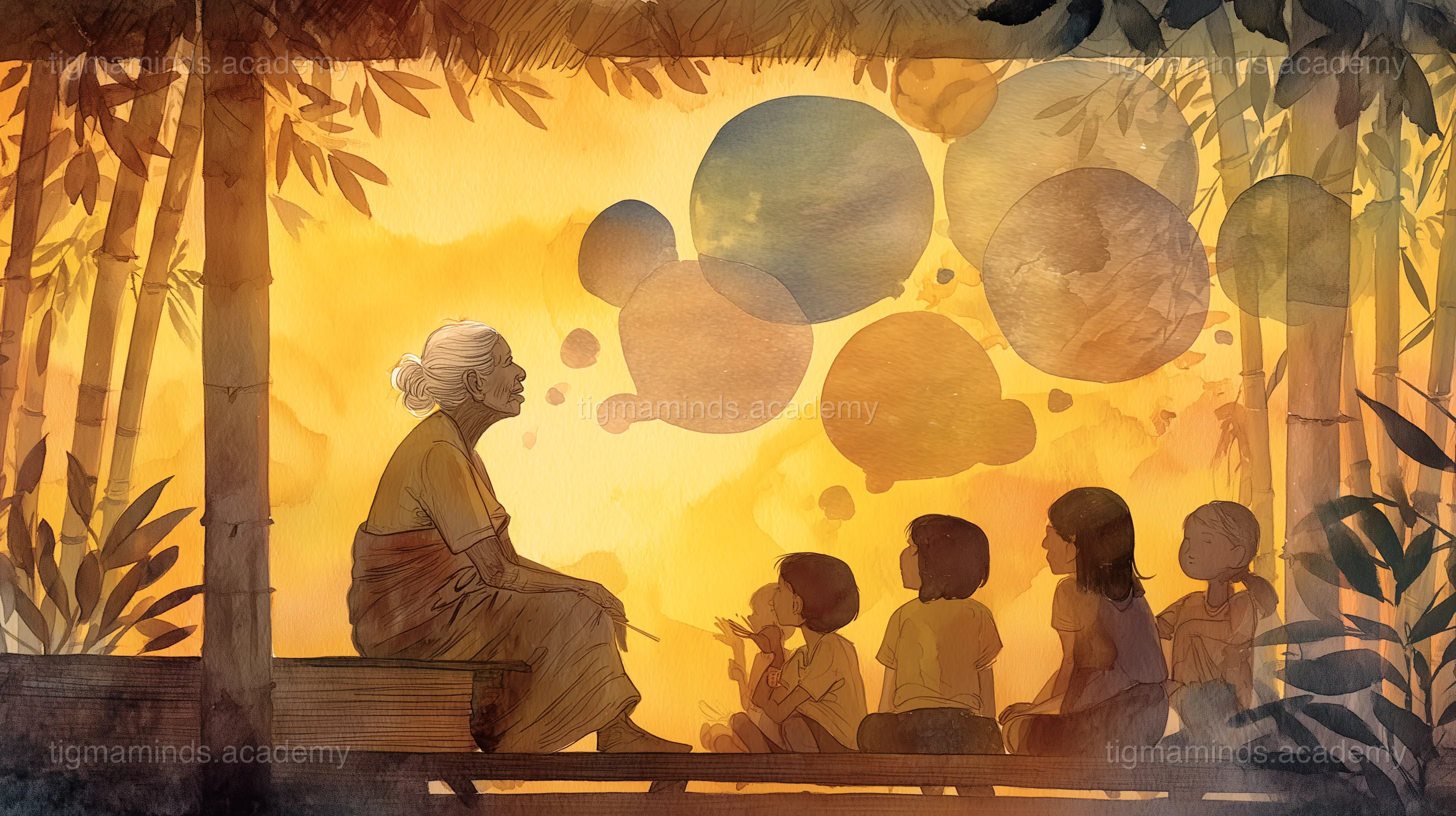
The Village Without Books
In a small Mishing village on the banks of the Brahmaputra, raised on bamboo stilts above the flood line, there lived a grandmother named Yaruini Mili. She was eighty-three years old. She had never been to school. She could not read or write a single letter.
And yet, she was the most important person in the village.
Because Yaruini remembered everything.
She remembered who married whom in 1962. She remembered the flood of 1971 — which houses survived and which were swept away. She remembered the name of every child born in the village for sixty years, the songs her mother sang, the recipes her grandmother cooked, and the exact spot where her great-grandmother had planted the first kosu plant that still grew by the river.
The village had no library, no archive, no written records. Yaruini was the library.
The Girl Who Asked Questions
A girl named Minam, eleven years old and fiercely curious, loved to sit at Yaruini's feet in the evenings and ask questions.
"Aai, who built the big bamboo bridge?"
"Your great-grandfather Jonaki, in 1953, after the old bridge was taken by the river. He used 200 bamboo poles and it took him three months. He tied every joint himself because he didn't trust anyone else's knots."
"Aai, why is the mango tree by the school crooked?"
"Because during the earthquake of 1966, the ground shifted and the tree leaned. But it didn't fall. Your grandmother said it was too stubborn to die. Just like her."
Every answer was a story. Every story connected to another story. Yaruini's memory was not like a filing cabinet — it was like a river, one thing flowing into the next, carrying everything along.
The Flood
In July, the Brahmaputra rose higher than anyone alive had seen. The water climbed past the stilt line. Houses that had never been touched by floods were suddenly knee-deep in brown, churning water. The villagers scrambled to save what they could — clothes, food, the school's few textbooks.
Minam waded to Yaruini's house and found the old woman sitting calmly on her raised bed, her feet tucked under her, watching the water swirl around the bamboo posts below.
"Aai, we have to go! The boats are ready!"
"I know, child. I'm not worried about myself. I'm worried about the things that can't swim."
"What things?"
"The photograph on the wall — the only one of your great-great-grandfather. The dried paan leaves I've been saving from your uncle's wedding. The cloth with the old map of the village that my mother drew in turmeric paste."
Minam looked around. The water was rising fast. They could save some things, but not all.
What Cannot Be Drowned
They saved what they could carry. The photograph. A few precious bundles. They left the rest to the river.
In the relief camp on higher ground, the villagers sat in rows, wet and exhausted, surrounded by the little they had saved. Some people wept for their lost things — the grain, the tools, the documents that proved who owned what land.
But Yaruini sat in the centre and began to speak.
"Haren's family has farmed the plot by the east bend since 1948 — I was there when his grandfather cleared the land." The village headman wrote it down. "Bina's house was built by her father-in-law in 1975 — I remember because it was the same year the big sal tree fell." Someone else wrote that down too.
For three days, Yaruini dictated the village's history — every land boundary, every family tree, every important date — while the younger people wrote it all down in notebooks for the first time.
The Living Library
When the flood receded and the village rebuilt, the headman erected a small wooden sign outside Yaruini's house. It read: VILLAGE LIBRARY.
People laughed at first — there wasn't a single book inside. But the headman was serious. "This woman holds more history than any building," he said. "Floods can drown books. They cannot drown memory."
Minam started a new tradition. Every week, she and the other children would sit with Yaruini and write down the stories she told. Slowly, the village grew a library of notebooks — written in the children's handwriting, filled with Yaruini's words.
"Now the stories are in two places," Minam said. "In your head and on the paper."
Yaruini smiled. "Good. Paper is useful. But remember, child — paper burns and paper drowns. The stories in your head go wherever you go. Learn to carry them."
The end.
Choose your level. Everyone starts with the story — the code gets deeper as you go.
Here is a taste of what Level 1 looks like for this lesson:
import numpy as np
import matplotlib.pyplot as plt
# Ebbinghaus forgetting curve simulation
hours = np.array([0, 1, 24, 72, 168, 720])
labels = ["Learn", "1 hr", "1 day", "3 days", "1 week", "1 month"]
no_review = 100 * np.exp(-0.005 * hours)
spaced = np.array([100, 95, 90, 88, 85, 82])
plt.figure(figsize=(10, 5))
plt.plot(hours, no_review, "o--", color="red", label="No review")
plt.plot(hours, spaced, "o-", color="green", label="Spaced repetition")
plt.xticks(hours, labels)
plt.ylabel("Recall (%)")
plt.title("Your Forgetting Curve: With vs Without Review")
plt.legend()
plt.grid(alpha=0.3)
plt.show() # Which line would Yaruini's storytelling follow?This is just the first of 6 coding exercises in Level 1. By Level 4, you will build: Test Your Own Forgetting Curve.
By Level 4, enrolled students build: Test Your Own Forgetting Curve
Free
Level 0: Listener
Stories, science concepts, diagrams, quizzes. No coding.
You are here
Level 0 is always free. Coding levels (1-4) are part of our 12-Month Curriculum.
Memory as technology — neuroscience of oral tradition.
The big idea: "The Grandmother Who Remembered Everything" teaches us about Memory & Neuroscience — and you don't need to write a single line of code to understand it.
Your brain does not store all memories the same way. It has two distinct systems: short-term memory (also called working memory) and long-term memory. Think of short-term memory as a small whiteboard — it holds about 7 items for roughly 30 seconds. Long-term memory is an enormous library that can store information for a lifetime.
When someone tells you a phone number, it enters short-term memory. If you repeat it a few times, it may transfer to long-term memory. But if someone distracts you immediately, the number vanishes — it never left the whiteboard. This is why cramming the night before an exam often fails: the information enters short-term memory but never makes the journey to long-term storage.
Prediction check: if short-term memory holds only about 7 items, how did Yaruini remember thousands of facts? She did not hold them all in short-term memory simultaneously. Over decades, through repeated storytelling, each fact was individually transferred to long-term memory by the hippocampus, one memory at a time, night after night during sleep.
Key idea: Short-term memory is small and temporary (7 items, 30 seconds). Long-term memory is vast and permanent. The hippocampus transfers memories from one to the other during sleep.
Deep inside your brain, roughly behind each ear, sit two curved structures shaped like seahorses. These are your hippocampi (singular: hippocampus), and they are the gateway to long-term memory.
During the day, the hippocampus encodes experiences by converting sensory information — sights, sounds, smells, emotions — into patterns of electrical signals between neurons. During sleep, it replays these patterns, strengthening the neural connections until the neocortex absorbs them as permanent memories.
The famous patient Henry Molaison had both hippocampi surgically removed in 1953. He could remember his childhood perfectly but could not form a single new memory for the remaining 55 years of his life. This tragic case proved the hippocampus is essential for creating new memories, even though old memories are stored elsewhere.
Key idea: The hippocampus encodes new experiences during the day and replays them during sleep to build permanent memories. Without it, no new long-term memories can form.
Access all 130+ lessons, quizzes, interactive tools, and offline activities
In 1885, German psychologist Hermann Ebbinghaus memorized lists of nonsense syllables and tested himself at intervals. He discovered the **forgetting ...
If memory fades so quickly, how do some people remember vast amounts of information? The answer is **memory techniques** — strategies that work *with*...
A Thought, in Motion