The Golden Deer of Kamakhya
Optics & Light

The Golden Deer of Kamakhya

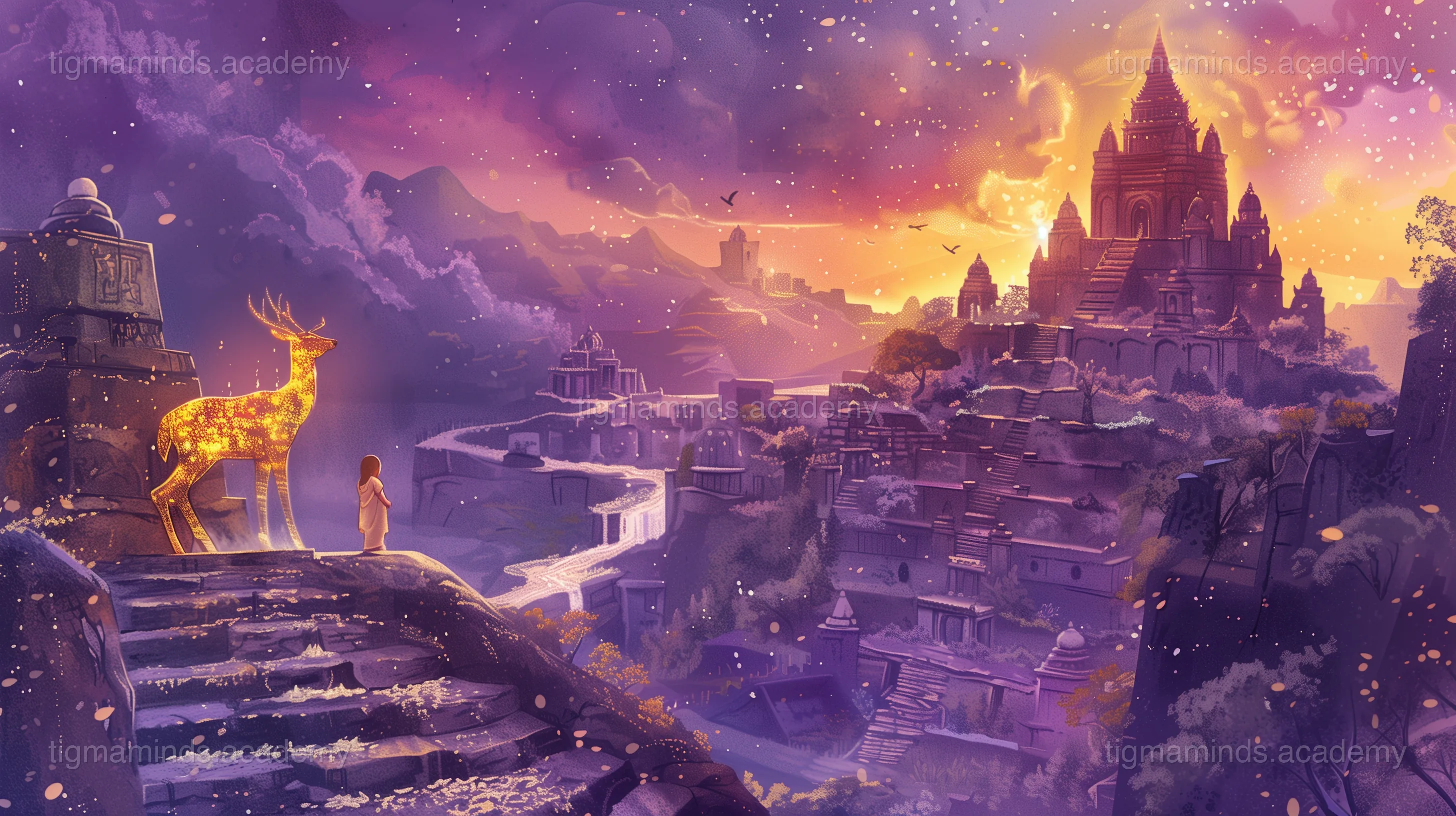
A golden deer whose coat shines like the sun grants one wish to anyone pure of heart.
Optics & Light12-Month Curriculum 12h

The Story

The Hill Above the River

On the outskirts of Guwahati, where the city gives way to forest and the air thickens with the scent of champa flowers and incense, Nilachal Hill rises above the Brahmaputra valley like a sleeping elephant. At its summit stands the ancient Kamakhya temple — its stone walls darkened by centuries of monsoon rain, its dome covered in moss, its courtyards alive with the sound of bells and murmured prayers.

The priests of Kamakhya told many stories, but one they told only to children, and only at dusk when the river below turned to liquid gold. It was the story of the golden deer.

They said it lived somewhere on the hill — not inside the temple, but in the wild places between the stone steps, where ferns grew from cracks in the rock and butterflies gathered around puddles of rainwater. Its coat was the colour of Muga silk caught in afternoon light — not a harsh, metallic gold, but a warm, living shimmer that seemed to breathe. Its eyes were dark and deep, like stars reflected in the river on a still night.

The deer, the priests said, could grant one wish. But only to someone whose heart was truly pure.

Those Who Climbed

Over the years, many people climbed Nilachal Hill seeking the golden deer. A king came first, wearing silk and surrounded by soldiers. He carried a bag of gold coins as an offering and wished for a larger kingdom. He searched every path, every clearing, every grove of trees. He found nothing but monkeys and moss.

A merchant came next, arriving on the back of an elephant. He wished for a trade route that would make him the richest man in the Brahmaputra valley. He hired trackers and hunters to find the deer. They found hoofprints in the mud — small, delicate, unmistakable — but the deer itself was always just around the next bend, just behind the next tree, always vanishing.

A scholar came, carrying books of philosophy. He wished for wisdom greater than any teacher could give. He sat in meditation for three days at the summit, waiting for the deer to come to him. On the third night, he heard hooves on stone — soft, careful — and opened his eyes. Nothing. Just moonlight on the temple walls and the distant sound of the river.

Each one climbed with something they wanted. And each one came down empty-handed.

Junali

In a village downstream, where the Brahmaputra flooded every monsoon and carried away a little more of the riverbank each year, lived a farmer's daughter named Junali. She was twelve years old, thin as a bamboo stalk, with hands roughened from planting rice and a smile that made old women in the market give her extra vegetables.

Junali's village was struggling. The river had taken their best fields two monsoons ago. The well water had turned brackish. Her father worked from dawn to dark and still there was barely enough rice.

One evening, her grandmother told her the story of the golden deer. Junali listened with wide eyes.

"But Aita," she said, "if the deer only appears to the pure of heart, how would I know if my heart is pure enough?"

Her grandmother laughed — a dry, warm laugh like the rustle of rice husks. "That, my child, is exactly the kind of question a pure heart asks."

The next morning, before the sun had fully risen, Junali began walking toward Guwahati. She carried nothing but a cloth bundle with a handful of rice — her lunch, packed by her mother, who did not know where she was going.

The Climb

The path up Nilachal Hill was steep and winding. Stone steps, worn smooth by a thousand years of pilgrims' feet, disappeared into the forest. The air grew cooler as she climbed. Rhesus macaques watched her from the branches, their amber eyes curious. A hornbill called from somewhere deep in the canopy — a sound like a rusty gate swinging open.

Junali passed the temple, touching the stone walls for luck. She passed the priests performing their morning rituals, the smoke of dhuna curling upward through shafts of green-gold light. She kept climbing, beyond the temple, into the wild part of the hill where few people went.

The forest closed around her. Ferns brushed her ankles. A spider's web, strung between two sal trees and decorated with dew, caught the light like a net of tiny diamonds. Junali stopped to admire it, then carefully ducked underneath so as not to break it.

She climbed for an hour. Two hours. The path grew faint. Her legs ached. She sat on a rock and opened her cloth bundle, thinking she would eat her rice and then go home.

And then she saw it.

The Deer

It stood in a clearing no larger than a village courtyard, where sunlight fell through a gap in the canopy like a spotlight. The golden deer was smaller than she had imagined — no larger than a young sambar — but its coat was exactly as the stories described. It shimmered. Not with the cold shine of metal, but with a warm, pulsing glow, as if the animal were lit from within. Each hair seemed to hold its own tiny sun.

The deer looked at her. Its eyes were ancient and kind, the dark brown of river stones polished by centuries of water.

Junali forgot about wishing. She forgot about the stories. She looked at the deer and saw that it was thin. Its ribs showed faintly beneath that glorious coat.

"Oh," she said softly. "You're hungry."

She opened her cloth bundle and held out her handful of rice — the only food she had for the long walk home.

The deer stepped forward, its hooves silent on the forest floor. It lowered its head and ate from her palm, its breath warm and gentle against her fingers.

When the rice was gone, the deer raised its head and spoke. Its voice was like wind through bamboo — not quite sound, not quite thought, but something Junali understood perfectly.

"You came to a wishing deer. Kings have come with gold. Merchants have come with elephants. Scholars have come with prayers. You came with a handful of rice and gave it away. Tell me, child — what do you truly want?"

Junali thought for a long time. She thought about the flooded fields. The brackish well. Her father's tired hands. Her mother counting grains of rice to make dinner stretch.

"I wish the river would be kinder to my village," she said.

The deer looked at her steadily. Then it stamped its right front hoof against the earth — once, sharply — and where its hoof struck, the ground cracked open and a spring of clear, sweet water bubbled up. It pooled in the hollow of the rock, overflowed, and began to trickle downhill toward the valley.

"This water will find your village," the deer said. "It will flow in drought and in flood, and it will never turn bitter. Not because of magic, but because you asked for something that was not for yourself alone."

The Spring

Junali walked home in the fading light. By the time she reached her village, the spring's water had already arrived — a thin, clear stream running through the dry channel behind the houses, tasting of mountain rock and moss.

The villagers gathered around it, cupping the water in their hands, laughing, crying. Her father knelt by the stream and let the water run over his cracked palms. "Where did this come from?" he whispered.

Junali never told anyone about the deer. She was not sure they would believe her, and besides, the deer had seemed like a private thing — a moment between two creatures sharing a meal.

The spring still flows. If you climb Nilachal Hill past the Kamakhya temple and into the wild forest beyond, you might find it — a thin thread of water emerging from a crack in the rock where something once stamped its hoof. The water is cool and sweet, and it has never stopped flowing, not once in all the years since a girl with a handful of rice climbed a hill expecting nothing and received everything.

The end.

Try It Yourself

Choose your level. Everyone starts with the story — the code gets deeper as you go.

Story Progress

0%

Ready to Start Coding?

Here is a taste of what Level 1 looks like for this lesson:

Level 1: Explorer — Python
import numpy as np
import matplotlib.pyplot as plt

# Your first data analysis with Python
data = [45, 52, 38, 67, 41, 55, 48]  # measurements
mean = np.mean(data)

plt.bar(range(len(data)), data)
plt.axhline(mean, color='red', linestyle='--', label=f'Mean: {mean:.1f}')
plt.xlabel("Sample")
plt.ylabel("Value")
plt.title("Optics & Light — Sample Data")
plt.legend()
plt.show()

This is just the first of 6 coding exercises in Level 1. By Level 4, you will build: Build a Spectroscope.

Free

Level 0: Listener

Stories, science concepts, diagrams, quizzes. No coding.

You are here

Enrolled

Levels 1-4

Python, NumPy, Matplotlib, real projects, mentorship.

Sign Up Free

Stay Updated

Join Waitlist

Get notified when enrollment opens for your area.

Notify Me

Level 0 is always free. Coding levels (1-4) are part of our 12-Month Curriculum.