Reforestation and carbon science.
The Empty Sandbar
In the middle of the Brahmaputra, not far from Jorhat, there was a sandbar so bare and white that it hurt your eyes to look at it in the afternoon sun. Nothing grew there. No trees, no grass, not even a weed. Just sand and silence and the endless river on every side.
A girl named Junali saw the sandbar every day from her school window, and it made her sad. “Everything around it is green,” she told her teacher. “The banks are green. The islands are green. But that sandbar is like a bald patch on the river’s head.”
Her teacher laughed. “Sand doesn’t grow trees, Junali.”
“Maybe it just needs someone to try,” said Junali.
One Tree a Day
The next morning, Junali paddled a small bhela — a raft made of banana stems — to the sandbar. She carried a single sapling in a clay pot: a sisoo tree, tough and fast-growing. She dug a hole in the sand, mixed in some river mud and cow dung, planted the sapling, and gave it water from the Brahmaputra.
“Grow,” she whispered. “Please grow.”
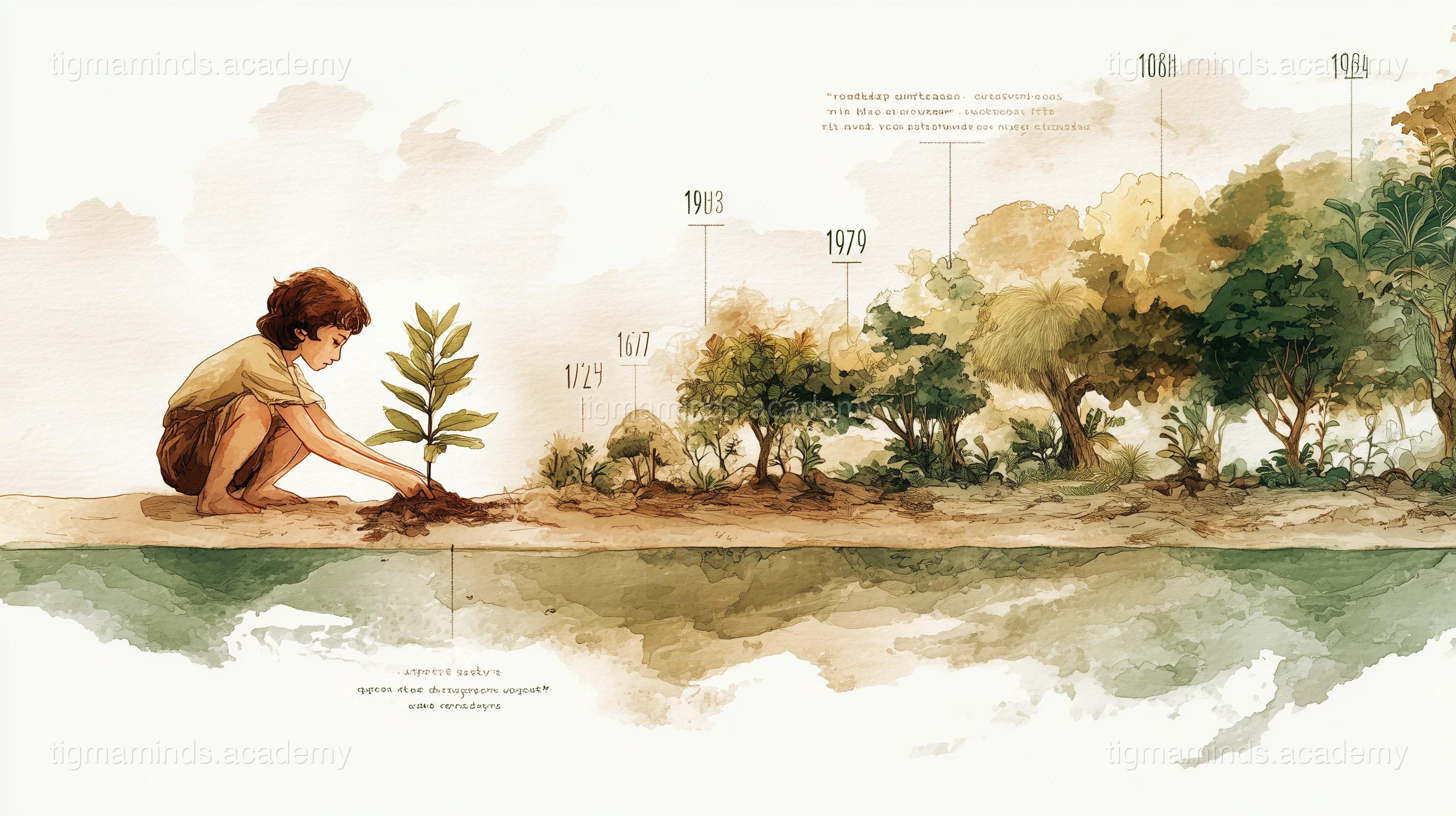
The next day, she planted another. And another. And another. One tree every day, rain or shine, school day or holiday. Sisoo, bamboo, cotton tree, arjun, neem. She carried them across the water on her little raft, one at a time, and planted them in the sand.
People thought she was strange. “It’s a sandbar,” they said. “The monsoon will wash everything away.”
The monsoon came. It washed away half her trees. Junali planted them again.
The First Shade
Two years passed. Junali had planted over seven hundred trees. Most had died — from floods, from drought, from goats that swam over and nibbled the leaves. But some survived. The sisoo trees were the toughest. They put down roots that gripped the sand like fingers, and their roots held the soil together, and the soil held more moisture, and the moisture helped more trees survive.
By the third year, the sandbar had shade. Actual shade. A patch of green in the middle of the brown-and-white river. Birds appeared — first a kingfisher, then mynahs, then a family of egrets that built nests in the tallest sisoo.
Junali sat under her first tree — now taller than she was — and cried. Not from sadness. From the overwhelming surprise of seeing her impossible idea become real.
The Forest Comes Alive
By the fifth year, the sandbar wasn’t a sandbar anymore. It was a forest — small, young, but unmistakably a forest. Bamboo groves rustled in the wind. Neem trees perfumed the air. The ground, once bare sand, was covered in fallen leaves and soft soil. Earthworms had arrived. Frogs sang after every rain. A monitor lizard took up residence in a hollow log.
A journalist from Guwahati heard about the girl who grew a forest and came to see it. He wrote a story that was read across the state. People compared Junali to Jadav Payeng, the real-life Forest Man of Majuli, who had done exactly the same thing decades earlier — turned a barren sandbar into a thriving forest, one tree at a time.
“I didn’t do anything special,” Junali told the journalist. “I just planted one tree a day. Anyone can plant one tree a day.”
The Living Proof
Today, Junali’s forest is home to over a hundred species of birds, dozens of insects, and even a small herd of wild buffalo that swims across from the mainland to graze in the clearings. The roots of a thousand trees hold the sandbar firm against the monsoon currents. What was once the barest spot on the river is now the greenest.
And every morning, Junali still paddles out to her forest and plants one more tree. Because a forest is never finished. It’s a living thing, always growing, always changing, always needing one more pair of hands.
“One tree is nothing,” Junali says. “But one tree every day for five years is a forest. That’s the secret. Not the size of the action. The stubbornness of repeating it.”
The end.
Choose your level. Everyone starts with the story — the code gets deeper as you go.
Here is a taste of what Level 1 looks like for this lesson:
# How many trees does it take to offset one car?
car_co2_per_year = 4600 # kg CO2 (average car)
tree_co2_per_year = 22 # kg CO2 absorbed by one mature tree
trees_needed = car_co2_per_year / tree_co2_per_year
print(f"One car emits {car_co2_per_year} kg CO2/year")
print(f"One tree absorbs {tree_co2_per_year} kg CO2/year")
print(f"Trees needed to offset one car: {trees_needed:.0f}")
# Jadav Payeng planted 1 tree/day for 30 years
total_trees = 1 * 365 * 30
offset_cars = (total_trees * tree_co2_per_year) / car_co2_per_year
print(f"\nPayeng planted ~{total_trees:,} trees")
print(f"That offsets ~{offset_cars:.0f} cars every year!")This is just the first of 6 coding exercises in Level 1. By Level 4, you will build: Calculate How Much Carbon a New Forest Stores.
By Level 4, enrolled students build: Calculate How Much Carbon a New Forest Stores
Free
Level 0: Listener
Stories, science concepts, diagrams, quizzes. No coding.
You are here
Level 0 is always free. Coding levels (1-4) are part of our 12-Month Curriculum.
Reforestation and carbon science.
The big idea: "The Girl Who Grew a Forest" teaches us about Reforestation & Carbon Sequestration — and you don't need to write a single line of code to understand it.
Imagine an empty car park — just concrete and dust. Now imagine nobody touches it for 200 years. What happens? First, cracks appear. Tiny mosses and grasses push through. Their roots break the concrete further. Dead grass adds a thin layer of soil. After a few years, shrubs arrive — they can grow in shallow soil. Their leaves fall, decay, and make the soil deeper. Insects and worms move in. After a few decades, tree seedlings sprout in the shade of the shrubs. The trees grow taller than the shrubs, stealing the sunlight. The shrubs die back. Eventually, you have a forest standing where a car park used to be.
This process is called ecological succession. It always follows the same sequence: bare ground → mosses and grasses (pioneer species) → shrubs → young trees → mature forest. The pioneers are the key — they are the first to arrive because they can survive in terrible conditions (no shade, no soil, blazing sun). But here is the twist: they create the very conditions that allow their replacements to grow. Grasses build soil. Shrubs create shade. Young trees create the canopy that shade-loving species need. Each stage makes the next one possible.
In the story, Junali plants sisoo and bamboo first. These are classic pioneers — fast-growing, tough, and able to survive in sand. Their roots grip the sand and hold it in place. Their fallen leaves rot and become soil. Within a few years, the "sandbar" starts to feel like land. That is succession in action, accelerated by a girl with a plan.
Try this: Find a crack in a pavement or an abandoned patch of ground. Look closely. Can you spot the pioneers? Mosses, weeds, tiny grasses? These are the very first stage of succession happening right in front of you.
Check yourself: Why do pioneer species eventually disappear from the forest they helped create? (Hint: think about what happens when taller plants block the sunlight.)
Key idea: Forests grow in stages: bare ground → pioneers → shrubs → young trees → mature forest. Each stage creates the conditions the next stage needs. Pioneers are the heroes who start the process but get replaced by what they made possible.
Here is a question that puzzled scientists for centuries: where does a tree’s mass come from? A mature oak tree can weigh 10,000 kg. Did all that mass come from the soil? If you weighed the soil before and after growing a tree, you would find the soil barely lost any weight. So where did 10,000 kg of tree come from?
The answer is the air. Specifically, carbon dioxide (CO₂) — an invisible gas that makes up about 0.04% of the atmosphere. Through photosynthesis, trees pull CO₂ from the air, split it apart using energy from sunlight, keep the carbon (C), and release the oxygen (O₂) for us to breathe. The carbon becomes wood, bark, leaves, and roots. A tree is, quite literally, solid air.
The formula is: 6CO₂ + 6H₂O + sunlight → C₆H₁₂O₆ + 6O₂. In plain English: six molecules of carbon dioxide plus six molecules of water, powered by sunlight, produce one molecule of sugar (glucose) plus six molecules of oxygen. The tree then converts that sugar into cellulose and lignin — the structural materials of wood.
This means every tree is a carbon store. A single mature tree holds roughly 50% carbon by dry weight. When Junali plants a tree, she is building a machine that pulls CO₂ from the atmosphere and locks it away as solid wood. One tree absorbs about 22 kg of CO₂ per year. Multiply that by a thousand trees and you have a serious climate solution.
Check yourself: If a tree weighing 500 kg is roughly 50% carbon by dry weight, and each kg of carbon originally came from 3.67 kg of CO₂, how much CO₂ did that tree pull from the air over its lifetime? (Answer: 500 × 0.5 × 3.67 = 917.5 kg.)
Key idea: Most of a tree’s mass comes from CO₂ in the air, not from the soil. Through photosynthesis, trees convert atmospheric carbon into solid wood — making every forest a massive carbon store.
Access all 130+ lessons, quizzes, interactive tools, and offline activities
Try this thought experiment. Take a bucket of sand and tilt it to 45 degrees. The sand slides off immediately. Now imagine that same sand threaded wit...
Junali’s story sounds like a fairy tale, but the maths behind it is completely real. One tree per day for five years is 1,825 trees. Over 30 years, th...