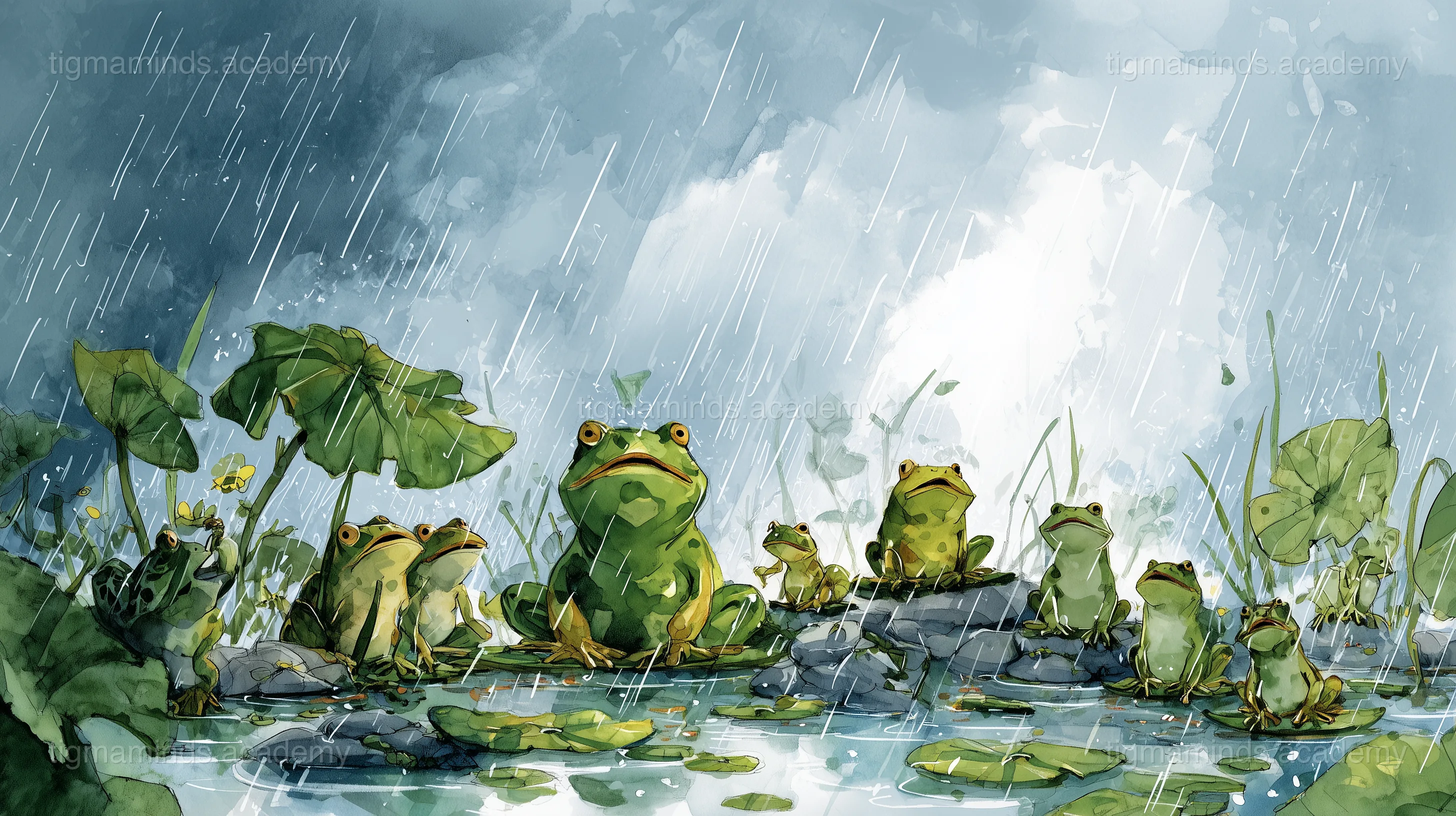
Wetland chorus — bioacoustics.
The Dry Pond
In the flat, green wetlands south of Nagaon, where the paddies stretch to the horizon and the sky is so wide it makes you dizzy, there once lived a chorus frog named Bhekuli. She was small — barely the size of a lemon — with bright green skin and a voice that could carry across three rice fields.
But Bhekuli hadn’t sung in weeks. Her pond had dried up.
It was April — the hottest, driest month before the monsoon — and the sun had sucked the water out of everything. The pond where Bhekuli lived was now a cracked, grey plate of mud. The water hyacinths lay flat and brown. The snails had buried themselves underground. Even the mosquitoes had left.
“When will the rain come?” Bhekuli asked the old bull frog, who sat in the last muddy puddle like a grumpy green stone.
“When it’s ready,” he said. “Rain doesn’t take orders.”
The Waiting
Bhekuli waited. She dug into the mud to stay cool. She ate whatever insects stumbled past. She watched the sky every evening for clouds, but the sky stayed blue and empty and relentlessly hot.
Other animals coped in their own ways. The cranes flew to the river. The snakes found shade under rocks. The water buffalo stood in whatever puddles they could find, looking miserable and dignified at the same time.
But frogs can’t fly or slither far. Frogs need their pond. Without it, they are stranded — small, soft creatures in a big, dry world.
“I miss my home,” Bhekuli whispered into the cracked mud. “I miss the cool water and the lily pads and the sound of my own voice echoing across the surface.”
The First Drop
One evening in late May, the sky changed. The blue drained away and was replaced by a wall of grey-purple clouds so tall they looked like mountains. The wind shifted. The air turned heavy and electric. The koel bird sang its frantic, rising call — the sound that every person in Assam knows means: the rain is coming.
Then: the first drop.
It hit the cracked mud with a splat. Bhekuli felt it on her back and her whole body shivered. A second drop. A third. Then the sky opened and the monsoon poured down like the river had been turned upside down.
Within an hour, the pond was filling. Brown water rushed in from the paddy channels, carrying leaves and insects and the rich, dark smell of wet earth. The cracks in the mud softened, closed, and disappeared under the rising water. The water hyacinths bobbed to the surface and spread their leaves, already turning green.
The Concert
Bhekuli climbed onto a floating leaf, took the deepest breath of her life, and sang.
It wasn’t a croak. It wasn’t a noise. It was a full-throated, joyful, impossibly loud song that rang across the wet fields like a bell. And before the first note faded, the old bull frog joined in with his deep, booming bass. Then the tree frogs chimed in from the branches above — high, tinkling notes like tiny bells. Then the cricket frogs, the paddy frogs, the burrowing frogs who emerged from the ground like small green miracles.
The pond erupted in music. Dozens of voices, hundreds, all singing at once — a full orchestra of frogs celebrating the return of their home. The sound carried for kilometres. In the village, children pressed their faces to the windows and laughed.
“The frogs are singing!” they shouted. “The monsoon is really here!”
The Reason
People often wonder why frogs sing after rain. Scientists say it’s to attract mates and mark territory. And that’s true. But Bhekuli knew the deeper reason.
“We sing,” she told a curious dragonfly who had asked, “because our home came back. Imagine losing your house for two months and then getting it back in an hour — full of fresh water, cool and deep and perfect. Wouldn’t you sing?”
The dragonfly admitted she probably would.
And that is why, every monsoon, when the first rain fills the ponds of Assam, the frogs begin to sing. They are not just calling to each other. They are saying thank you — to the clouds, to the rain, to the earth that held their mud and kept them safe through the long, dry wait. Their song is the oldest gratitude prayer in the world, sung by the smallest voices, heard by everyone.
The end.
Choose your level. Everyone starts with the story — the code gets deeper as you go.
Here is a taste of what Level 1 looks like for this lesson:
import matplotlib.pyplot as plt
import numpy as np
# Acoustic niche partitioning: 4 frog species, different frequencies
t = np.linspace(0, 0.05, 1000) # 50 ms window
species = {
"Chorus frog (3.5 kHz)": 3500,
"Tree frog (2.0 kHz)": 2000,
"Bull frog (0.4 kHz)": 400,
"Cricket frog (5.0 kHz)": 5000,
}
fig, axes = plt.subplots(4, 1, figsize=(10, 8), sharex=True)
for ax, (name, freq) in zip(axes, species.items()):
wave = np.sin(2 * np.pi * freq * t)
ax.plot(t * 1000, wave, linewidth=1)
ax.set_ylabel(name, fontsize=8)
ax.set_ylim(-1.5, 1.5)
axes[-1].set_xlabel("Time (ms)")
fig.suptitle("Acoustic Niche Partitioning: 4 Species, 4 Frequencies")
plt.tight_layout()
plt.show() # Why don't these species drown each other out?This is just the first of 6 coding exercises in Level 1. By Level 4, you will build: Record and Analyze Frog Call Patterns.
By Level 4, enrolled students build: Record and Analyze Frog Call Patterns
Free
Level 0: Listener
Stories, science concepts, diagrams, quizzes. No coding.
You are here
Level 0 is always free. Coding levels (1-4) are part of our 12-Month Curriculum.
Wetland chorus — bioacoustics.
The big idea: "Why Frogs Sing After Rain" teaches us about Acoustics & Animal Communication — and you don't need to write a single line of code to understand it.
A frog's call begins in the larynx, where air from the lungs vibrates vocal cords to produce sound. But a frog's tiny vocal cords alone would produce a barely audible squeak. The secret to their surprisingly loud calls (up to 100 decibels in some species — as loud as a motorcycle) is the vocal sac, an inflatable membrane of skin beneath the chin or on the sides of the head.
The vocal sac acts as a resonating chamber — it amplifies specific frequencies through acoustic resonance, much like the sound box of a guitar amplifies string vibrations. When the frog calls, air shuttles between the lungs and the vocal sac without escaping, allowing the frog to call repeatedly without inhaling. The sac's size and elasticity determine which frequencies are amplified, tuning each species to its optimal pitch.
The physics is similar to a Helmholtz resonator — the principle behind blowing across a bottle neck. The vocal sac's volume and the opening size (the glottis) create a system that resonates at a specific frequency. Larger sacs produce lower-frequency calls; smaller sacs produce higher-frequency calls. Female frogs can assess a male's body size from the pitch of his call, because larger frogs have larger vocal sacs and therefore deeper voices.
Key idea: Frog vocal sacs are resonating chambers that amplify calls to 100 decibels. The sac's size determines the resonant frequency, allowing females to assess male size from call pitch alone.
Frogs often call intensely before rain arrives, leading to the folk belief that frogs "predict" weather. There is real science behind this. Barometric pressure (atmospheric pressure) drops before storms as low-pressure weather systems approach. Frogs and many other animals are sensitive to pressure changes because pressure affects their physiology.
Frogs may detect pressure changes through several mechanisms. Their tympanic membrane (eardrum) is exposed and pressure-sensitive. Their swim bladder (in aquatic species) or body cavities change volume with pressure, potentially stimulating internal mechanoreceptors. Some researchers hypothesize that changes in dissolved gas concentrations in water (which vary with atmospheric pressure) trigger behavioral changes in aquatic frogs.
The correlation is real but imperfect. Studies show that calling activity in many frog species increases when barometric pressure drops below about 1,005 millibars and when humidity rises above 80%. These conditions correlate with approaching rain but do not guarantee it. Frogs are not weather prophets — they are organisms responding to environmental cues that happen to correlate with rain. Their behavior is a probabilistic signal, not a deterministic forecast.
Key idea: Frogs intensify calling when barometric pressure drops, correlating with approaching rain. They detect pressure changes through their exposed eardrums and body cavities — responding to environmental cues, not predicting the future.
Access all 130+ lessons, quizzes, interactive tools, and offline activities
In a tropical wetland, dozens of frog species may call simultaneously. How do they avoid drowning each other out? The answer is **acoustic niche parti...