The Friendship Bridge
Bridge Engineering

The Friendship Bridge

Bridge engineering between two villages.
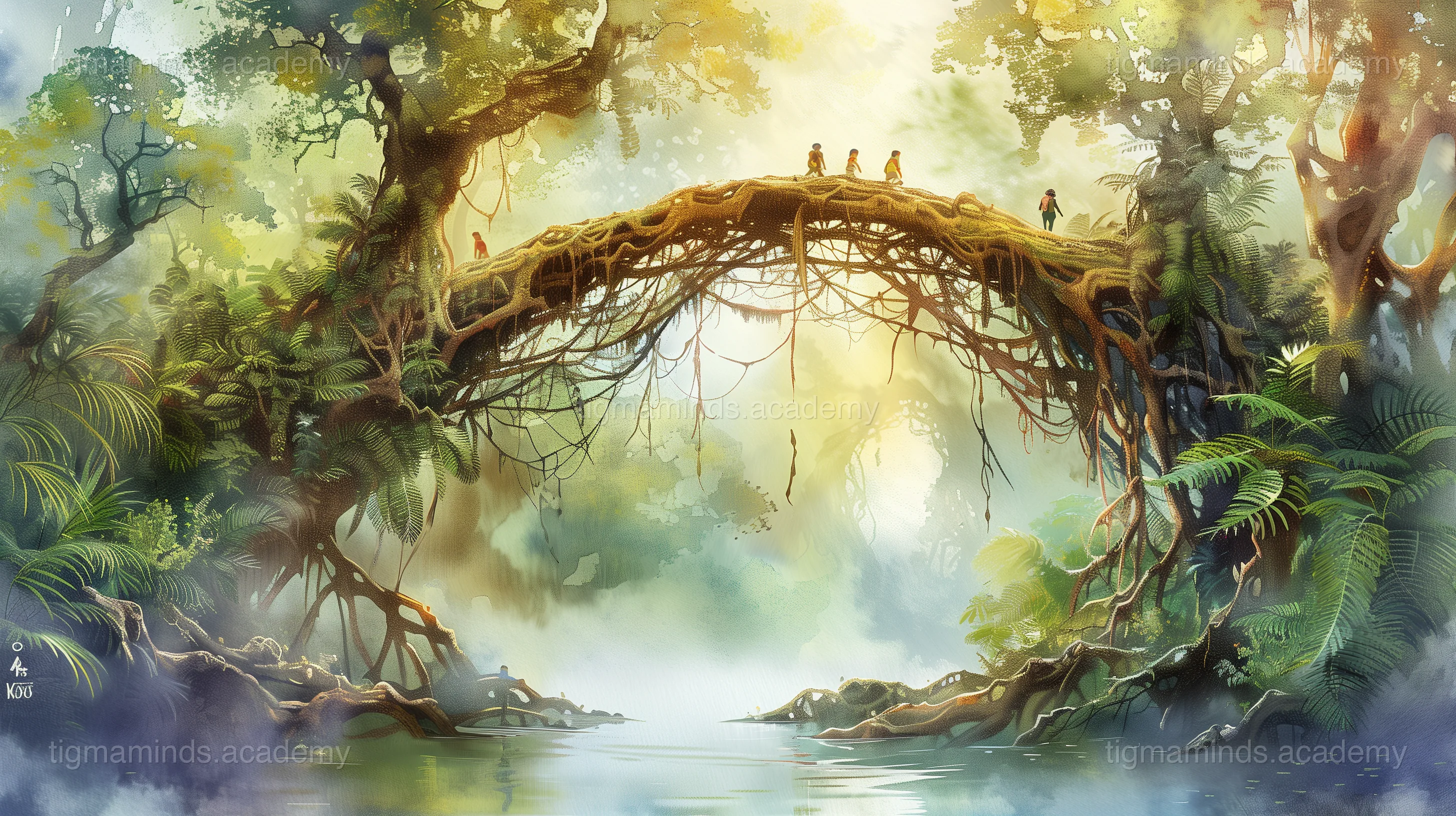
Bridge Engineering12-Month Curriculum 12h

The Story

The Two Sides

In the hills of Karbi Anglong, there were two villages separated by a river. The river wasn't very wide — you could throw a stone across it — but it was deep and fast, with slippery rocks on the bottom, and no one had ever built a bridge.

The village on the east side was called Rongkhang. The village on the west side was called Phangjili. The people of Rongkhang were Karbi. The people of Phangjili were Dimasa. They spoke different languages, ate different foods, and celebrated different festivals. They had lived within shouting distance of each other for a hundred years and had almost never spoken.

"The people over there are strange," the elders of Rongkhang told their children. "They don't do things the way we do."

"The people over there are odd," the elders of Phangjili told their children. "Best to stay on our side."

The Ball

One afternoon, a boy from Rongkhang named Sar was playing with a ball made of rubber strips near the river. He kicked it too hard, and it bounced off a rock and sailed across the water, landing on the Phangjili side.

Sar stood at the bank, staring. His ball sat in the grass on the other side, just twenty feet away but utterly unreachable.

Then a girl appeared. She was about his age, with her hair in two braids, and she picked up the ball and looked across the water at Sar.

They stared at each other. Neither spoke the other's language. But a ball is a ball in any language. The girl threw it back.

Sar caught it, grinned, and threw it to her again. She caught it and threw it back. For ten minutes, they threw the ball back and forth across the river, laughing without words.

The girl's name was Haseng. Sar didn't know that yet. He only knew that she had a good arm and a better laugh.

The Idea

The next day, Sar came back with three friends. Haseng came back with four. They couldn't talk, but they could throw. The ball went back and forth. Someone brought a second ball. Then someone brought fruit — kordoi from the Rongkhang side, banana fritters from Phangjili. They tossed food across the water, tasting each other's snacks, pointing and nodding and laughing.

On the fourth day, Sar pointed at the river and then made a flat shape with his hands. Bridge. Haseng understood immediately. She nodded vigorously and pointed to the bamboo grove behind her village.

They were going to build a bridge.

The Building

The children didn't tell the elders — they knew what the elders would say. Instead, they worked in the afternoons, when the adults were in the fields or resting.

The Rongkhang children cut bamboo poles and dragged them to the river. The Phangjili children did the same from their side. They waded into the shallow edges and met in the middle, waist-deep in cold water, lashing bamboo poles together with strips of cane. It took two weeks, many soakings, and one spectacular collapse that sent six children tumbling into the current (no one was hurt; everyone laughed).

But eventually, the bridge held. It was crooked and narrow, and it wobbled when you walked on it, but it held.

Sar stepped onto the bridge from the east. Haseng stepped on from the west. They met in the middle, where the river roared beneath their feet, and shook hands.

"Sar," said the boy, pointing to himself.

"Haseng," said the girl, pointing to herself.

It was the first conversation between the two villages in a hundred years, and it was two words long. It was enough.

The Discovery

The children crossed. The Rongkhang children visited Phangjili and discovered that the Dimasa people made rice beer that tasted like sweet apples. The Phangjili children visited Rongkhang and discovered that the Karbi people wove cloth with patterns that looked like the mountains they both called home.

Both villages grew rice. Both villages fished in the same river. Both villages told stories about a great flood that happened long ago. Both villages celebrated harvests with dancing, feasting, and drumming — different drums, different steps, but the same joy.

"They're not strange at all," said Sar to his grandmother that evening. "They're like us, but with different songs."

His grandmother was quiet for a long time. Then she said, "Perhaps we should have built that bridge a hundred years ago."

The Bridge Today

The elders found out, of course. They came to the river and saw the wobbly bamboo bridge, and they saw their children playing on both sides of the water, and they stood there not knowing what to say.

Then the headman of Rongkhang looked at the headman of Phangjili across the bridge and said, in halting Dimasa he must have learned from the children, "The bridge is too narrow. Shall we build a better one?"

The headman of Phangjili smiled. "Together?"

"Together."

They built a wider bridge, strong enough for adults and carts. But they kept the children's wobbly bridge beside it — because some things should not be replaced, only remembered. In Karbi Anglong, they call it the friendship bridge, and the story of Sar and Haseng is still told to remind everyone that the people on the other side of any river are never as different as you think.

The end.

Try It Yourself

Choose your level. Everyone starts with the story — the code gets deeper as you go.

Story Progress

0%

Ready to Start Coding?

Here is a taste of what Level 1 looks like for this lesson:

Level 1: Explorer — Python
import numpy as np
import matplotlib.pyplot as plt

# Your first data analysis with Python
data = [45, 52, 38, 67, 41, 55, 48]  # measurements
mean = np.mean(data)

plt.bar(range(len(data)), data)
plt.axhline(mean, color='red', linestyle='--', label=f'Mean: {mean:.1f}')
plt.xlabel("Sample")
plt.ylabel("Value")
plt.title("Bridge Engineering — Sample Data")
plt.legend()
plt.show()

This is just the first of 6 coding exercises in Level 1. By Level 4, you will build: Build and Test Bridge Designs for Maximum Load.

Free

Level 0: Listener

Stories, science concepts, diagrams, quizzes. No coding.

You are here

Enrolled

Levels 1-4

Python, NumPy, Matplotlib, real projects, mentorship.

Sign Up Free

Stay Updated

Join Waitlist

Get notified when enrollment opens for your area.

Notify Me

Level 0 is always free. Coding levels (1-4) are part of our 12-Month Curriculum.