The Flying Squirrel of Hollongapar
Gliding & Aerodynamics

The Flying Squirrel of Hollongapar

Gliding through the canopy — aerodynamics.
Gliding & Aerodynamics12-Month Curriculum 12h

The Story

The Night Hike

Hollongapar Gibbon Wildlife Sanctuary near Jorhat is famous for its hoolock gibbons — the only apes found in India. But the gibbons sleep at night, and the forest after dark belongs to entirely different creatures. Most people never see them.

Biren, a ten-year-old whose father was a forest guard at the sanctuary, knew this. His father had told him stories about the nighttime forest — the glowing eyes, the rustling canopy, the animals that appeared only when the sun disappeared. Biren had begged for months to go on a night hike.

“Tonight,” said his father one warm March evening. “But you carry the torch. And you walk quietly. The night forest has rules.”

The rules were simple: move slowly, speak in whispers, and never shine the torch directly into an animal’s eyes.

The First Encounter

They entered the forest at eight o’clock. The darkness was immediate and total. Biren’s torch cut a narrow yellow tunnel through the blackness, and everything outside that tunnel was alive with sounds — crickets, frogs, the distant bark of a barking deer.

Then Biren saw the eyes. Two round discs of orange light, glowing in the canopy like tiny lanterns. He froze.

“Slow loris,” whispered his father. “She’s hunting insects. Watch.”

The Bengal slow loris moved along the branch with exaggerated slowness, each hand gripping with precision, her enormous eyes scanning the bark for beetles. She was beautiful — soft brown fur, a dark stripe down her back, and those impossible eyes that seemed to hold all the moonlight in the forest.

Biren could have watched her all night. But a sound from above made him look up.

The Flying Squirrel

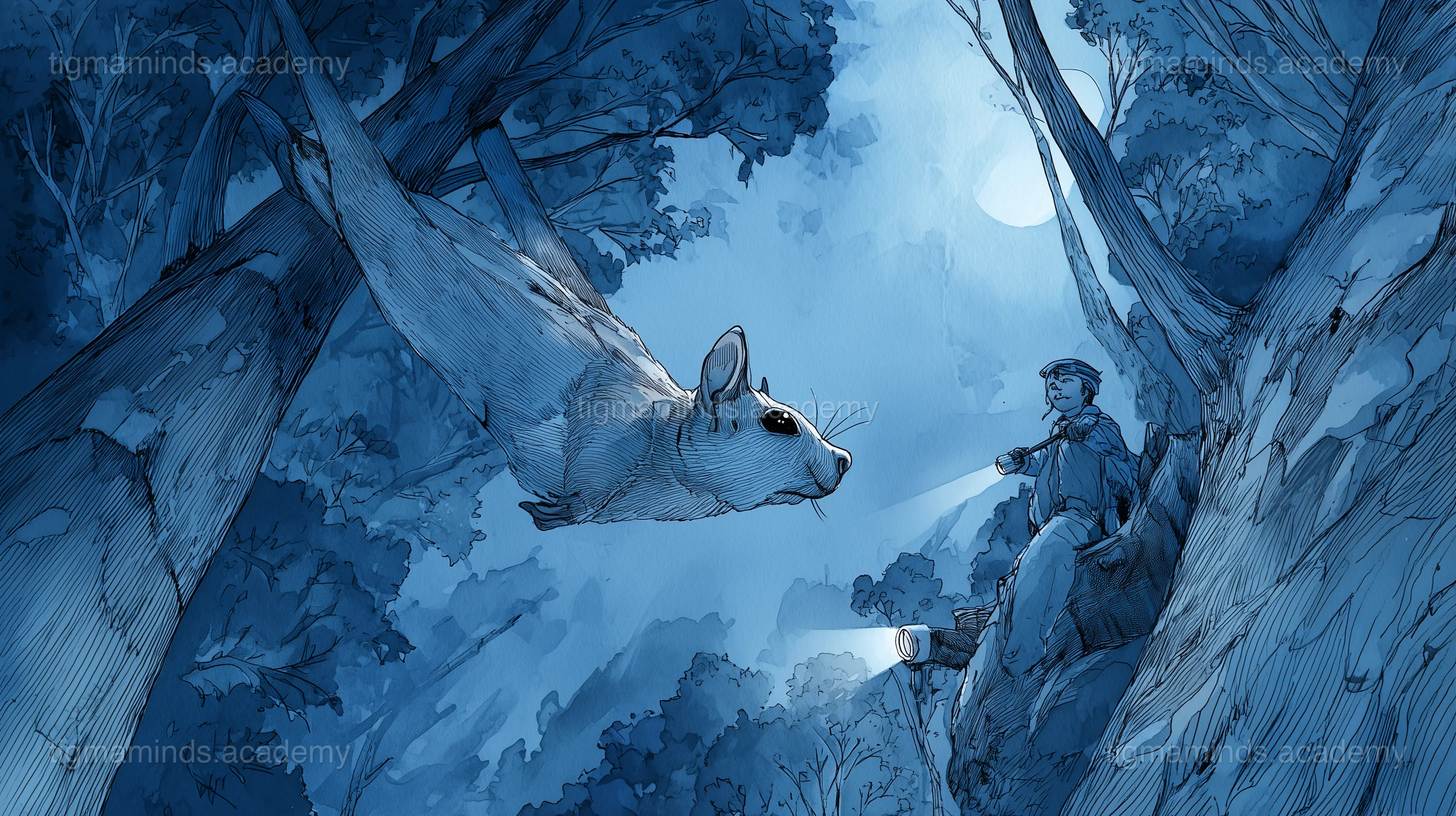
Something large and flat soared across the gap between two hollong trees. It was silent, graceful, and impossibly wide — a living kite, gliding on stretched skin.

“Indian giant flying squirrel,” said his father, and even he sounded impressed. “We don’t see them often.”

The squirrel landed on a trunk and turned to look at Biren. She was as big as a cat, with dark brown fur and a membrane of skin stretching between her front and back legs like a cape. Her tail was long and bushy — her rudder for gliding.

“Hello,” Biren whispered.

The squirrel twitched her nose, then launched off the trunk and glided to the next tree. And the next. And the next. Biren followed her with his torch, watching her sail through the dark forest like a furry paper airplane.

The Secret Forest

The flying squirrel led Biren and his father deeper into the sanctuary — not intentionally, but Biren kept following her, and his father kept following Biren. As they walked, the nighttime forest revealed itself layer by layer.

A civet crept along a fallen log, its spotted body low and slinky. A barn owl swooped past so silently that Biren felt only the breeze from its wings. A colony of fruit bats hung from a fig tree, their leathery wings folded like dark umbrellas. Fireflies blinked in the undergrowth like scattered stars.

“It’s a whole different world,” Biren breathed. “The same forest, but completely different.”

“The daytime forest and the nighttime forest share the same trees,” said his father. “But they’re run by different animals. Like two shifts in a factory.”

The Glide Home

They turned back at midnight. The flying squirrel was still soaring between the hollongs, a dark shape against the stars. Biren watched her make one final glide — a long, sweeping arc that carried her from the tallest tree to a hollow fifty metres away — and disappear into the dark.

“She showed me everything,” said Biren as they walked home along the forest path.

“She showed you what was already there,” said his father. “The secret life has always been happening. You just have to be brave enough to come out at night and look.”

Biren nodded. He knew he would come back. The daytime forest was wonderful, but the nighttime forest was magic — a world of gliders and glowing eyes and silent wings that existed in the same space as the gibbons and sunbirds, sharing the trees, splitting the hours, each half of the forest trusting the other with its home.

The end.

Try It Yourself

Choose your level. Everyone starts with the story — the code gets deeper as you go.

Story Progress

0%

Ready to Start Coding?

Here is a taste of what Level 1 looks like for this lesson:

Level 1: Explorer — Python
import numpy as np
import matplotlib.pyplot as plt

# Glide ratio comparison across species and designs
names = ["Paper glider A", "Paper glider B", "Flying squirrel",
         "Sugar glider", "Hang glider", "Sailplane"]
ratios = [3, 5, 2.5, 4, 15, 40]

plt.figure(figsize=(10, 5))
colors = ["#0ea5e9", "#06b6d4", "#22c55e", "#84cc16", "#f59e0b", "#ef4444"]
bars = plt.barh(names, ratios, color=colors)
plt.xlabel("Glide Ratio (horizontal distance / vertical drop)")
plt.title("Glide Ratio Comparison: Your Gliders vs Nature vs Engineering")
for bar, val in zip(bars, ratios):
    plt.text(bar.get_width() + 0.5, bar.get_y() + bar.get_height()/2,
             f'{val}:1', va='center', fontweight='bold')
plt.grid(axis='x', alpha=0.3)
plt.tight_layout()
plt.show()  # Why is the flying squirrel's ratio lower than a hang glider?

This is just the first of 6 coding exercises in Level 1. By Level 4, you will build: Test Paper Glider Designs for Maximum Distance.

By Level 4, enrolled students build: Test Paper Glider Designs for Maximum Distance

Free

Level 0: Listener

Stories, science concepts, diagrams, quizzes. No coding.

You are here

Enrolled

Levels 1-4

Python, NumPy, Matplotlib, real projects, mentorship.

Sign Up Free

Stay Updated

Join Waitlist

Get notified when enrollment opens for your area.

Notify Me

Level 0 is always free. Coding levels (1-4) are part of our 12-Month Curriculum.