The Fisherman's Daughter and the Storm
Ocean Science & Storm Formation

The Fisherman's Daughter and the Storm

Surviving a cyclone — the science of storms and the sea.
Ocean Science & Storm Formation12-Month Curriculum 12h

The Story

The Nets

In a village on the banks of the Brahmaputra, near Jorhat, there lived a fisherman named Biren and his daughter Anamika. Biren was not a wealthy man. He owned one boat, one set of nets, and a small bamboo house with a tin roof that sang in the rain.

The nets were everything. Biren had spent three months weaving them from the finest nylon thread, knotting each junction by hand, attaching the weights and floats with the precision of a man who knew that these nets would feed his family for the next five years.

Every evening, Biren set the nets across a quiet channel of the Brahmaputra where the hilsa and rohu gathered. Every morning, he pulled them in, heavy with silver fish that Anamika helped sort into baskets for the market.

It was a simple life, held together by thread and routine.

The Storm Warning

One afternoon in late June, while Biren was in town buying supplies, Anamika noticed the sky changing. The western horizon turned the colour of a bruise — dark purple and green, the kind of sky that fishermen's children learn to fear before they learn to read.

The wind picked up. The banana trees bent. The river, which had been flat and lazy all morning, began to chop and heave.

Anamika ran to the riverbank. The nets were still set — stretched across the channel, anchored to stakes on both banks. If the storm hit before the nets were pulled in, the current would rip them apart. Three months of her father's work, destroyed in minutes.

She looked toward town. Biren wouldn't be back for at least an hour. The storm would arrive in twenty minutes. There was no one else.

Anamika looked at the boat. She was twelve years old. She had rowed before — in calm water, with her father beside her. Never alone. Never in a storm.

She pushed the boat into the water.

Into the Wind

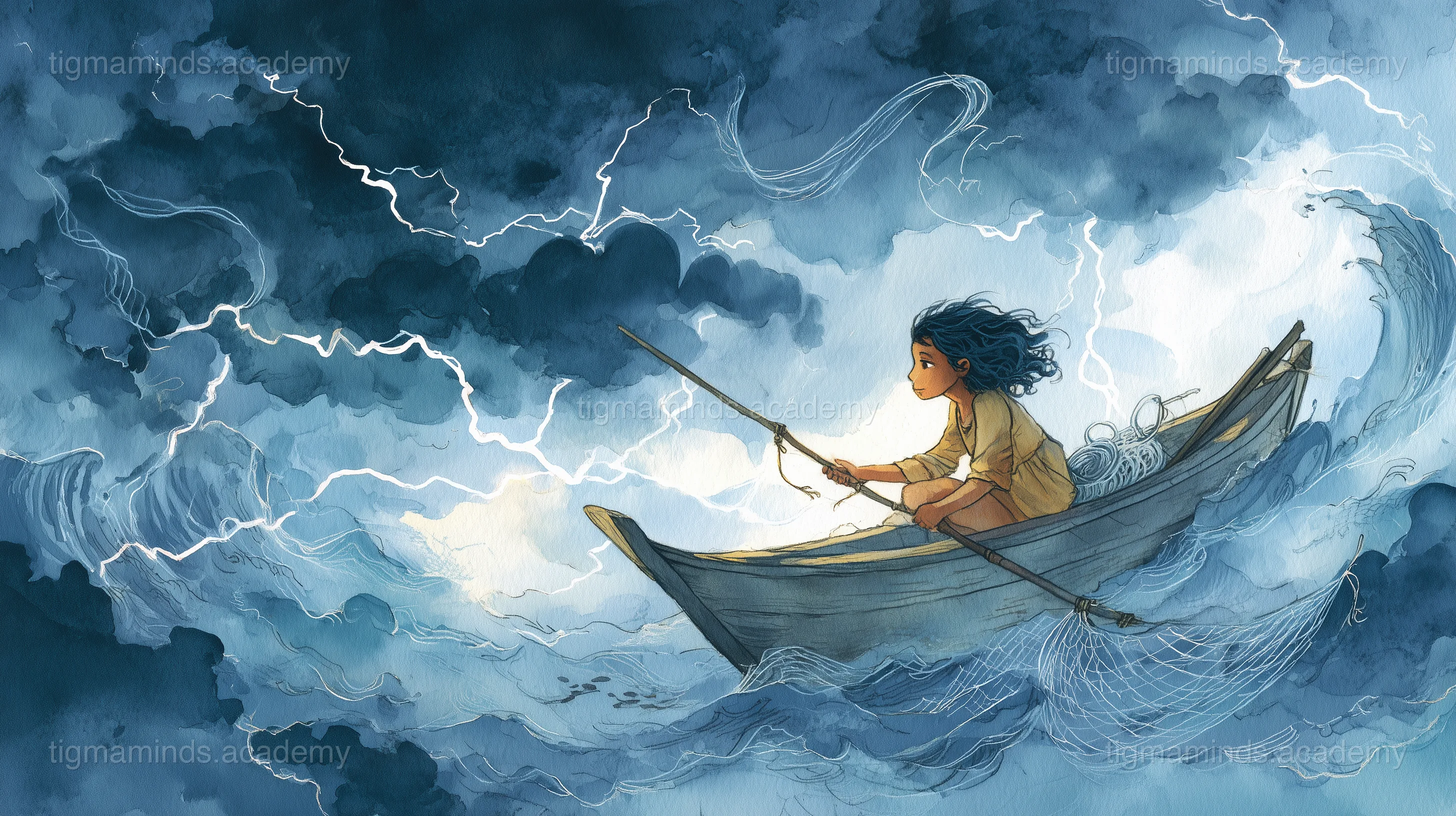
The first gust nearly knocked Anamika off her seat. She gripped the oars and pulled, her thin arms straining against a current that seemed to have woken up angry. The boat lurched left, then right. Water splashed over the bow and soaked her feet.

The nets were fifty metres out — a distance she could normally row in two minutes. Today, fighting the wind, it took ten. By the time she reached the first float, the sky had turned almost black and the first fat raindrops were striking the water like pebbles.

Anamika grabbed the net and began pulling it in, hand over hand. The net was heavy with fish — a good catch, her father would have been happy — but she didn't have time to sort. She hauled the whole thing into the boat, fish and all, working as fast as her hands would move.

Lightning cracked across the sky. The thunder that followed shook Anamika's chest. She pulled faster.

The Hardest Part

The second section of net was caught on something — a submerged branch, a rock, she couldn't tell. Anamika pulled until her shoulders burned, but it wouldn't come free. The current was dragging the boat downstream, stretching the net taut between the anchor stake and whatever held it below.

She had a choice: cut the net and lose half of it, or go into the water and free it.

Anamika tied the boat to the anchor stake, took a deep breath, and slipped over the side. The water was chest-deep and shockingly cold. The current pressed against her like a wall. She waded along the net, feeling with her feet, until she found the snag — a tangle of roots beneath the surface.

She worked the net free, one knot at a time, rain hammering her head, the river trying to push her downstream. It took five minutes that felt like five hours. When the last strand came loose, she scrambled back into the boat and hauled the rest of the net in.

The storm hit in full fury just as Anamika turned the boat toward shore. Wind and rain and waves all at once, a grey wall of water and noise. She couldn't see the bank. She rowed by memory, counting strokes the way her father had taught her. Thirty strokes to the big rock. Turn left. Twenty strokes to the ghat.

The Shore

Anamika's boat scraped mud just as Biren came running down the bank, soaked and terrified. He had seen the storm from town and run the whole way home.

"Anamika!" he shouted over the wind. "Are you hurt?"

She stood up in the boat, dripping, shaking, grinning. "The nets are safe, Baba. And there's a good catch."

Biren pulled her out of the boat and held her so tight she could feel his heart hammering. He didn't scold her for going out alone. He didn't say it was too dangerous. He just held her and said, very quietly, "You are the bravest person on this river."

That night, after the storm passed and the stars came out, Biren and Anamika sat on the veranda sorting fish by lantern light. The nets lay in a neat pile, undamaged, drying in the warm night air.

"You saved our livelihood today," said Biren. "Most grown men wouldn't have gone out in that."

Anamika shrugged. "The nets are our life. I wasn't going to let the river take them."

In the fishing villages along the Brahmaputra, the people of Assam still tell the story of the fisherman's daughter who rowed into a storm. Not because she wasn't afraid — she was terrified. But because she knew that courage isn't the absence of fear. It's deciding that something matters more.

The end.

Try It Yourself

Choose your level. Everyone starts with the story — the code gets deeper as you go.

Story Progress

0%

Ready to Start Coding?

Here is a taste of what Level 1 looks like for this lesson:

Level 1: Explorer — Python
import numpy as np

# Estimate cyclone intensity from sea temperature
# Warmer ocean = lower eye pressure = stronger winds

sea_temp = 28.5       # °C — Bay of Bengal surface
pressure = 1013       # millibars — normal
wind_speed = 120      # km/h — severe cyclone

# Cyclone pressure drop (simplified)
eye_pressure = pressure - (wind_speed / 3.5) ** 2
storm_surge = wind_speed * 0.04  # rough estimate in metres

print(f"Sea surface temp: {sea_temp}°C (>{26.5} = cyclone fuel)")
print(f"Eye pressure: {eye_pressure:.0f} mb (normal: 1013)")
print(f"Estimated storm surge: {storm_surge:.1f} metres")
print(f"Danger level: {'EXTREME' if storm_surge > 3 else 'HIGH'}")

This is just the first of 6 coding exercises in Level 1. By Level 4, you will build: Track and Visualize Historical Cyclone Paths.

Free

Level 0: Listener

Stories, science concepts, diagrams, quizzes. No coding.

You are here

Enrolled

Levels 1-4

Python, NumPy, Matplotlib, real projects, mentorship.

Sign Up Free

Stay Updated

Join Waitlist

Get notified when enrollment opens for your area.

Notify Me

Level 0 is always free. Coding levels (1-4) are part of our 12-Month Curriculum.