
A Tiwa origin tale — the birth of agriculture.
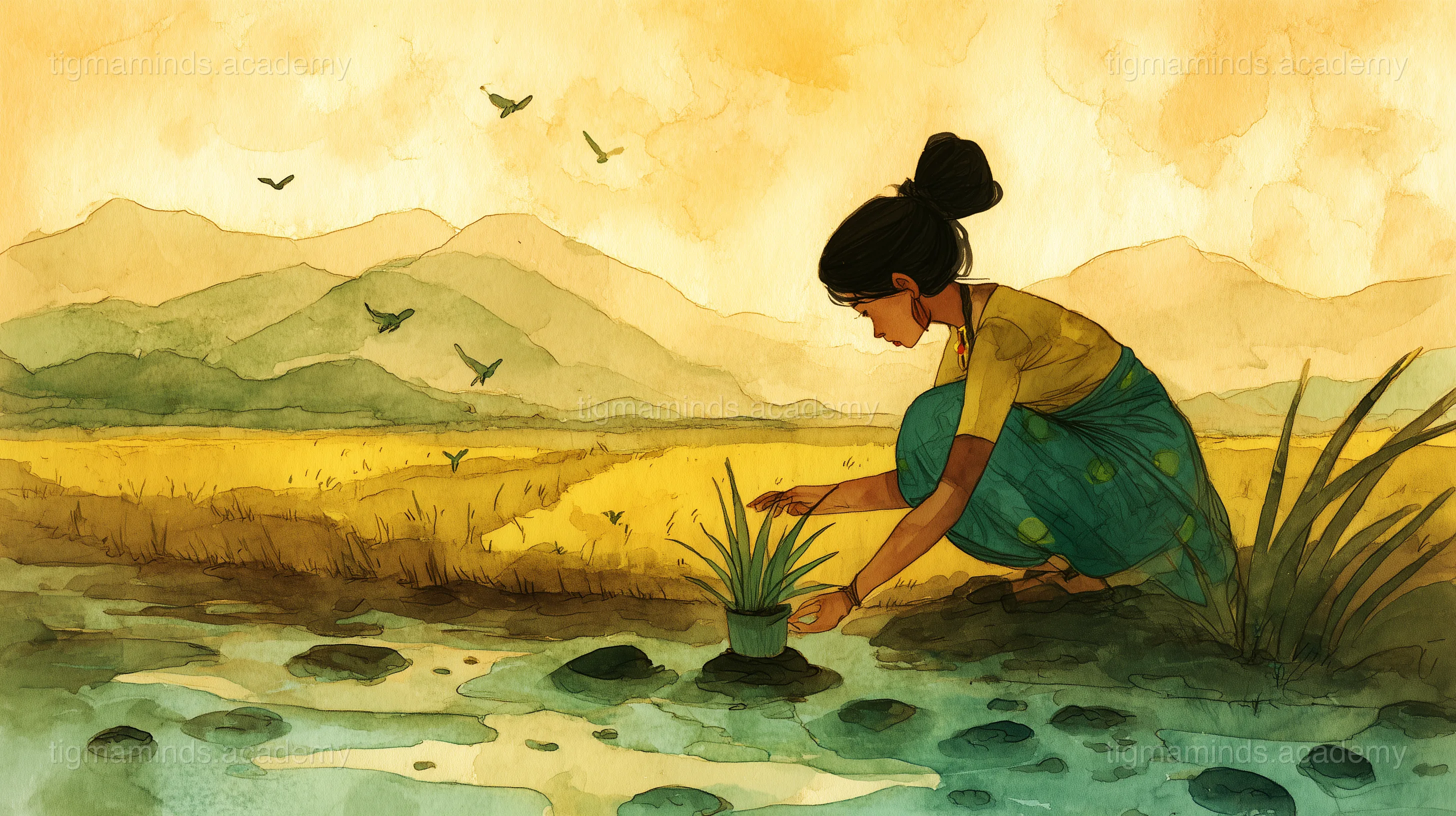
Before Rice
In the hills of Karbi Anglong, long before anyone can remember, the Tiwa people lived on what the forest gave them — wild yams, roots, leafy greens, and whatever fruit the season offered. Some years the forest was generous. Some years it was not.
A girl named Lakhi was twelve years old the year the forest was not generous at all. The rains came late, the fruit trees bore little, and by winter, the village's food stores were nearly empty.
"We cannot depend on the forest forever," said Lakhi's grandmother, stirring a thin soup of boiled roots. "The forest gives when it wants, not when we need."
"Then what do we do?" asked Lakhi.
"That," said her grandmother, "is the question no one has answered yet."
The Birds and the Seeds
Lakhi spent her days gathering food on the hillside. One morning, she sat resting beside a marshy patch of land where water collected after the rains. She watched a flock of munias — tiny, rust-coloured birds — pecking at the ground.
They were eating seeds from a tall grass that grew at the edge of the marsh. The seeds were small, hard, and pale — not much to look at. But the birds loved them. They pecked and pecked, scattering as many seeds as they ate.
Lakhi noticed something. Where the scattered seeds fell into the wet mud, tiny green shoots had sprouted. The seeds were growing. By themselves. In the wet earth. Without anyone planting them.
"The birds are farmers," Lakhi said aloud, astonished. "They drop seeds, and the seeds become plants, and the plants make more seeds."
The Experiment
Lakhi gathered a handful of the pale seeds and carried them home. Her grandmother looked at them and shrugged. "Those are just wild grass seeds. Too small to eat."
But Lakhi had a plan. She cleared a small patch of earth near the stream behind her house. She flooded it with water, the way the marsh was flooded. Then she pressed the seeds into the mud, one by one, in neat rows — just as the birds had scattered them, but with intention.
She waited. The village children laughed at her. "You're planting grass?" they said. "Grass isn't food!"
"Not yet," said Lakhi.
The Green Rows
Within a week, green shoots appeared — thin and delicate, like eyelashes rising from the mud. Within a month, they stood knee-high, swaying in the breeze. Within three months, each stalk bore a drooping head full of pale seeds — hundreds of them, where Lakhi had planted just one.
Lakhi harvested the seeds, dried them in the sun, and rubbed off the husks. Underneath was a grain — white, smooth, and when boiled in water, soft and filling and faintly sweet.
Rice.
Her grandmother tasted it and went quiet. Then she tasted it again. Then she began to cry.
"This is it," she said. "This is what we've been waiting for. Food that we can grow, not just find. Food that comes when we need it, not when the forest decides."
The Gift That Spread
Lakhi taught the village how to prepare paddies, flood them, plant seeds, and wait. The next harvest fed the entire village with grain left over. The village after that learned from Lakhi's village. And the village after that learned from them.
Within a generation, the hills and valleys of the Northeast were green with rice paddies — terraced fields carved into hillsides, flat paddies shimmering in river plains, each one a mirror reflecting the sky.
The Tiwa people remember Lakhi in their harvest songs. They say she didn't invent rice — the birds knew about it long before humans did. What Lakhi invented was paying attention. She watched what the birds did, understood it, and turned wild grass into the food that would feed millions across the land.
Every grain of rice on your plate began with a girl on a hillside, watching birds drop seeds into wet earth.
The end.
Choose your level. Everyone starts with the story — the code gets deeper as you go.
Here is a taste of what Level 1 looks like for this lesson:
# Simulate rice growth under different conditions
import matplotlib.pyplot as plt
days = list(range(0, 22, 3))
normal = [0, 2, 8, 18, 32, 50, 68, 85]
fertilized = [0, 3, 12, 28, 48, 72, 92, 105]
low_light = [0, 1, 4, 8, 14, 20, 26, 30]
plt.plot(days, normal, "b-o", label="Normal")
plt.plot(days, fertilized, "g-o", label="Fertilized")
plt.plot(days, low_light, "y--o", label="Low light")
plt.xlabel("Days"); plt.ylabel("Height (mm)")
plt.title("Rice Seedling Growth Curves")
plt.legend(); plt.show()This is just the first of 6 coding exercises in Level 1. By Level 4, you will build: Grow Rice and Measure Growth Variables.
By Level 4, enrolled students build: Grow Rice and Measure Growth Variables
Free
Level 0: Listener
Stories, science concepts, diagrams, quizzes. No coding.
You are here
Level 0 is always free. Coding levels (1-4) are part of our 12-Month Curriculum.
A Tiwa origin tale — the birth of agriculture.
The big idea: "How the First Rice Was Planted" teaches us about Agriculture & Crop Origins — and you don't need to write a single line of code to understand it.
About 10,000 years ago, the ancestors of today’s rice were wild grasses growing in marshy areas of Asia. Wild rice (Oryza rufipogon) looked nothing like the plump grains we eat today. Its seeds were tiny, its stalks were tall and floppy, and — most importantly — its seeds shattered (fell off the stalk as soon as they ripened). This is great for the plant (seeds scatter and grow) but terrible for humans trying to harvest them.
The key moment in domestication was when early farmers noticed that some rare plants had seeds that stayed on the stalk. They collected and replanted these “non-shattering” seeds. Generation after generation, this selective breeding shifted the population. Over thousands of years, humans also selected for larger grains, shorter stems (less falling over in wind), and uniform ripening (all grains ready at once).
Assam is one of the world’s centers of rice genetic diversity. Indigenous communities cultivate hundreds of landraces adapted to specific conditions: ahu (autumn upland rice), sali (winter lowland rice), bao (deepwater rice for flood plains), and boro (spring irrigated rice). Each represents centuries of local breeding — a living library of agricultural genetics.
Key idea: Rice was domesticated from wild grass over 10,000 years by selecting for non-shattering seeds, larger grains, and shorter stems. Assam’s hundreds of traditional landraces are a living genetic library.
When you cross a tall rice plant (TT) with a dwarf rice plant (tt), the first generation (F1) offspring are all tall (Tt) — because tall (T) is dominant over dwarf (t). But cross two F1 plants (Tt × Tt), and the second generation (F2) separates into 3 tall : 1 dwarf. This 3:1 ratio is Mendel’s law of segregation in action.
The Green Revolution exploited this principle. Scientists crossed high-yielding tall varieties with a naturally occurring dwarf mutant from Taiwan (a rice plant with a broken gene for the growth hormone gibberellin). The dwarf gene (sd1) was recessive, so breeders had to carefully select tt offspring from the F2 generation. The result was semi-dwarf rice: short, sturdy stems that could support heavy grain heads without falling over (lodging), combined with the ability to absorb large amounts of fertilizer.
Understanding Mendelian genetics lets breeders predict outcomes. Want to combine flood tolerance (from a Bao rice landrace) with high yield (from a modern variety)? Cross them, grow the F2 generation, and look for the 1-in-16 plants that inherited both recessive traits. It is slow, but it works — and it is exactly how breeders developed flood-tolerant rice varieties like Swarna-Sub1 that can survive 2 weeks of complete submersion.
Key idea: Mendel’s laws predict how traits segregate in crop crosses. The Green Revolution used this to combine dwarf stems with high yield. Modern breeders use the same principles to stack flood tolerance, pest resistance, and nutritional traits.
Access all 130+ lessons, quizzes, interactive tools, and offline activities
In the 1960s, India faced severe food shortages. The **Green Revolution** introduced high-yielding variety (HYV) seeds, synthetic fertilizers, pestici...
For 10,000 years, farmers saved seeds from their best plants and replanted them the next season. This **seed saving** is free, adapts varieties to loc...