
Floating lamps — the science of light and energy.
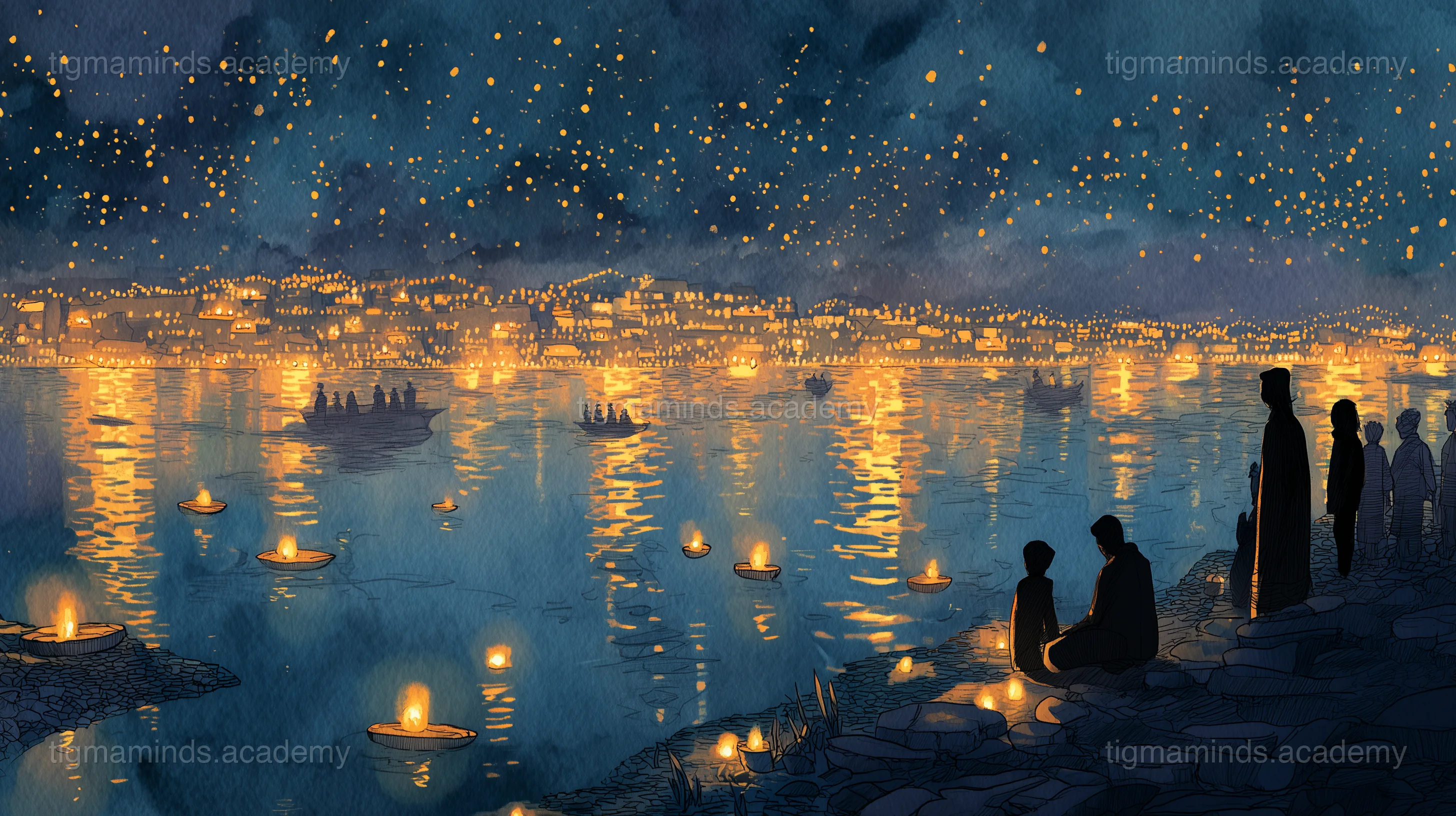
The Night of Lamps
Every year in the month of Kati — October in the English calendar — the people of Assam celebrate Kati Bihu, the quietest and most beautiful of the three Bihus. There are no feasts, no dancing. Instead, families light earthen lamps and place them at the foot of tulsi plants, on granary posts, and — in the river villages — on the waters of the Brahmaputra itself.
The lamps are small clay diyas, no bigger than a child's palm, filled with mustard oil and a cotton wick. When lit, they glow like tiny golden hearts. And when they are set on the river, the Brahmaputra becomes a road of flickering stars.
In the village of Nimati, near the ferry ghat that connects the mainland to Majuli, a boy named Hriday was preparing his lamp for the festival.
The Wish
Hriday was ten years old, and this was his first year making his own lamp. His mother had taught him how to shape the clay, smooth the edges, and press a small channel for the wick. His lamp was simple — not as elegant as his mother's, not as sturdy as his father's — but it was his.
"What will you wish for?" asked his little sister, Mrinmoyee, who was six and believed that the lamp carried your wish to wherever the river took it.
Hriday thought carefully. Last year he would have wished for a cricket bat or a bicycle. But this year, something different was on his mind. His best friend, Pankaj, had moved away when his family relocated to Guwahati for work. The empty seat next to Hriday in school felt like a hole in the day.
"I wish for Pankaj to remember me," said Hriday. "Even though he's far away."
Mrinmoyee nodded solemnly. "That's a good wish. The river will carry it."
The Floating
At dusk, the whole village gathered at the ghat. Hundreds of families, each carrying their small clay lamps, each lamp holding a wish. The Brahmaputra stretched before them, dark and vast, its surface smooth as silk in the windless evening.
One by one, the families lit their wicks and placed their lamps on the water. Hriday's mother placed hers first — a prayer for a good harvest. His father placed his — a prayer for the family's health. Mrinmoyee placed hers, whispering her wish so quietly that even the river had to lean in to hear.
Then it was Hriday's turn. He knelt at the water's edge, cupped his lamp in both hands, and lit the wick. The flame caught immediately — steady, bright, confident, as if it knew where it was going. Hriday placed the lamp on the water and gave it a gentle push.
"Find Pankaj," he whispered.
The Journey
Most lamps drifted a few hundred metres before their wicks burned out or the current tipped them over. By midnight, the river was dark again, littered with spent clay cups bobbing in the shallows.
But Hriday's lamp kept going.
It caught the central current — the strong, deep flow that runs down the middle of the Brahmaputra like a highway. The flame burned steady, protected by the slightly raised rim that Hriday had shaped by accident when his thumb slipped during the making. That imperfect rim acted as a windbreak, shielding the flame from the breeze.
The lamp floated past Nimati. Past the Majuli ferry route. Past the sandbars where fishermen slept in their boats. Past Jorhat, past Kaziranga, past Tezpur. The flame burned on, fed by the mustard oil, sheltered by the crooked rim, carried by the river that seemed to know where it was going.
Nobody saw this, of course. A tiny lamp on a vast river at night is invisible to everyone but the stars. But the river knew. The Brahmaputra, old as the Himalayas, carries many things — water, silt, fish, stories. One more lamp was nothing to carry. And the wish inside it was the kind the river understood: the wish to stay connected.
The Arrival
In Guwahati, a hundred and fifty kilometres downstream, Pankaj couldn't sleep. He was homesick — not for the village exactly, but for the river, the ghats, the sound of water against the ferry's hull, and most of all for Hriday.
He walked to the Fancy Bazaar ghat at dawn, just to watch the river. And there, caught in the reeds at the water's edge, was a small clay lamp. Its wick had finally burned out, but the lamp was intact — a simple, slightly crooked diya with a thumbprint on one side and a raised rim that looked like a smile.
Pankaj picked it up. He didn't know where it had come from. He couldn't know that it had travelled all night from Nimati, carrying a wish with his name on it. But he turned the lamp over in his hands and felt something — a warmth that had nothing to do with the morning sun. A feeling of being remembered.
He took the lamp home and placed it on his windowsill. And that evening, he wrote a letter to Hriday — the first of many — that began: "I found something in the river today, and it made me think of you."
The people of Assam say that during Kati Bihu, the Brahmaputra isn't just a river. It's a postman. It carries lamps and wishes from one heart to another, connecting people who are separated by distance but not by love. And if your lamp travels farther than anyone else's, it means the river heard your wish — and decided it was worth delivering.
The end.
Choose your level. Everyone starts with the story — the code gets deeper as you go.
Here is a taste of what Level 1 looks like for this lesson:
import numpy as np
import matplotlib.pyplot as plt
# Energy efficiency of light sources (lumens per watt)
sources = ["Oil lamp", "Incandescent", "CFL", "LED"]
efficiency = [0.3, 15, 65, 120] # lumens per watt
plt.figure(figsize=(10, 5))
bars = plt.bar(sources, efficiency, color=["#f59e0b", "#ef4444", "#a855f7", "#22c55e"])
plt.ylabel("Lumens per Watt")
plt.title("Light Source Efficiency: From Oil Lamps to LEDs")
for bar, val in zip(bars, efficiency):
plt.text(bar.get_x() + bar.get_width()/2, bar.get_height() + 2,
f'{val}', ha='center', fontweight='bold')
plt.grid(axis='y', alpha=0.3)
plt.show() # How many times more efficient is an LED than an oil lamp?This is just the first of 6 coding exercises in Level 1. By Level 4, you will build: Compare Light Source Efficiency.
By Level 4, enrolled students build: Compare Light Source Efficiency
Free
Level 0: Listener
Stories, science concepts, diagrams, quizzes. No coding.
You are here
Level 0 is always free. Coding levels (1-4) are part of our 12-Month Curriculum.
Floating lamps — the science of light and energy.
The big idea: "The Festival of Lights on the River" teaches us about Energy & Light Technology — and you don't need to write a single line of code to understand it.
For thousands of years, humans made light the same way: heat something until it glows. A campfire, an oil lamp, a candle, an incandescent light bulb — all work by making a material so hot that it emits visible photons. The problem? Most of the energy becomes heat, not light. An incandescent bulb converts only about 10% of electrical energy into light; the other 90% is wasted as heat.
LEDs (Light Emitting Diodes) work completely differently. Instead of heating a filament, they use electroluminescence: electrons flow across a semiconductor junction, and as they do, they release energy as photons — directly, without the heating step. This is why LEDs are cool to the touch while producing the same brightness as a scorching incandescent bulb.
Check yourself: hold your hand near a lit incandescent bulb (careful!) and then near an LED of similar brightness. The incandescent bulb radiates heat you can feel from 30 cm away. The LED barely warms. That temperature difference is the efficiency difference — energy going to heat is energy not going to light.
Key idea: Incandescent bulbs heat a wire until it glows (90% wasted as heat). LEDs emit photons directly through electroluminescence, achieving 5–10 times better efficiency.
How do we compare light sources fairly? Not by watts (that measures energy consumed), but by lumens per watt — how much visible light you get for each unit of energy. An oil diya manages about 0.3 lumens per watt. An incandescent bulb does about 15. A modern LED achieves 120 or more.
This means one 10-watt LED produces the same brightness (about 1,600 lumens) as a 100-watt incandescent bulb. Switch every bulb in a house from incandescent to LED and you cut the lighting electricity bill by 85–90%. Scale that to an entire country and the savings are enormous — the global switch to LEDs saves roughly 570 million tonnes of CO₂ per year.
Prediction: if LEDs are so much better, why were they not invented first? Because electroluminescence requires semiconductor physics that was not understood until the 20th century. The incandescent bulb (1879) came from a simpler principle — heat something and it glows. Science had to advance before the more efficient path became possible.
Key idea: Lumens per watt measures light output per unit of energy. LEDs achieve 120+ lm/W vs 15 for incandescent — an 8× improvement that saves billions of tonnes of CO₂.
Access all 130+ lessons, quizzes, interactive tools, and offline activities
A solar (photovoltaic) cell does the reverse of an LED: instead of converting electricity into light, it converts light into electricity. When a photo...
Before LEDs, artificial lighting consumed about 20% of global electricity. Today, that fraction is dropping fast as LEDs replace older technologies wo...