
The best things in life are sometimes the messiest.
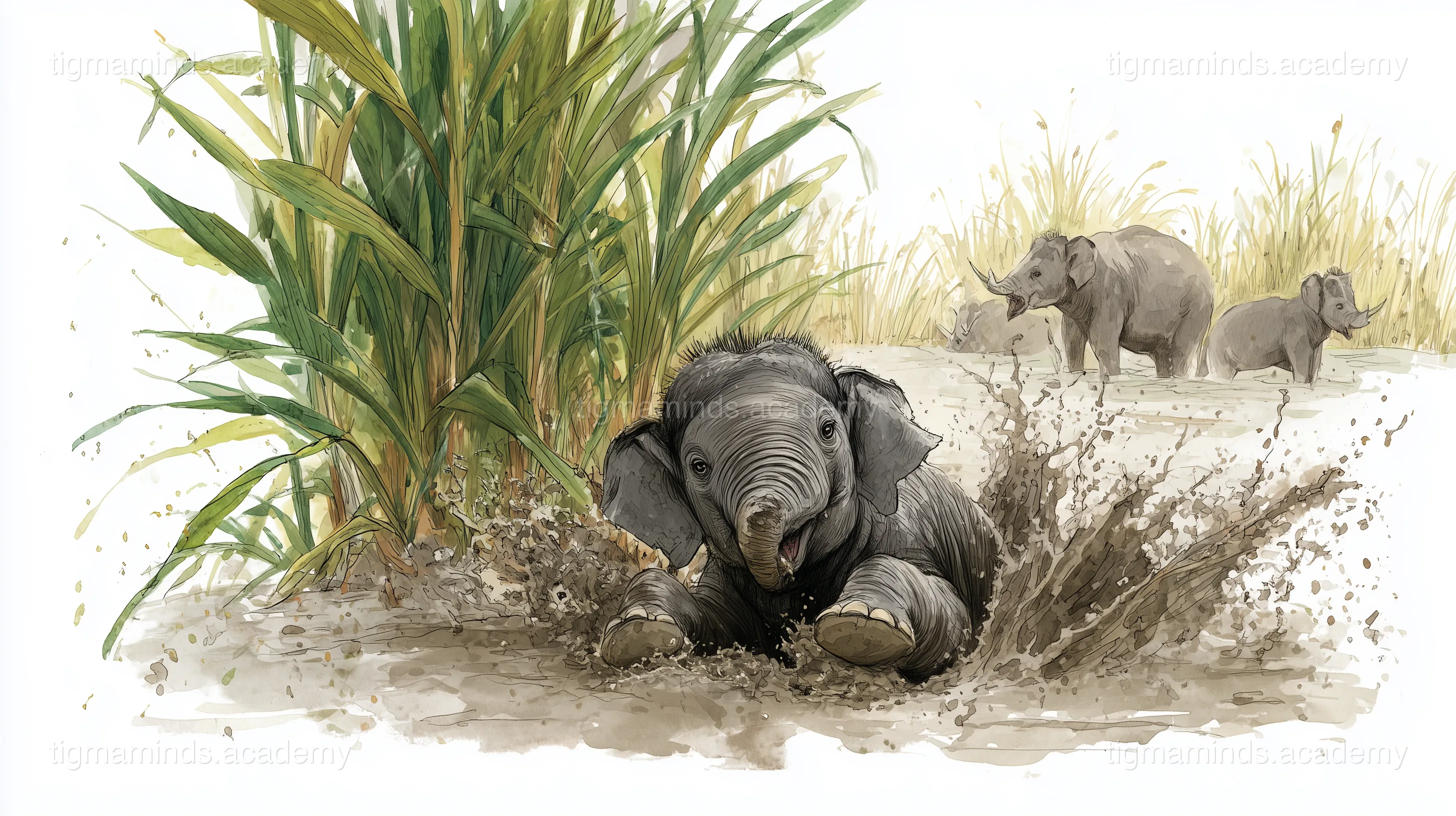
The Clean Elephant
In Kaziranga National Park, where the grass grows taller than a bus and the Brahmaputra spreads like a silver blanket, a baby elephant named Gaja was having a terrible morning.
Her mother wanted her to take a mud bath.
"No," said Gaja, backing away from the mud wallow. "Absolutely not."
"Every elephant takes mud baths," said Mama. "It's good for your skin. It keeps the bugs away. It cools you down."
"It's dirty," said Gaja. "I just washed in the river."
Gaja was the cleanest baby elephant in Kaziranga. While other calves rolled in dust and splashed in puddles, Gaja stayed on the dry path. While other calves rubbed against muddy trees, Gaja rubbed against smooth rocks. Her skin was pale grey and spotless — which, for an elephant, was deeply unusual.
The Hot Day
The sun rose higher. The air shimmered with heat. The tall grass drooped. Even the rhinos — who are built like tanks and fear nothing — retreated to the shade.
Gaja was miserable. Her skin burned. Tiny flies buzzed around her ears and wouldn't leave. She itched everywhere but couldn't reach anywhere.
"Mud would fix all of that," said Mama, lounging comfortably in the wallow, coated in a thick layer of cool, grey mud. She looked like a statue carved from clay, and she looked happy.
"Come on," said Gaja's older brother, who was already so muddy that only his eyes were visible. "Just try it."
The First Step
Gaja put one foot in the mud. It squished between her toes — cold and thick and deeply, wonderfully squishy.
"Oh," she said.
She put another foot in. Then a third. Then she was standing in the wallow up to her knees, and the coolness was spreading up her legs like a gift.
"Now lie down," said Mama.
Gaja lay down. The mud rose around her like a cool, soft blanket. It covered her belly, her back, her itchy ears. The flies left. The heat vanished. The itching stopped.
"Oh," said Gaja. "OH."
The Convert
Gaja rolled. She splashed. She sprayed mud with her tiny trunk. She flopped on her side and wriggled until every inch of her was coated. She trumpeted with joy — a small, squeaky trumpet that made all the nearby birds take off in alarm.
"I love mud!" she announced. "Why didn't anyone tell me about mud?"
"We tried," said her brother, from under his mud helmet. "About a hundred times."
Mama smiled the way mothers smile when their children discover something that was obvious all along — with patience, with warmth, and with a quiet I told you so hidden behind her eyes.
The Muddiest Elephant
From that day on, Gaja was no longer the cleanest elephant in Kaziranga. She was the muddiest. She was the first into the wallow every morning and the last to leave every evening. She developed a technique — a running belly-flop that created a mud splash visible from the other side of the park.
The rhinos watched and nodded approvingly. In Kaziranga, mud is not dirt. Mud is sunscreen, bug spray, moisturiser, and air conditioning, all rolled into one. Mud is what makes the hard, hot life of the grasslands bearable.
And sometimes, Gaja thought, the things you're most afraid of turn out to be the things you love the most. You just have to take the first squishy step.
The end.
Choose your level. Everyone starts with the story — the code gets deeper as you go.
Here is a taste of what Level 1 looks like for this lesson:
# What temperature does an elephant reach without mud?
body_temp = 36.0 # starting body temperature in °C
air_temp = 40.0 # Kaziranga summer day
for hour in range(1, 7):
# Heat gain: metabolism + hot environment
heat_gain = 0.3 + 0.1 * (air_temp - body_temp)
# Without mud: only ears help (a little)
ear_cooling = 0.15
body_temp += heat_gain - ear_cooling
status = "OK" if body_temp < 38 else "DANGER" if body_temp < 40 else "LETHAL"
print(f"Hour {hour}: {body_temp:.1f}°C [{status}]")
print("\nWithout mud, elephants overheat in hours.")
print("Level 1 builds the full simulation with mud bathing.")This is just the first of 6 coding exercises in Level 1. By Level 4, you will build: Model Elephant Thermoregulation.
By Level 4, enrolled students build: Model Elephant Thermoregulation
Free
Level 0: Listener
Stories, science concepts, diagrams, quizzes. No coding.
You are here
Level 0 is always free. Coding levels (1-4) are part of our 12-Month Curriculum.
The best things in life are sometimes the messiest.
The big idea: "The Little Elephant's First Mud Bath" teaches us about Thermoregulation & Animal Behavior — and you don't need to write a single line of code to understand it.
Imagine standing outside on a 40 °C day in Kaziranga. You are sweating buckets. Now imagine you cannot sweat at all — not a single drop. That is life for an elephant. Elephants have almost no sweat glands. For an animal that weighs 4,000 kg and generates enormous body heat, this sounds like a death sentence. So how do they survive?
The answer is mud. When an elephant rolls in a mud wallow, three things happen at once. First, the cool mud conducts heat away from the body (like pressing an ice pack on your forehead). Second, as the mud dries, the water inside it slowly evaporates. Every gram of water that evaporates absorbs 2,260 joules of heat from the elephant’s skin — that is a LOT of cooling. Third, the dried mud layer reflects sunlight and blocks UV rays, acting as a natural sunscreen with roughly SPF 5–10.
But that is not all. Dried mud also forms a physical armour against biting flies, ticks, and mosquitoes. When the mud eventually flakes off, it carries attached parasites with it — a free exfoliation that removes pests along with dead skin. So a single mud bath is simultaneously air conditioning, sunscreen, and bug repellent. Gaja in the story did not just discover fun — she discovered the elephant’s most important survival tool.
Key idea: Mud bathing is not play — it is the elephant’s primary cooling system, sunscreen, and parasite shield, all in one.
Heat always moves from hot to cold. Your body at 37 °C is warmer than a 25 °C room, so heat flows out of you constantly. But HOW does heat move? There are four main ways, and understanding them explains everything from why you shiver to why elephants flap their ears.
Conduction is heat moving through direct contact. Touch a cold metal railing and your hand feels cold — heat is conducting from your warm skin into the cold metal. When an elephant stands in a cool river, heat conducts from its legs into the water. Water conducts heat 24 times better than air, which is why a 20 °C pool feels much colder than 20 °C air.
Convection is heat carried away by moving fluid (air or water). A breeze feels cooling because moving air replaces the warm layer near your skin with fresh cool air. Elephants flap their blood-rich ears to create their own breeze — forced convection that can double their ear’s heat loss.
Radiation is heat emitted as invisible infrared light. Every object above absolute zero radiates heat. At night, elephants radiate infrared energy toward the cold sky. The hotter the object, the more it radiates (the power goes as temperature to the fourth power — Stefan-Boltzmann law).
Evaporation is the most powerful cooling method. When liquid water becomes gas, it must absorb energy from its surroundings. That energy comes from whatever surface the water is on — your skin, an elephant’s mud coating. This is why stepping out of a pool on a windy day feels freezing even when the air is warm. An elephant’s mud bath uses all four methods at once: conduction (cool mud touches skin), convection (wind over wet surface), radiation (skin emits infrared), and evaporation (water in mud slowly turns to gas).
Key idea: Heat moves by conduction, convection, radiation, and evaporation. A mud bath uses all four simultaneously — it is a complete cooling system.
Access all 130+ lessons, quizzes, interactive tools, and offline activities
Here is a puzzle: if you break one big ice cube into many tiny pieces, the ice melts much faster. Same amount of ice, same temperature — so what chang...
When an elephant digs a mud wallow, it is not just helping itself — it is reshaping the landscape for hundreds of other species. Ecologists call this ...