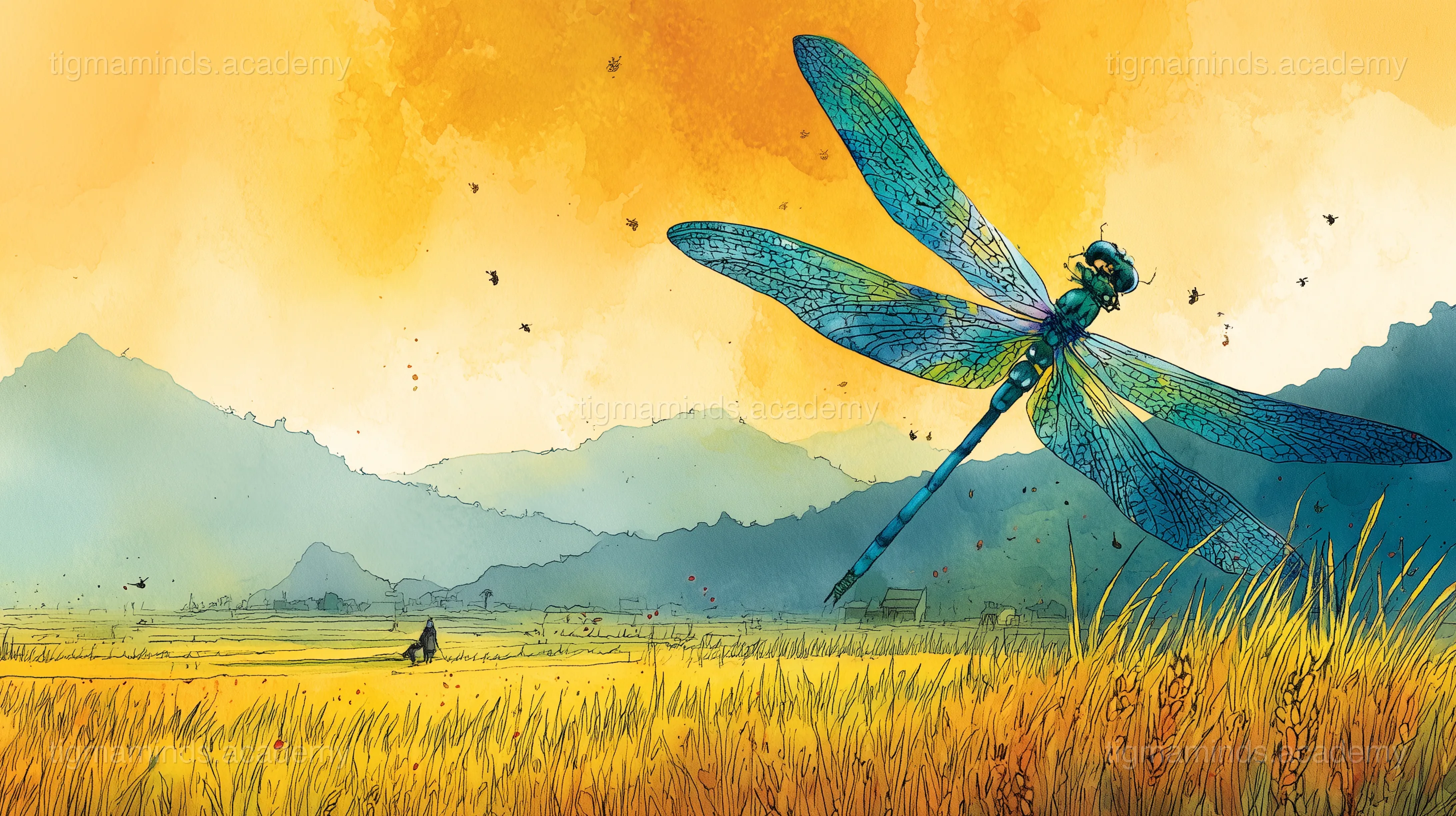
A dragonfly protects the rice harvest by eating the pests that threaten it — a story about the small heroes we never notice.
The Golden Field
In the wide, flat Brahmaputra valley, where the river spreads its fingers into a thousand channels and the soil is so rich you could grow a tree from a twig, there lay a paddy field. It was not the biggest field in Assam, nor the smallest. It belonged to a farmer named Biren and his wife Bonti, and it was their whole world.
Every year, Biren and Bonti planted rice in June, tended it through the monsoon, and harvested it in November. The field fed their family, paid for their children's school fees, and gave them enough extra to share with neighbours during festivals. It was not much, but it was everything.
"If the harvest is good, we are good," Biren always said. "If the harvest fails, we have nothing."
The Pest Army
One August, when the rice plants were tall and green and heavy with promise, Bonti noticed something wrong. The leaves of the rice were being eaten. Not by one or two insects, but by thousands. An army of stem borers and leafhoppers had descended on the field — tiny, relentless creatures that chewed through the rice stalks like children eating sugarcane.
"If they eat the stems, the rice heads will fall before they ripen," said Biren, his face grey with worry. "We'll lose everything."
Bonti wanted to buy pesticide, but it cost more money than they had. Biren tried picking the insects off by hand, but there were too many — for every one he removed, ten more appeared. The pest army was winning, and the harvest was dying.
The Guardian Arrives
One misty morning, as Bonti stood at the edge of the field watching the leafhoppers feast, she saw a flash of colour — a streak of iridescent blue-green darting above the rice. Then another. Then a dozen. Then a hundred.
Dragonflies.
They came in a shimmering cloud, their wings catching the early light like chips of stained glass. They hovered above the paddy, their huge compound eyes scanning the rice stalks — and then they dove.
Each dragonfly was a tiny hunting machine. They snatched leafhoppers out of the air with legs that worked like baskets. They plucked stem borers from the stalks with precision that would shame a surgeon. They ate and ate and ate — hundreds of pests per dragonfly per day — moving through the field like a benevolent storm.
Bonti watched, open-mouthed. "Biren! Come see!"
Nila the Dragonfly
Among the dragonflies, there was one who was larger and more brilliant than the rest. Her body was the deep blue of a Brahmaputra twilight, and her wings hummed with a sound like a tiny prayer bell. The children from the neighbouring houses came to watch and gave her a name: Nila, meaning blue.
Nila worked harder than any other dragonfly. She patrolled the field from dawn to dusk, eating pests, chasing moths, skimming the water between the rice rows to catch mosquito larvae before they could hatch. She was tireless. She was fierce. And she was the reason the rice survived.
By September, the pest army was defeated. The rice stalks stood tall and healthy, their heads bowing under the weight of golden grain. The field had been saved — not by chemicals or machines, but by a cloud of dragonflies led by one stubborn blue warrior.
The Harvest Celebration
In November, when the rice was cut and the granary was full, Biren and Bonti held a harvest feast. They invited the whole neighbourhood. There was rice beer and fish curry and pitha cakes and laughter that carried across the fields in the cool evening air.
Bonti stood up and raised her cup. "Every year, we thank the rain and the river and the sun for the harvest," she said. "This year, I want to thank someone else — the dragonfly. She is small. She is silent. She does not ask for thanks. But without her, this field would be empty and our children would be hungry."
She pointed to the edge of the field, where Nila still patrolled in the fading light, her blue body glowing like a tiny lantern.
"To the guardian of the field," Bonti said.
"To the guardian!" everyone echoed.
What the Field Remembers
Nila did not live forever. Dragonflies live only a few months. But every monsoon season, her daughters and their daughters returned to Biren and Bonti's field, drawn by the water and the abundance of insects. And every year, the rice was saved.
Biren never bought pesticide. He didn't need to. He had something better — a natural army, beautiful and ruthless, that asked for nothing in return except a wet field and a warm breeze.
In the villages of the Brahmaputra valley, people still call the dragonfly the farmer's friend. If you see one hovering over a rice field, do not swat it away. She is working. She is protecting the harvest with a dedication that puts most humans to shame.
And if her wings catch the light just right, and you see that flash of impossible blue — that is Nila's spirit, still guarding the field, still hunting the pests, still earning a celebration she will never attend.
The end.
Choose your level. Everyone starts with the story — the code gets deeper as you go.
Here is a taste of what Level 1 looks like for this lesson:
import numpy as np
# How computers "see" — an image is just numbers!
pixel_healthy = [34, 197, 94] # low red, HIGH green
pixel_sick = [146, 64, 3] # HIGH red, low green
def is_plant(pixel):
r, g, b = pixel
return g > r # Green dominates = plant!
print(is_plant(pixel_healthy)) # True
print(is_plant(pixel_sick)) # FalseThis is just the first of 6 coding exercises in Level 1. By Level 4, you will build: Build a Crop Health Detector.
By Level 4, enrolled students build: Build a Crop Health Detector
Free
Level 0: Listener
Stories, science concepts, diagrams, quizzes. No coding.
You are here
Level 0 is always free. Coding levels (1-4) are part of our 24-Week Bootcamp.
Nila the dragonfly patrolled the paddy field with her compound eyes, spotting pests invisible to humans. Modern drones do the same — flying over farms with cameras and AI to detect crop disease, pest damage, and water stress.
The big idea: "The Dragonfly and the Paddy Field" teaches us about Drones & Computer Vision — and you don't need to write a single line of code to understand it.
A quadcopter drone achieves flight using four rotors (propellers), each driven by an electric motor. Each rotor spins and pushes air downward, generating an upward thrust force (Newton's third law: every action has an equal and opposite reaction). When the total thrust from all four rotors exceeds the drone's weight, it rises. When thrust equals weight, it hovers. When thrust is less than weight, it descends. This is the same principle as a helicopter, but with four smaller rotors instead of one large one.
Steering a quadcopter requires no moving control surfaces — it is done entirely by varying the speed of individual rotors. To move forward, the rear two rotors spin faster than the front two, tilting the drone forward so that some thrust is directed backward. To yaw (rotate), diagonal pairs of rotors spin at different speeds. Adjacent rotors spin in opposite directions (two clockwise, two counterclockwise) to cancel out the rotational torque that would otherwise make the drone spin uncontrollably. A flight controller — a small computer with gyroscopes and accelerometers — adjusts motor speeds hundreds of times per second to maintain stability.
Agricultural drones used for crop monitoring in paddy fields typically carry cameras, multispectral sensors, and sometimes spray systems. They fly at altitudes of 10-50 meters, covering 10-20 hectares per battery charge. The flight controller uses GPS for positioning, barometric pressure for altitude, and inertial measurement units (IMUs) for orientation. Modern agricultural drones can fly pre-programmed routes automatically, capturing images with centimeter-level resolution — enough to spot individual plants showing signs of disease or pest damage.
Key idea: Quadcopter drones fly by varying the speed of four rotors — no moving control surfaces needed — and a flight controller with gyroscopes adjusts motor speeds hundreds of times per second for stability.
Computer vision is the field of artificial intelligence that enables machines to interpret and understand visual information from the world — photographs, video, and real-time camera feeds. When a drone camera captures an image of a paddy field, the raw data is just a grid of numbers: each pixel stores three values (red, green, blue intensity, each from 0-255). A 12-megapixel image contains 36 million numbers. Computer vision algorithms extract meaning from these numbers — identifying plants, detecting pests, measuring crop health.
The key technology is the convolutional neural network (CNN), a type of deep learning model inspired by the visual cortex of the brain. A CNN processes an image through multiple layers: early layers detect simple features (edges, corners, color gradients), middle layers combine these into more complex patterns (leaf shapes, insect outlines), and deep layers recognize complete objects ("this is a rice plant," "this is a brown planthopper"). The network learns these patterns from thousands of labeled training images — it is never explicitly programmed with rules about what a pest looks like.
For crop monitoring, drones often carry multispectral cameras that capture light beyond what human eyes can see — particularly near-infrared (NIR). Healthy plants absorb red light for photosynthesis but strongly reflect NIR light. Stressed or diseased plants reflect less NIR. The Normalized Difference Vegetation Index (NDVI), calculated as (NIR - Red)/(NIR + Red), produces a map where healthy vegetation appears bright and stressed vegetation appears dark. By flying a drone over a paddy field and computing NDVI for every pixel, a farmer can identify problem areas before they are visible to the naked eye — catching pest infestations or nutrient deficiencies weeks earlier.
Key idea: Computer vision uses convolutional neural networks to extract meaning from images, and multispectral cameras measure plant health through NDVI — catching crop problems weeks before they are visible to the human eye.
Access all 130+ lessons, quizzes, interactive tools, and offline activities
Precision agriculture uses technology to manage crops at a fine spatial scale — treating each part of a field according to its specific needs rather t...
Nila the dragonfly could spot a leafhopper from metres away using **compound eyes** with nearly 30,000 tiny lenses (ommatidia). Dragonflies catch prey...