How the Dhol Drum Got Its Thunder
Percussion Physics & Vibration

How the Dhol Drum Got Its Thunder

The heartbeat of celebration — percussion physics.
Percussion Physics & Vibration12-Month Curriculum 12h

The Story

The Silent Drum

Before the dhol had its thunder, it was the quietest instrument in all of Assam. The flute had the voice of the wind. The pepa had the cry of the buffalo horn. The gogona had the buzz of a bamboo reed. But the dhol — the big, barrel-shaped drum that is now the heartbeat of every Bihu celebration — produced nothing but a soft, embarrassed thup when you struck it.

The drummer was a young man named Keshav, and he was devastated.

“I built you from the finest jackfruit wood,” he told the drum. “I stretched the best cowhide across your ends. I tightened your ropes until my fingers bled. Why won’t you sing?”

The drum said nothing. It was, after all, a drum.

The Search for Sound

Keshav carried his silent dhol across the land, searching for a voice to give it. He went to the Brahmaputra and asked the river. “Can you lend me your roar?”

The river churned and said, “My roar belongs to the monsoon. When the rains come, I am loud. When the rains go, I am quiet. I cannot give you a sound that is always there.”

Keshav went to the elephant and asked for his trumpet. The elephant shook his great head. “My trumpet is for warning and for joy. It comes from my belly, not from wood. I cannot put it inside your drum.”

He asked the waterfall in the Karbi hills. The waterfall sighed. “I only know one note, and I play it forever. You need a sound that can change — fast and slow, loud and soft. I am not that sound.”

The Thunder Cloud

One evening, as Keshav sat on a hilltop feeling defeated, the sky turned dark. A storm was coming — a proper bordoisila, the spring thunderstorm that arrives before Rongali Bihu like an uninvited guest who turns out to be the best part of the party.

The first bolt of lightning split the sky. Then came the thunder.

BOOM.

It shook Keshav’s chest. It rattled his teeth. It echoed off the hills and rolled across the paddy fields and faded into a low, rumbling growl that made the earth tremble.

“That,” Keshav whispered, staring at the sky. “That is the sound I need.”

He stood up in the rain and shouted at the thunder cloud: “Cloud! Will you lend me your voice?”

The cloud rumbled thoughtfully. “Why should I?”

“Because the people of Assam are about to celebrate Bihu, and they need a sound that can make them dance. A sound that shakes the ground and fills the heart. Only thunder can do that.”

The Bargain

The thunder cloud considered this. It was, truth be told, a little lonely. It only got to speak during storms, and storms didn’t last long. The idea of its voice living inside a drum — being heard at festivals, weddings, celebrations all year round — was appealing.

“I’ll give you my voice,” said the cloud, “on one condition. Every time you play the drum, you must play it with joy. Thunder without joy is just noise. Thunder with joy is music.”

“Deal,” said Keshav.

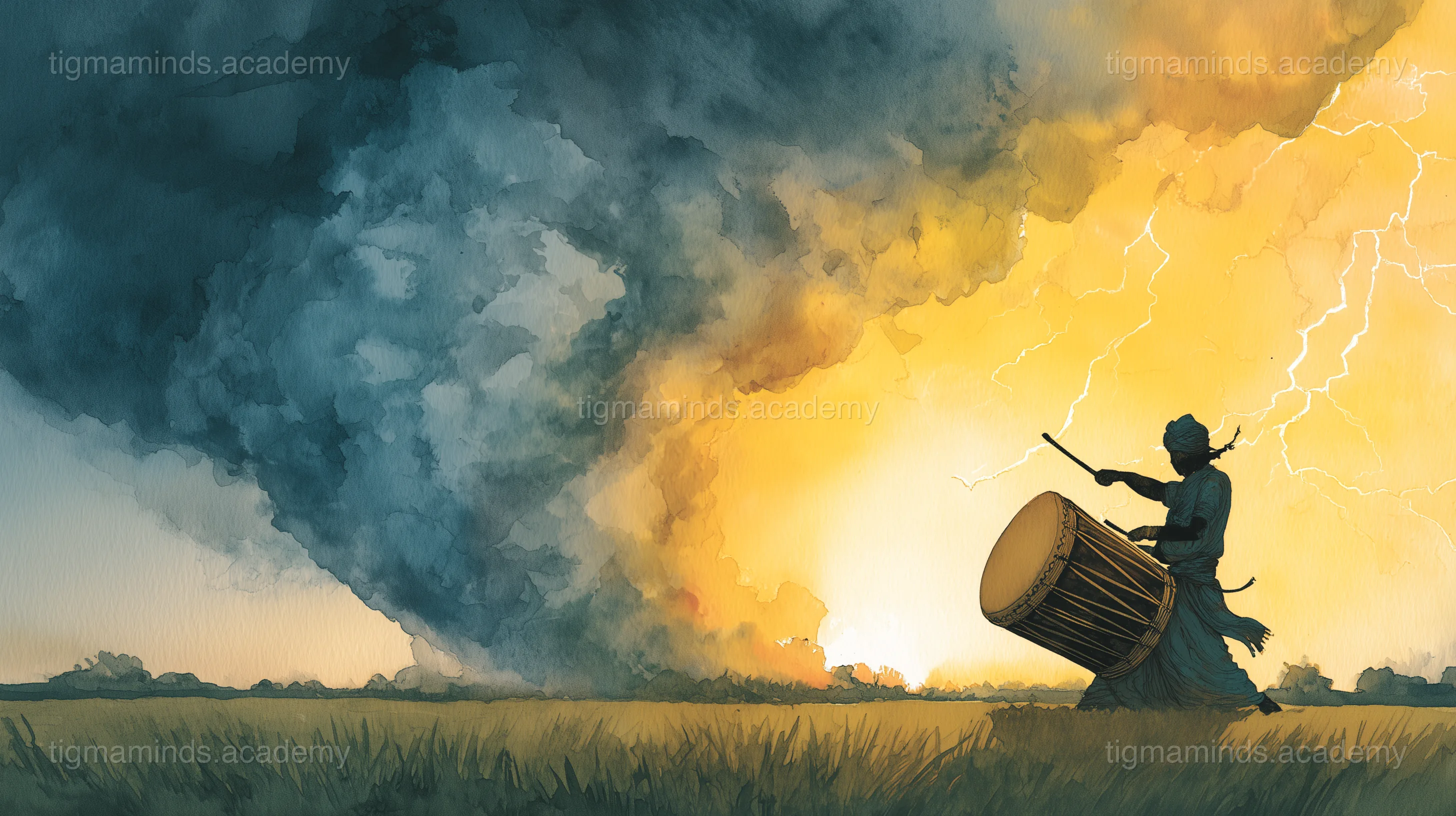
The cloud sent a single, perfect bolt of lightning into the dhol. The drum shuddered. The cowhide tightened. The jackfruit wood hummed. And when Keshav struck it with his palm —

DHOOM!

The sound exploded across the hilltop. Deep, resonant, thunderous — a sound that started in the drum and ended in the sky. Birds took flight. Monkeys howled. In the village below, people stopped what they were doing and looked up, grinning, because their bodies understood the sound before their minds did.

The First Bihu Beat

Keshav ran down the hill and into the village. He played the dhol all night — fast beats, slow beats, rolling rhythms that made the young people dance and the old people tap their feet. The pepa joined in, then the gogona, then the taal. But it was the dhol that drove everything, the dhol that was the heartbeat.

And from that Bihu onward, the dhol has carried the thunder’s voice. If you listen closely during a Bihu celebration, you can still hear it — not just the beat, but the storm inside the beat, the joy that a thunder cloud lent to a desperate drummer on a rainy hilltop.

The end.

Try It Yourself

Choose your level. Everyone starts with the story — the code gets deeper as you go.

Story Progress

0%

Ready to Start Coding?

Here is a taste of what Level 1 looks like for this lesson:

Level 1: Explorer — Python
# Drum pitch depends on diameter, tension, mass
import numpy as np
import matplotlib.pyplot as plt

diameters = np.linspace(0.15, 0.60, 50)  # metres
tension = 2000; sigma = 0.5  # N/m, kg/m^2
freq = (0.766 / diameters) * np.sqrt(tension / sigma)

plt.plot(diameters * 100, freq)
plt.xlabel("Diameter (cm)")
plt.ylabel("Frequency (Hz)")
plt.title("Bigger drum = lower pitch")
plt.show()

This is just the first of 6 coding exercises in Level 1. By Level 4, you will build: Visualize Vibration Patterns on a Drum.

By Level 4, enrolled students build: Visualize Vibration Patterns on a Drum

Free

Level 0: Listener

Stories, science concepts, diagrams, quizzes. No coding.

You are here

Enrolled

Levels 1-4

Python, NumPy, Matplotlib, real projects, mentorship.

Sign Up Free

Stay Updated

Join Waitlist

Get notified when enrollment opens for your area.

Notify Me

Level 0 is always free. Coding levels (1-4) are part of our 12-Month Curriculum.