
A shepherd boy, a giant, and the science hidden inside a spinning stone.
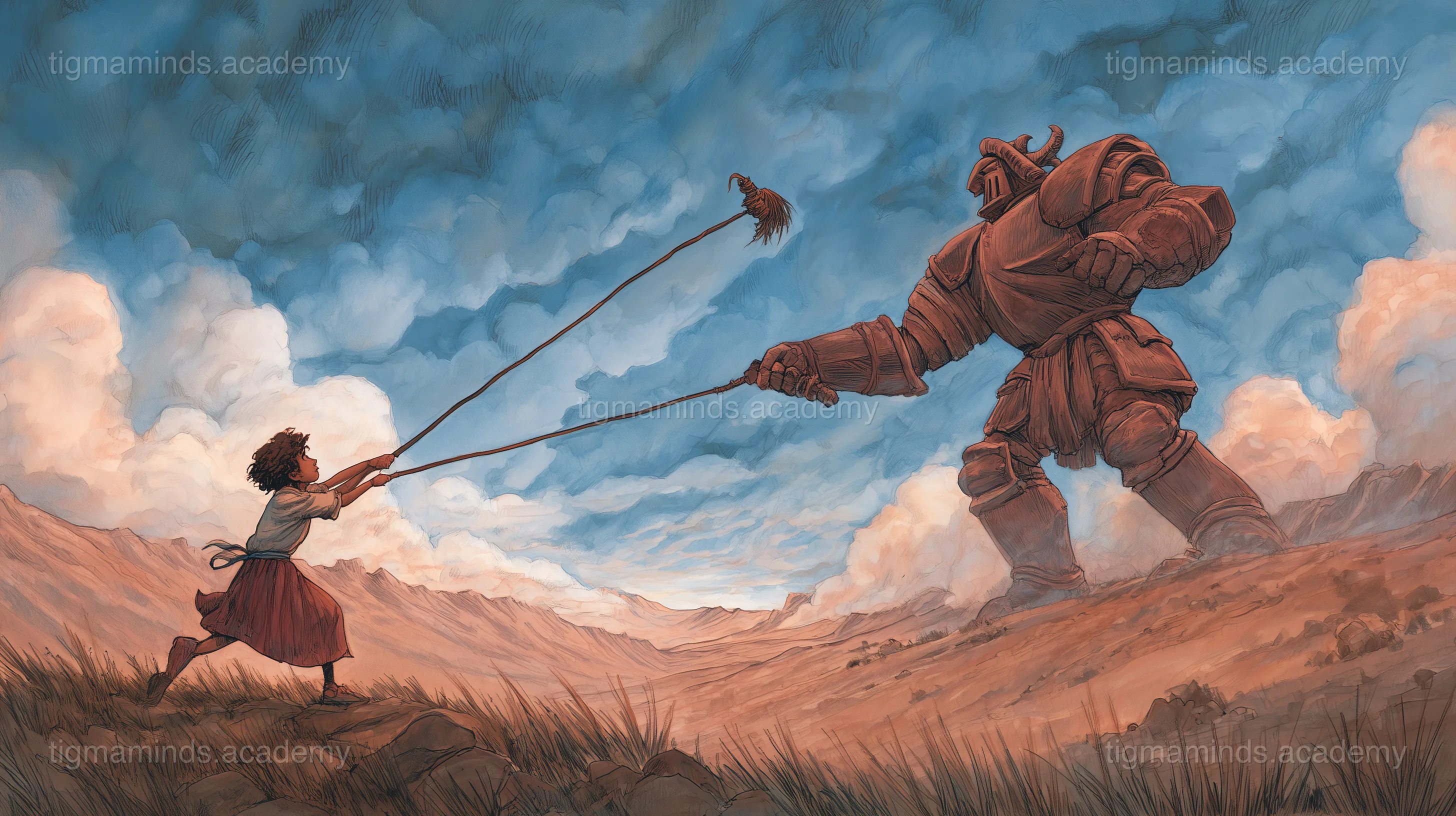
The Valley of Elah
Three thousand years ago, in a dusty valley between two hills, two armies faced each other. The Israelites stood on one hill, the Philistines on the other, and between them lay a valley that neither side dared cross. They had been staring at each other for forty days.
The reason was a man named Goliath.
Goliath was enormous — nearly three metres tall. He wore a bronze helmet, a coat of scale armour weighing sixty kilograms, and carried a spear with an iron tip the size of a weaving beam. Every morning, he walked into the valley and shouted: "Send your best warrior to fight me."
No one volunteered.
The Shepherd Boy
Then David arrived. He was not a soldier — he was a shepherd boy from Bethlehem, bringing bread and cheese to his older brothers. He was young, lean, and had never worn armour. But he had spent years protecting his father's sheep from wolves and lions, and he carried a sling.
Not a slingshot with rubber bands. David's sling was an ancient weapon: a leather pouch attached to two cords, each about a metre long. You place a stone in the pouch, swing it in wide circles above your head, and release one cord at exactly the right moment.
King Saul tried to give David his armour. David put it on, took a few steps, and took it off. "I cannot wear this." Instead, he picked up five smooth stones from a stream and walked toward Goliath with nothing but his sling.
The Physics of the Moment
Goliath laughed. A boy with a sling? He lumbered forward, weighed down by sixty kilograms of armour, moving slowly because heavy things are hard to accelerate.
David ran toward him — light, fast. He loaded a stone and began spinning it. Around and around the stone went, accelerating with every revolution. David's arm provided centripetal force — pulling inward while the stone's natural tendency was to fly outward in a straight line.
The stone wanted to escape. David held it in a circular path, building speed with every loop, storing energy like winding a spring tighter.
Then he released one cord.
The stone flew. Released from its circular prison, it shot forward in a straight line — not level, but in a gentle upward arc that curved back down under gravity. A parabolic trajectory. David had spent years calibrating this arc against wolves and lions. The stone was not a guess — it was a calculation, refined by ten thousand practice throws.
It struck Goliath in the forehead — the one spot not covered by his helmet. A small stone, perhaps 50 grams, but travelling at roughly 35 metres per second. Its kinetic energy depended on the square of its speed. Double the speed, four times the energy. David's stone was small but blindingly fast, and speed matters more than weight.
All that energy delivered to a single point. The stone's contact area was tiny — perhaps two square centimetres — which meant the pressure was enormous. The same force spread over a dinner plate would be harmless. Concentrated on a pebble-sized point, it was devastating.
Goliath fell face-first into the dust.
What David Really Knew
David didn't know the equations. He didn't know the words centripetal or kinetic or parabolic. But he knew, in the way that anyone who practises for years comes to know, that spinning makes things fast, that release angle determines where the stone lands, that a small fast stone hits harder than a large slow one, and that a point impact does more damage than a flat one.
He knew the physics. He just knew it in his hands.
The end.
Choose your level. Everyone starts with the story — the code gets deeper as you go.
Here is a taste of what Level 1 looks like for this lesson:
import numpy as np
import matplotlib.pyplot as plt
v = 35 # launch speed (m/s)
g = 9.8 # gravity
angles = np.arange(10, 85, 5)
ranges = v**2 * np.sin(np.radians(2 * angles)) / g
plt.bar(angles, ranges, color='sandybrown', edgecolor='saddlebrown')
plt.xlabel("Launch angle (°)")
plt.ylabel("Range (m)")
plt.title("David's Sling: Range vs Launch Angle")
plt.axvline(x=45, color='red', linestyle='--', label='45° = max')
plt.legend()
plt.show() # Which angle wins?This is just the first of 6 coding exercises in Level 1. By Level 4, you will build: Build a Projectile Range Calculator.
By Level 4, enrolled students build: Build a Projectile Range Calculator
Free
Level 0: Listener
Stories, science concepts, diagrams, quizzes. No coding.
You are here
Level 0 is always free. Coding levels (1-4) are part of our 12-Month Curriculum.
The physics of the sling — circular motion, projectiles, kinetic energy, and impact.
The big idea: "David and Goliath — The Physics of the Sling" teaches us about Projectile Motion & Biomechanics — and you don't need to write a single line of code to understand it.
Tie a ball to a string and swing it in a circle above your head. Feel the pull in your hand? That pull is real: centripetal force. It means "center-seeking force" — it keeps pulling the ball inward, preventing it from flying away.
Here is the key insight: the ball wants to travel in a straight line. If you let go, it does not spiral outward — it shoots off in a straight line, tangent to the circle. The string is what forces the ball into a curve.
The faster you spin, the harder you have to pull. The centripetal force needed increases with the square of the speed: F = mv²/r. David used this every day as a shepherd. Each revolution of the sling added more speed. By release, the stone was travelling at about 35 m/s — roughly 125 km/h.
Try this: Swing a ball on a string and pay attention to where it goes when you release. It always flies off tangent to the circle — at a right angle to the string at the moment of release.
Key idea: Centripetal force keeps a spinning object on a circular path. Release it, and it flies in a straight line tangent to the circle. Spinning builds speed — the sling converts rotation into projectile velocity.
The moment David releases the stone, it becomes a projectile — moving through the air under gravity alone. No engine, no string, just its existing speed and gravity pulling it down.
A projectile's path is always a curve called a parabola. The stone moves forward at constant speed, but gravity pulls it down at 9.8 m/s². The combination creates a smooth arc.
The launch angle determines how the stone's speed splits between forward and upward. Too flat (10°) — it drops quickly. Too steep (80°) — it goes mostly up and comes down in the same spot. The sweet spot for maximum range is 45 degrees.
The range formula: R = v² sin(2θ) / g. The sin(2θ) term is maximized when θ = 45°. At 30° or 60°, you get the same range — but less than 45°.
Prediction you can test: Throw a ball at 30° and then at 60° with the same force. Both should land at roughly the same distance. The 30° throw is fast and flat; the 60° throw is high and slow.
Key idea: A projectile follows a parabolic arc shaped by its launch speed and angle. 45 degrees gives maximum range. The range equation R = v² sin(2θ)/g shows why.
Access all 130+ lessons, quizzes, interactive tools, and offline activities
A 10 kg bowling ball rolling at 2 m/s, or a 50-gram stone flying at 35 m/s — which carries more energy? Your instinct says the bowling ball. Your inst...
The stone hit Goliath's forehead. Why so much damage from a small object? Two concepts: **impulse** and **pressure**....