The Dancer of the Floating Market
Floating Market Economics

The Dancer of the Floating Market

Economics of floating markets.
Floating Market Economics12-Month Curriculum 12h

The Story

The Floating Islands

Loktak Lake in Manipur is unlike any lake in the world. Its surface is dotted with phumdis — floating islands made of tangled vegetation, soil, and organic matter that drift slowly across the water like green rafts. People live on some of these phumdis. They build huts, grow vegetables, and fish from their edges. Their homes move with the wind.

On one such phumdi lived a girl named Tombi. She was thirteen, with quick dark eyes and feet that never seemed to touch the ground, even when she was standing still. Tombi's family had lived on the floating island for three generations, fishing and farming the way their grandparents had.

But the phumdi was shrinking. Every year, a little more of its edge crumbled into the lake. The soil was thinning. The vegetation was dying. Tombi's parents talked in worried whispers about moving to the mainland.

The Dance

Tombi had one great love: Manipuri dance. Since she was five years old, she had studied the classical Ras Lila — the graceful, spinning, swaying dance that the people of Manipur had performed for centuries. Her teacher, old Ima Memcha, lived on the lakeshore and taught Tombi every afternoon on a packed-earth courtyard behind her house.

"Your feet must be like lotus petals on water," Ima Memcha would say. "Light enough to float, strong enough to hold."

Tombi practiced on the phumdi at dawn, when the mist lay thick over the lake and the world was silent. She danced on the floating island's surface, and the phumdi swayed gently beneath her, as if the island itself were dancing along. Her movements were so light that the water beneath the vegetation barely rippled.

"You dance like the lake breathes," her mother said one morning, watching from the doorway.

The Festival Idea

When the village council met to discuss the phumdi's future — whether to abandon it, whether to try to reinforce its edges — Tombi stood up. She was the youngest person in the meeting, and her voice shook, but her idea was clear.

"What if we hold a dance festival on the phumdi?" she said. "I'll perform Ras Lila on the floating island. People will come from the mainland to watch. They'll see how beautiful the phumdis are. They'll want to help save them."

The elders exchanged glances. A dance festival? On a sinking island?

"It might sink faster with all those people," said one elder.

"Only I will be on the phumdi," said Tombi. "The audience will watch from boats."

The council agreed to try — mostly because nobody had a better idea.

The Performance

Word spread across Bishnupur and beyond. A classical dancer performing on a floating island? Boats arrived from every village on the lake. Fishermen, farmers, schoolteachers, even officials from Imphal came in long wooden canoes, forming a floating amphitheatre around the phumdi.

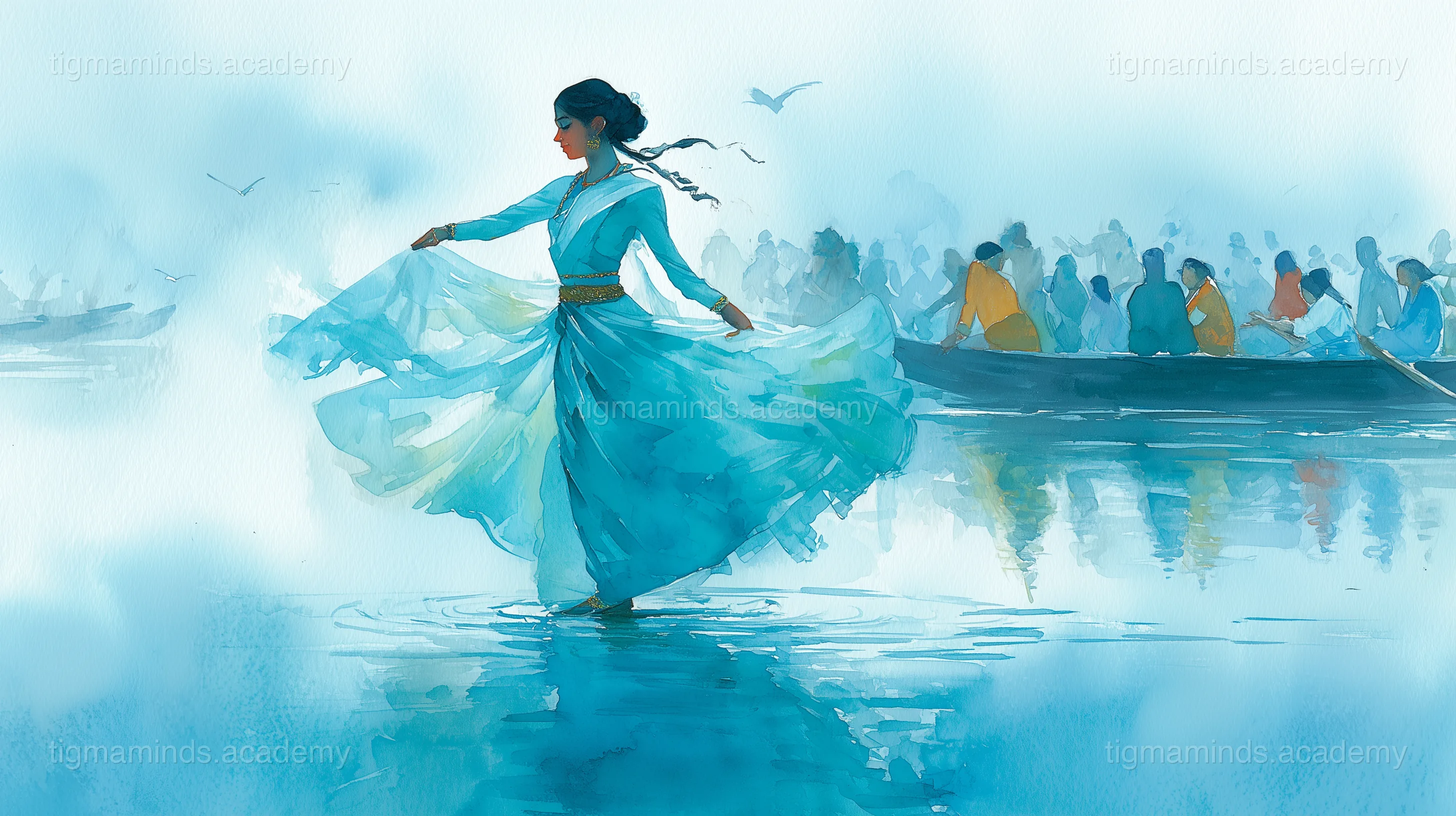
Tombi stepped onto the centre of the island as the sun began to set. She wore the traditional potloi — the stiff, barrel-shaped skirt of Manipuri dance — in green and gold, and a white veil that caught the evening breeze. Her anklets chimed as she took her opening position.

The pung drummer began to play from a nearby boat. The cymbals joined. The flute wove between them like a bird threading through branches.

And Tombi danced.

She spun on the floating island, and the phumdi rocked gently with her movements, turning her dance into something no stage could replicate — a performance that breathed with the water, that rose and fell with the lake's own rhythm. Her feet barely pressed the surface. Her arms drew circles that mirrored the rings spreading across the water. She was not dancing on the lake. She was dancing with it.

The audience fell silent. Even the birds stopped calling. For twenty minutes, the only sounds on Loktak Lake were the drum, the cymbals, the flute, and the soft whisper of Tombi's feet on the floating earth.

The Island Lives

When Tombi finished and bowed, the lake erupted in cheers. People stood in their boats and clapped until the canoes rocked dangerously. The officials from Imphal wiped their eyes and promised funds to restore the phumdis. A photographer's images appeared in newspapers across the state.

Within a month, volunteers arrived to reinforce the phumdi's edges with fresh vegetation. Scientists came to study how to keep the floating islands healthy. Tourists began visiting Loktak Lake not just to see the water but to see the girl who danced on a floating world.

Tombi's phumdi didn't sink. It grew. New vegetation knit itself to the old edges, and the island became stronger than it had been in years. Tombi performed every full moon, and each time, boats gathered in a wide circle, and each time, the lake and the dancer moved as one.

"You saved the island," her mother told her.

"The dance saved the island," said Tombi. "I just gave it a stage."

The end.

Try It Yourself

Choose your level. Everyone starts with the story — the code gets deeper as you go.

Story Progress

0%

Ready to Start Coding?

Here is a taste of what Level 1 looks like for this lesson:

Level 1: Explorer — Python
import numpy as np
import matplotlib.pyplot as plt

# Your first data analysis with Python
data = [45, 52, 38, 67, 41, 55, 48]  # measurements
mean = np.mean(data)

plt.bar(range(len(data)), data)
plt.axhline(mean, color='red', linestyle='--', label=f'Mean: {mean:.1f}')
plt.xlabel("Sample")
plt.ylabel("Value")
plt.title("Floating Market Economics — Sample Data")
plt.legend()
plt.show()

This is just the first of 6 coding exercises in Level 1. By Level 4, you will build: Analyze the Economics of a Local Market.

Free

Level 0: Listener

Stories, science concepts, diagrams, quizzes. No coding.

You are here

Enrolled

Levels 1-4

Python, NumPy, Matplotlib, real projects, mentorship.

Sign Up Free

Stay Updated

Join Waitlist

Get notified when enrollment opens for your area.

Notify Me

Level 0 is always free. Coding levels (1-4) are part of our 12-Month Curriculum.