
The cuckoo keeps perfect time — biological clocks.
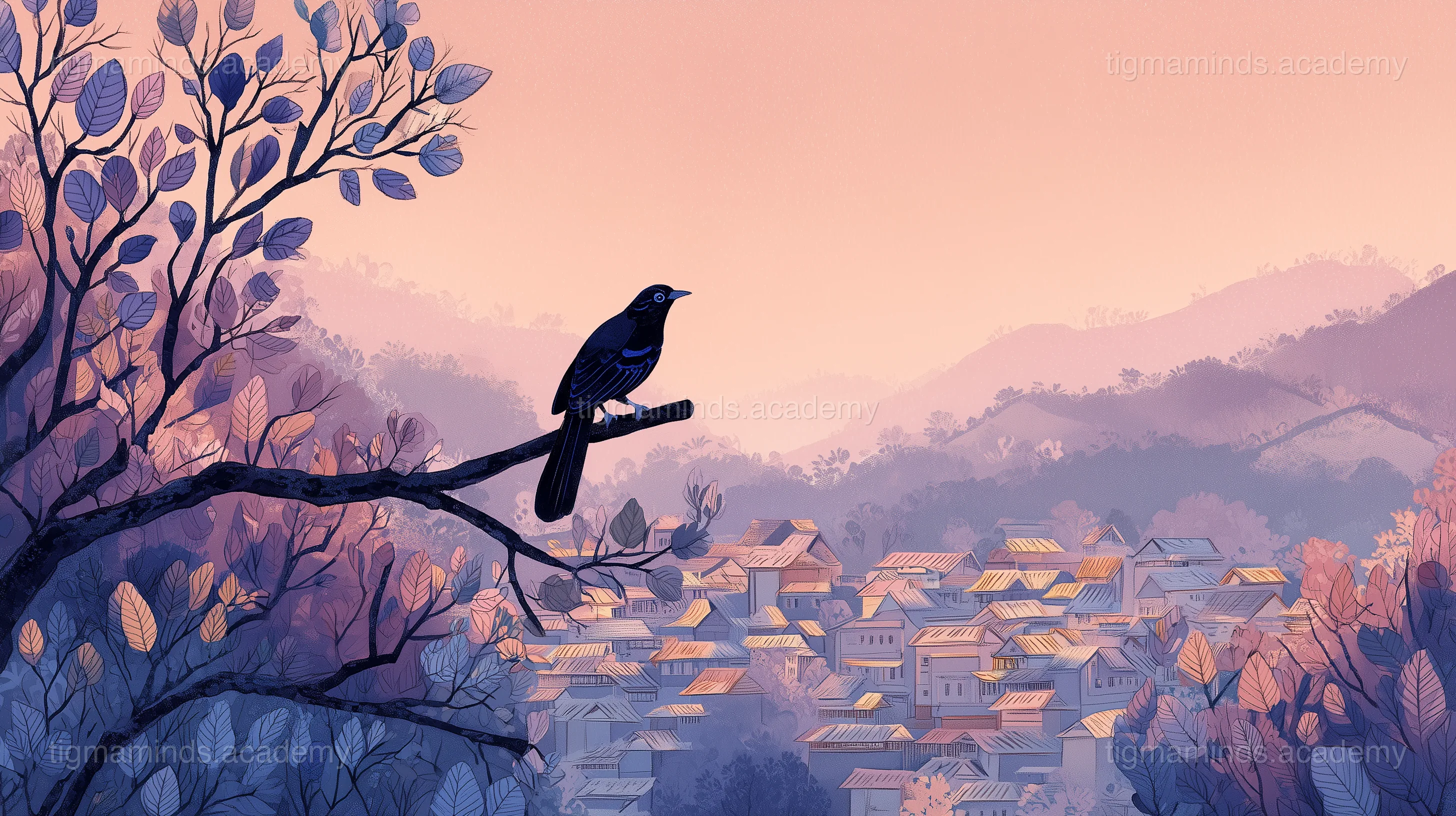
The World That Overslept
In the very beginning, when the world was new and the forests of northeast India were still learning how to grow, there was a problem. Nobody could wake up on time.
The sun rose, but the animals slept on. The flowers opened, but no bees came to visit. The rivers flowed, but no one drank. The whole world was beautiful in the morning, and nobody was awake to see it.
The Creator — the old spirit who had shaped the hills and filled the rivers — looked down and frowned. "This won't do," she said. "I've made the most beautiful mornings, and everyone is sleeping through them. I need a wake-up caller."
The Auditions
The Creator sent word through the forest: every bird was invited to audition for the job of Dawn Caller — the one who would wake the world each morning.
The birds gathered in a great clearing in the hills of Meghalaya, where the morning mist was thickest and the challenge greatest. If your voice could cut through Meghalaya's fog, it could wake anyone anywhere.
The rooster went first. "Cock-a-doodle-doo!" he crowed, his red comb trembling with effort. It was loud, but it was harsh — the kind of sound that makes you cover your ears, not open your eyes.
"Too aggressive," said the Creator. "I want the world to wake up happy."
The kingfisher tried next — a sharp, bright call that echoed off the water. Beautiful, but too quick. It was over before the sleepers could register it.
The owl offered to stay up all night and hoot until dawn, but the Creator shook her head. "Hooting is for the night. I need a sound that belongs to the morning."
One by one, the birds tried. The mynah was too chatty. The crow was too harsh. The peacock was too dramatic — his call sounded like a scream, and the Creator didn't want the world waking up in fright.
The Cuckoo's Turn
At the back of the clearing, perched on a low branch of a jackfruit tree, sat the cuckoo — a modest grey bird with no bright feathers, no impressive crest, no fancy tail. She had been listening to every audition and growing more nervous by the minute.
"Your turn," said the Creator.
The cuckoo took a breath. She closed her eyes. And she sang.
"Ku-oo. Ku-oo."
Two notes. That's all. Two soft, clear, rising notes that floated through the mist like warm light through a window. The sound didn't shout. It didn't demand. It invited. It said: Wake up. The world is waiting. Something beautiful is happening outside.
The call drifted across the clearing, through the trees, over the hills, across the river, and into the valley beyond. A sleeping deer lifted its head. A hibernating frog opened one eye. A child in a bamboo house stirred and smiled in her sleep.
The Creator nodded slowly. "Sing it again."
The cuckoo sang again. "Ku-oo. Ku-oo." And again the sound carried — not because it was loud, but because it was the exact right frequency to travel through leaves, fog, walls, and even dreams.
The Gift of Distance
"That's the one," said the Creator. "Your voice doesn't wake people up by startling them. It wakes them up by reaching them — wherever they are, however deep they're sleeping. You carry farther than the rooster and gentler than the peacock. The job is yours."
The other birds protested. "She's so plain!" said the peacock. "She doesn't even build her own nest!" said the weaver bird.
The Creator raised a hand. "I didn't ask for the fanciest bird or the loudest bird. I asked for the voice that carries the farthest and wakes the world with kindness. The cuckoo's call does both."
She placed a blessing on the cuckoo: "From this day on, your call will be the first sound of every morning. It will travel across rivers and over mountains. It will reach into the deepest sleep and the heaviest heart. And everyone who hears it will know that a new day has begun."
The Dawn Song
And so the cuckoo became the dawn caller. Every morning, before the sun has fully risen, before the mist has lifted from the tea gardens of Assam or the rice paddies of Manipur, the cuckoo sings her two notes. "Ku-oo. Ku-oo."
The people of Assam call the cuckoo kokilaa, and her call is woven into the poetry, the music, and the mornings of northeast India. When the elders hear it, they say, "The world is awake. Time to begin."
And if you ever wonder why the cuckoo's call feels different from every other birdsong — why it seems to reach inside your chest and gently shake you awake — now you know. It was designed that way, by a Creator who knew that the best alarm clock isn't the loudest one. It's the one that makes you want to get up.
The end.
Choose your level. Everyone starts with the story — the code gets deeper as you go.
Here is a taste of what Level 1 looks like for this lesson:
import matplotlib.pyplot as plt
import numpy as np
# Sunrise time vs cuckoo first-call time across the year
months = ["Jan", "Feb", "Mar", "Apr", "May", "Jun",
"Jul", "Aug", "Sep", "Oct", "Nov", "Dec"]
sunrise_min = [395, 380, 360, 335, 315, 305,
310, 325, 340, 355, 375, 395]
cuckoo_min = [375, 360, 340, 315, 295, 285,
290, 305, 320, 335, 355, 375]
plt.figure(figsize=(10, 5))
plt.plot(months, sunrise_min, "o-", label="Sunrise", color="orange")
plt.plot(months, cuckoo_min, "s-", label="Cuckoo first call", color="green")
plt.ylabel("Time (minutes after midnight)")
plt.title("Does the Cuckoo Call Before Sunrise?")
plt.legend()
plt.show() # How many minutes before sunrise does it call?This is just the first of 6 coding exercises in Level 1. By Level 4, you will build: Track Dawn Chorus Timing Across Seasons.
By Level 4, enrolled students build: Track Dawn Chorus Timing Across Seasons
Free
Level 0: Listener
Stories, science concepts, diagrams, quizzes. No coding.
You are here
Level 0 is always free. Coding levels (1-4) are part of our 12-Month Curriculum.
The cuckoo keeps perfect time — biological clocks.
The big idea: "Why the Cuckoo Calls at Dawn" teaches us about Circadian Rhythms & Biological Clocks — and you don't need to write a single line of code to understand it.
The common cuckoo (Cuculus canorus) is nature's most famous cheat. Instead of building a nest, incubating eggs, and feeding chicks, the female cuckoo lays her eggs in the nests of other bird species — known as hosts — and leaves the entire burden of parenting to them. This strategy, called brood parasitism, saves the cuckoo enormous amounts of energy and time, allowing her to lay up to 25 eggs per season in different host nests.
The cuckoo's deception is remarkably sophisticated. Different cuckoo "gentes" (genetic lineages) specialize in parasitizing specific host species, and each gens produces eggs that closely mimic the host's eggs in color, pattern, and size. A cuckoo targeting reed warblers lays eggs with olive-green speckles; one targeting redstarts lays blue eggs. This egg mimicry has evolved through an arms race — hosts that reject dissimilar eggs survive and reproduce, selecting for cuckoos that produce better mimics.
The newly hatched cuckoo chick takes the deception further. Within hours of hatching (often before the host's own eggs hatch), the blind, naked cuckoo chick instinctively pushes all other eggs and chicks out of the nest using a scoop-shaped depression on its back. The host parents, now with only the cuckoo chick to feed, devote all their resources to raising the impostor — even though it quickly grows to several times their own body size. A tiny reed warbler feeding an enormous cuckoo chick is one of nature's most striking images.
Key idea: Cuckoos exploit other species by mimicking their eggs and eliminating their young — an evolutionary strategy refined by millions of years of arms-race coevolution.
The "dawn chorus" — the burst of birdsong at first light — is controlled by circadian rhythms, internal biological clocks that cycle with a period of approximately 24 hours. In birds, the master clock resides in the suprachiasmatic nucleus (SCN) of the hypothalamus, with secondary clocks in the pineal gland and retina. These clocks are synchronized to the external light-dark cycle through photoreceptors that detect the blue light of dawn.
Circadian rhythms are not simply responses to light — they are self-sustaining oscillations. If you keep a bird in constant darkness, it will continue to wake, sing, eat, and sleep on a roughly 24-hour cycle for weeks. The molecular basis is a transcription-translation feedback loop: "clock genes" (like CLOCK and BMAL1) produce proteins that accumulate during the day, and when they reach a critical concentration, they inhibit their own genes, causing protein levels to drop overnight. This molecular oscillation takes almost exactly 24 hours.
For the cuckoo, circadian timing is critical to its parasitic strategy. Female cuckoos typically lay their eggs in host nests during a narrow window in the early morning, when host parents are away foraging. They can lay an egg in as few as 10 seconds — faster than almost any other bird. This speed, combined with precise timing, minimizes the chance of being caught by the host. Studies with nest cameras have shown that cuckoos monitor host nests for days before laying, timing their intrusion to the host's predictable daily departure pattern.
Key idea: Circadian rhythms are self-sustaining 24-hour molecular clocks that regulate behavior in all animals — cuckoos exploit the predictable daily patterns of their hosts.
Access all 130+ lessons, quizzes, interactive tools, and offline activities
Many cuckoo species are long-distance migrants. The common cuckoo breeds across Europe and Asia in summer, then migrates to sub-Saharan Africa for win...
Your circadian clock drifts by about 11 minutes per day without light cues. Morning light **resets** it daily, keeping your body synchronized with the...