Genetics and species identity.
The Envious Coconut
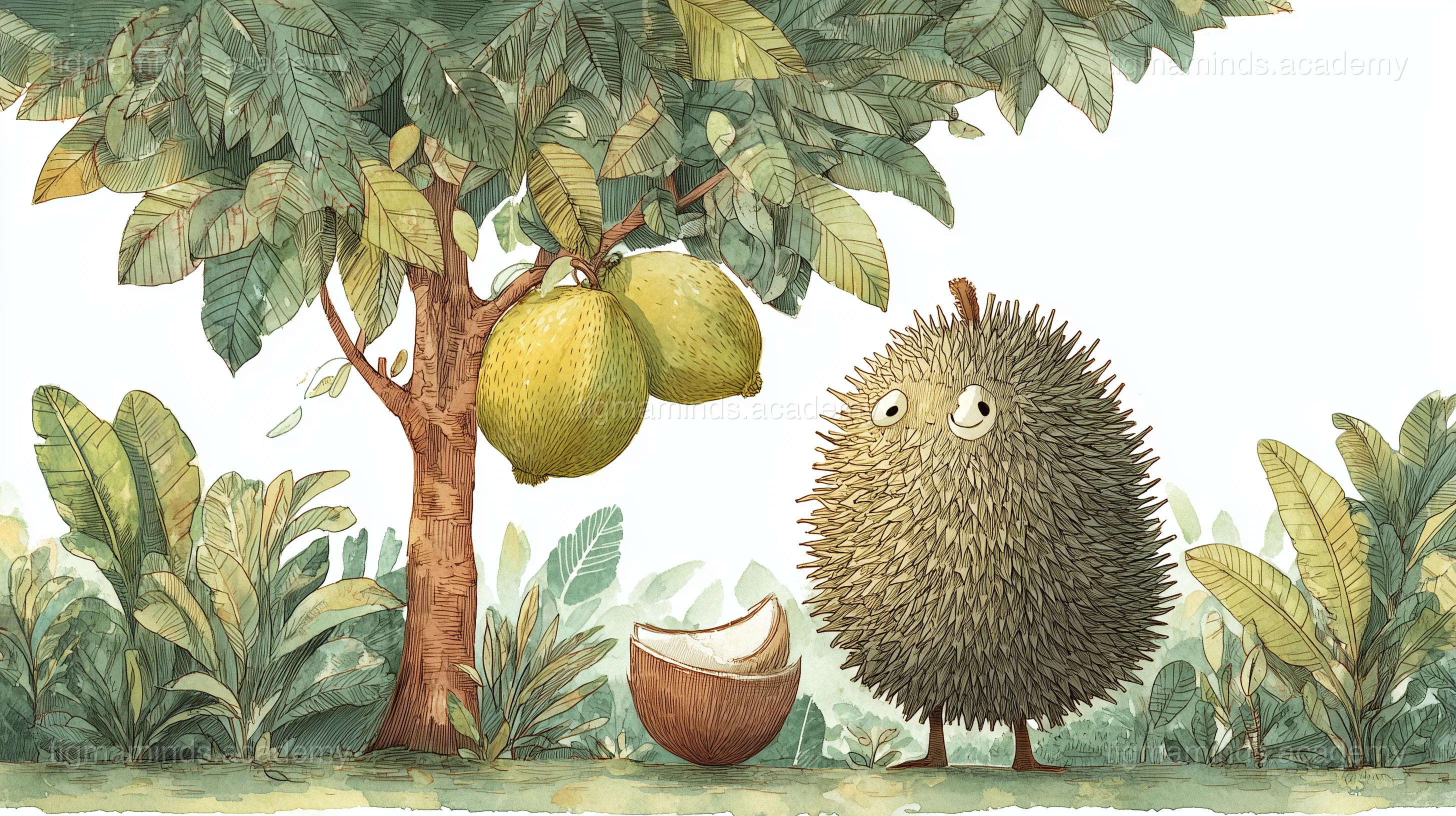
In a garden in Jorhat, there grew two trees side by side — a coconut palm, tall and slender, and a jackfruit tree, wide and generous with shade. On the coconut palm hung a small, round coconut named Nari. On the jackfruit tree hung a massive, bumpy jackfruit named Kothal.
Nari was unhappy.
"Look at you," she said to Kothal every morning. "You are the biggest fruit in the whole garden. People stop and stare at you. Children point and say, 'Look how big!' Nobody says that about a coconut."
Kothal, who was a gentle giant, said, "But Nari, you are perfectly round. I am covered in bumps."
"Bumps are interesting," said Nari. "Round is boring."
Nari's Attempts
Nari tried everything to make herself bigger. She drank extra rainwater until she felt bloated. She asked the sun to shine on her longer. She even tried puffing herself up by holding her breath — which, for a coconut, is not easy.
Nothing worked. She stayed small and round while Kothal grew bigger every week, his bumpy green skin stretching and swelling until he was the size of a pillow.
"It's not fair," Nari grumbled to the mynah bird who sat on her palm frond. "Why can't I be big?"
The mynah cocked her head. "Why do you want to be big?"
"Because big is important," said Nari.
The mynah laughed — a bright, chattery laugh. "Oh, Nari. You have no idea what you are, do you?"
The Monsoon Test
That June, the monsoon arrived with a fury. Winds howled across Jorhat, bending trees and rattling windows. Rain fell so hard it sounded like drums on a tin roof. The coconut palm swayed and danced, bending almost to the ground — but her flexible trunk snapped right back. Nari held on tight, her hard shell protecting her from every raindrop.
Poor Kothal was not so lucky. He was so big and heavy that the wind pulled at him mercilessly. His branch groaned. Water pooled in his bumpy skin. And on the third night of the storm — crack — Kothal's branch broke, and he tumbled to the ground with a thud.
"Kothal!" cried Nari. "Are you all right?"
"I'm fine," said Kothal from the mud. "A little bruised. But this always happens to us big ones. We fall sooner."
The Discovery
After the storm, the gardener's daughter came outside. She picked up Kothal and carried him to the kitchen — he was too heavy for one hand. Then she reached up for Nari with the other.
In the kitchen, something wonderful happened. The girl cracked Nari open. Inside, Nari discovered she carried sweet water — cool, refreshing coconut water that the girl drank with a smile. And beneath that, she had rich, white coconut meat that the girl grated into a curry.
Kothal was delicious too — his golden pods were sweet and fragrant. But Nari realised something she had never understood before: she had water inside her. Kothal didn't. She could quench thirst on a hot day. She could flavour rice. She could make oil, make milk, make chutney. She could do a hundred things Kothal couldn't.
"I was so busy wanting to be big," Nari whispered, "that I forgot to look at what was inside me."
The Garden's Wisdom
When the next batch of fruits grew on the coconut palm and the jackfruit tree, the older fruits passed down the story. Don't wish to be another fruit, they said. Every fruit has something special inside — something no other fruit carries. The coconut has water. The jackfruit has golden sweetness. The mango has sunshine. The banana has comfort.
And in that garden in Jorhat, no coconut ever envied a jackfruit again — because they finally understood that the best thing you can be is exactly what you already are.
The end.
Choose your level. Everyone starts with the story — the code gets deeper as you go.
Here is a taste of what Level 1 looks like for this lesson:
import numpy as np
import matplotlib.pyplot as plt
# Your first data analysis with Python
data = [45, 52, 38, 67, 41, 55, 48] # measurements
mean = np.mean(data)
plt.bar(range(len(data)), data)
plt.axhline(mean, color='red', linestyle='--', label=f'Mean: {mean:.1f}')
plt.xlabel("Sample")
plt.ylabel("Value")
plt.title("Genetics & Species Identity — Sample Data")
plt.legend()
plt.show()This is just the first of 6 coding exercises in Level 1. By Level 4, you will build: Extract DNA from Fruit and Observe It.
Free
Level 0: Listener
Stories, science concepts, diagrams, quizzes. No coding.
You are here
Level 0 is always free. Coding levels (1-4) are part of our 12-Month Curriculum.
Can one species become another?
The big idea: "The Coconut That Wanted to Be a Jackfruit" teaches us about Genetics & Species Identity — and you don't need to write a single line of code to understand it.
A fruit, in botanical terms, is a mature ovary of a flower, and its wall — the pericarp — has three distinct layers. The exocarp (outer skin), the mesocarp (middle flesh), and the endocarp (inner layer surrounding the seed). In a peach, these are obvious: the fuzzy skin, the juicy flesh, and the hard pit. In other fruits, the layers are modified beyond easy recognition.
A coconut is a drupe (like a peach), but its layers serve different functions. The exocarp is the smooth green outer skin. The mesocarp is the thick, fibrous husk (coir) — not fleshy like a peach's but adapted for flotation, allowing coconuts to disperse across oceans. The endocarp is the hard brown shell. The "meat" and "water" inside are actually the seed (endosperm), not fruit tissue.
A jackfruit is a multiple fruit — formed from the fusion of many individual flowers packed on a single stalk. Each fleshy "bulb" you eat is a single fruit (derived from one flower), with its own pericarp layers, seed, and the sweet, rubbery flesh that is actually the perianth (modified sepals). Understanding pericarp anatomy explains why fruits with similar exteriors can be radically different inside — form follows function in plant reproduction.
Key idea: Every fruit has three pericarp layers (exocarp, mesocarp, endocarp) that evolution has modified for different dispersal strategies — a coconut's fibrous mesocarp is for ocean travel, while a jackfruit's structure reflects its origin as many fused flowers.
Seed dormancy is a survival strategy in which a mature seed delays germination even when water, oxygen, and temperature are suitable. This prevents all seeds from sprouting simultaneously (which would make the entire next generation vulnerable to a single disaster) and allows seeds to wait for optimal conditions.
Dormancy comes in several types. Physical dormancy involves a hard, waterproof seed coat that must be broken (by fire, animal digestion, or mechanical abrasion) before water can reach the embryo — coconuts have this. Physiological dormancy involves chemical inhibitors within the seed that must be broken down, often requiring a period of cold (stratification) or exposure to light. Morphological dormancy means the embryo is not fully developed at the time of seed release and must grow further before germination.
Coconut seeds have minimal dormancy — they germinate readily when they reach moist soil, which makes sense for a species that disperses across oceans (there is no guarantee of returning to the right conditions later). Jackfruit seeds, by contrast, are recalcitrant — they cannot tolerate drying and must germinate quickly or die. This is why jackfruit seeds sprout within weeks of falling, while some desert seeds can remain dormant for decades, waiting for the rare rain.
Key idea: Seed dormancy is a bet-hedging strategy — coconuts germinate quickly after ocean dispersal, while other species wait months or decades for the right environmental trigger.
Access all 130+ lessons, quizzes, interactive tools, and offline activities
**Ethylene** (C2H4) is a gaseous plant hormone that triggers fruit ripening. When a fruit begins to ripen, it produces ethylene, which activates genes...
Click Inside a Cell