
Clouds become stories waiting to be woven.
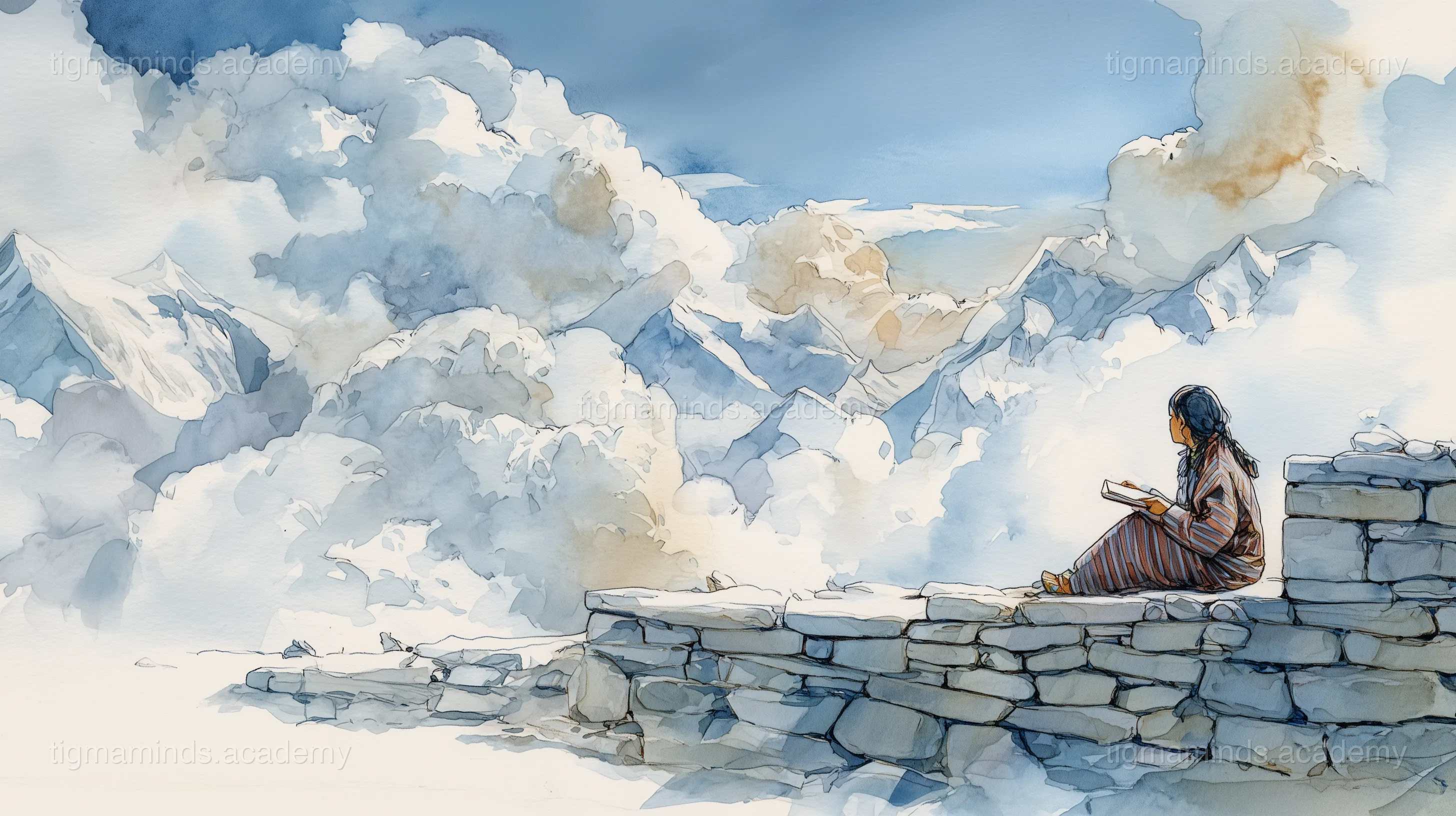
Above the Clouds
Tawang sits so high in the mountains of Arunachal Pradesh that some mornings, when you look out the window, you see clouds below you. It is a town that lives in the sky.
In this sky-town lived a girl named Dechen. While other children played in the monastery courtyard, Dechen sat on the stone wall and watched the clouds. She watched them form and dissolve, merge and separate, thin into wisps and thicken into mountains.
"What are you doing?" her brother asked.
"Weaving," said Dechen.
"You don't have a loom."
"The sky is my loom," said Dechen. "And the clouds are my thread."
The Old Weaver
In Tawang, there lived an old woman who wove the most beautiful shawls anyone had ever seen. Her patterns were famous — intricate dragons and flowers and mountains, all in colours that seemed to glow from within.
One day, Dechen asked the old weaver her secret.
"I don't invent my patterns," said the old woman. "I copy them from the clouds. Every morning, I look at the sky and see what the clouds have woven overnight. Then I weave the same pattern into cloth."
"But clouds don't have patterns," said Dechen.
"They do if you know how to look," said the old woman. "Come, I'll teach you."
Learning to See
Every morning for a month, Dechen sat with the old weaver and watched the clouds. At first, she saw nothing but white shapes. But slowly, she began to notice.
The clouds had edges — some sharp like mountain ridges, some soft like a grandmother's shawl. They had layers — thin clouds over thick ones, like silk over wool. They had rhythm — the way they moved was like the shuttle of a loom, back and forth, back and forth.
"I see it!" Dechen cried one morning. "That cloud looks like the dragon pattern on your shawl!"
The old woman smiled. "Now you're a cloud weaver too."
The First Shawl
Dechen learned to weave on a real loom, but she never used a pattern book. Every pattern came from the clouds — a spiral from a monsoon cloud, a zigzag from wind-torn cirrus, a soft gradient from morning fog rising over the monastery.
Her first shawl was white and grey and silver — the colours of clouds. It was so beautiful that the monks at the Tawang Monastery asked her to weave prayer flags with cloud patterns.
"When the wind blows through them," said the head monk, "the prayers will travel on clouds to every corner of the world."
The Cloud Weaver
Dechen grew up to become Tawang's most famous weaver. People asked where she got her patterns, and she always pointed to the sky. "The clouds weave all day long," she said. "I just translate their work into thread."
And on quiet mornings, when the clouds sit below Tawang like a white ocean, you can still see a figure sitting on the stone wall, sketchbook in hand, copying the patterns of the sky. Because in Tawang, the best art doesn't come from imagination. It comes from paying attention to what's already there.
The end.
Choose your level. Everyone starts with the story — the code gets deeper as you go.
Here is a taste of what Level 1 looks like for this lesson:
import numpy as np
import matplotlib.pyplot as plt
# Generate a weaving pattern as a binary grid
rows, cols = 16, 16
pattern = np.zeros((rows, cols), dtype=int)
# Plain weave: checkerboard
for r in range(rows):
for c in range(cols):
pattern[r][c] = (r + c) % 2
plt.imshow(pattern, cmap='RdYlBu', interpolation='nearest')
plt.title("Plain Weave Pattern (binary grid)")
plt.xlabel("Warp thread")
plt.ylabel("Weft row")
plt.colorbar(label="0=weft on top, 1=warp on top")
plt.show() # Try making a twill pattern!This is just the first of 6 coding exercises in Level 1. By Level 4, you will build: Analyze Fabric Structure Under Magnification.
By Level 4, enrolled students build: Analyze Fabric Structure Under Magnification
Free
Level 0: Listener
Stories, science concepts, diagrams, quizzes. No coding.
You are here
Level 0 is always free. Coding levels (1-4) are part of our 12-Month Curriculum.
Clouds become stories waiting to be woven.
The big idea: "The Cloud Weaver of Tawang" teaches us about Textiles & Weaving Technology — and you don't need to write a single line of code to understand it.
Every piece of woven fabric on Earth — from Dechen's shawls in Tawang to the shirt you are wearing right now — is made of exactly two sets of threads crossing each other at right angles. Understanding these two systems is the foundation of textile science.
The warp threads run vertically (lengthwise) and are set up first. They are stretched tight on the loom under tension, like guitar strings. Because they bear the weight of the entire fabric during weaving, warp threads must be strong — they endure thousands of back-and-forth passes of the shuttle without breaking. The weft threads run horizontally (widthwise) and are woven in second, one row at a time, passing over and under alternate warp threads.
The over-under pattern of how weft crosses warp determines everything about the fabric: its strength, its feel, its drape, and its pattern. The simplest arrangement — over one, under one, alternating each row — is called plain weave. It is the strongest and most stable weave structure, used in everything from canvas to bandages. Dechen's cloud-pattern shawls use variations of this basic over-under logic to create intricate designs.
Key idea: All woven fabric consists of warp (vertical, under tension) and weft (horizontal, woven in) threads. Their crossing pattern determines the fabric's strength and appearance.
A loom looks complicated, but it really does only three things, repeated thousands of times: open a gap (shed), pass thread through it (shuttle), and push the new thread tight (beat). Every loom ever built — from a stick loom in a Tawang village to a computer-controlled factory loom — performs these same three steps.
Opening the shed: the loom lifts every other warp thread, creating a V-shaped gap (called the "shed") between the upper and lower threads. This is done by a heddle — a bar with loops that grab alternate warp threads and pull them up. Passing the shuttle: a shuttle carrying the weft thread is passed through the shed from one side to the other. This lays one row of weft across the entire width. Beating: a beater bar pushes the new weft row tightly against the previous rows, creating a dense, strong fabric.
Then the heddle switches — the threads that were up go down, and the threads that were down go up — and the whole cycle repeats. Each cycle adds one row. A skilled Tawang weaver using a backstrap loom (where her own body provides the tension) can complete about 5,000 cycles to produce one shawl. That is 5,000 repetitions of open-pass-beat, each one precise, each one building the pattern thread by thread.
Key idea: Every loom in the world performs the same three-step cycle: open a shed (gap), pass the shuttle (weft thread), beat the new row tight. Repeat 5,000 times for one shawl.
Access all 130+ lessons, quizzes, interactive tools, and offline activities
The most important skill in weaving is not speed or pattern-making — it is controlling tension. Tension determines whether the fabric is strong or wea...
Dechen's cloud patterns are beautiful, but traditional weaving patterns are not just decorative — they carry information. Among the Naga tribes, Mizo,...