
Chemistry and fluid dynamics hidden in one of the oldest stories ever told.
The Problem
Long ago — so long ago that the stars were in different places — the Devas and the Asuras had a problem. The Devas were the celestial beings who upheld order. The Asuras were their powerful rivals. They were always fighting, and the fighting had gone on for so long that both sides were exhausted.
Then the Devas heard of something that could change everything: Amrit, the nectar of immortality, hidden deep beneath the cosmic ocean of milk — the Kshira Sagara. Whoever drank it would never die.
But there was a catch. The nectar could only be released by churning the entire ocean, the way a village woman churns curd to make butter. And the ocean was vast beyond imagination — no single group could churn it alone.
So the Devas made a deal with the Asuras. "Help us churn the ocean," they said. "We will share whatever comes out."
The Asuras agreed. Neither side trusted the other. But both wanted the nectar.
The Setup
The churning needed three things: a churning rod, a rope, and a base.
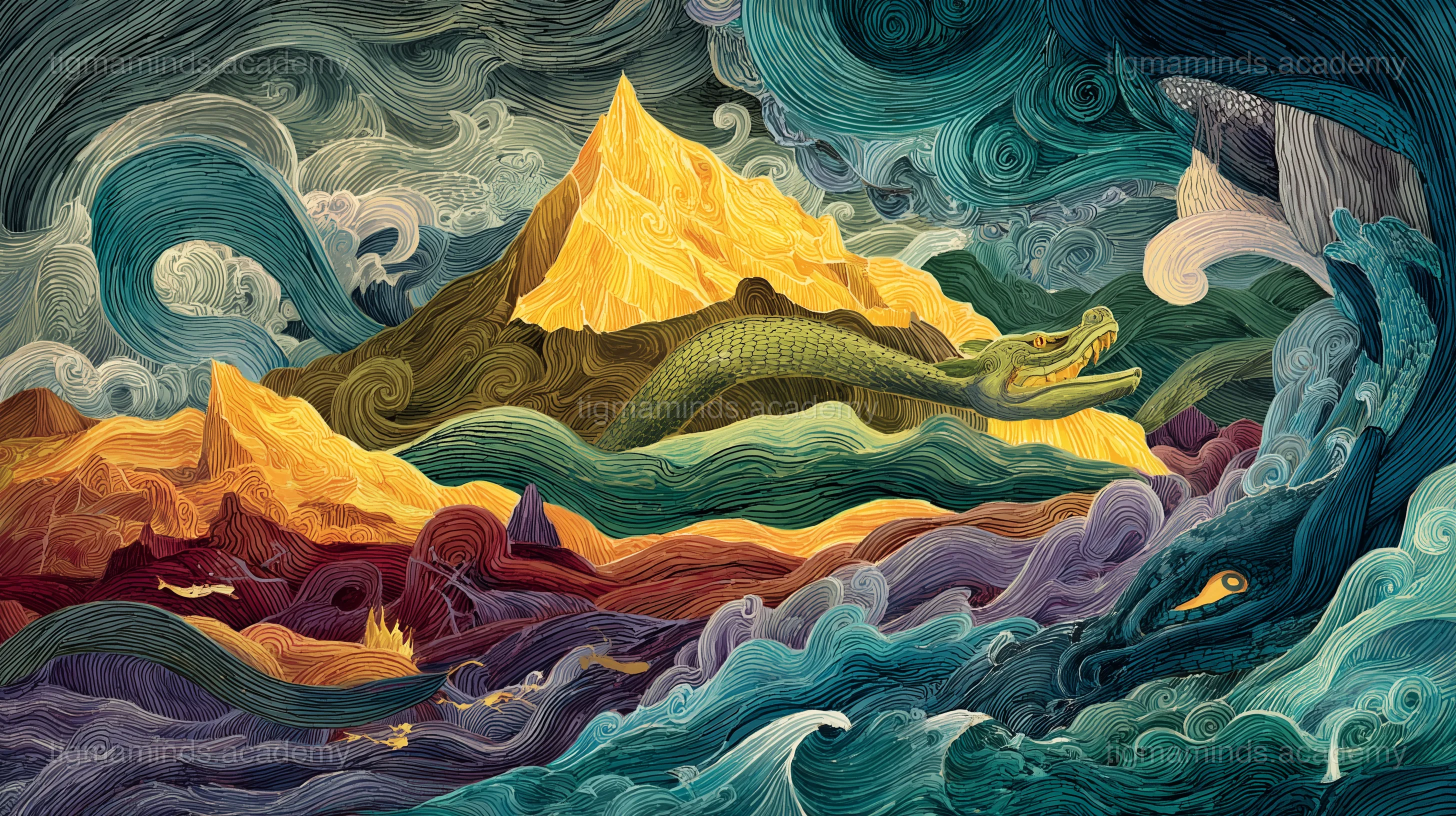
For the rod, they uprooted Mount Mandara, the tallest mountain in creation, and set it upright in the middle of the ocean. For the rope, they asked Vasuki, the great serpent king, to wrap himself around the mountain. The Devas held Vasuki's tail. The Asuras held his head.
But when they began to pull, the mountain started sinking. It was too heavy. It drilled into the ocean floor like a pestle with no mortar.
That is when Vishnu appeared in the form of a giant tortoise — Kurma — and dove beneath the mountain. His broad, curved shell became the base, the pivot point on which Mount Mandara could spin without sinking.
The churning began.
What Rose from the Depths
The Devas pulled one way. The Asuras pulled the other. Mount Mandara spun, and the ocean of milk began to foam and swirl. The force was tremendous — imagine every river, every waterfall, every wave on Earth combined into one colossal whirlpool.
And from this churning, things began to rise.
First came Halahala, a poison so terrible that its fumes darkened the sky and its touch could destroy all creation. The Devas and Asuras recoiled in terror. No one could contain it. The poison spread across the surface of the churning ocean, killing everything it touched.
In desperation, they called upon Shiva. The great god came, looked at the poison, and did something no one else would dare: he drank it. His wife Parvati pressed her hand against his throat to stop the poison from reaching his stomach. The poison stayed in his throat, turning it blue. From that day, Shiva was called Neelakantha — the blue-throated one.
With the poison contained, the churning continued. And now, wondrous things emerged: Kamadhenu, the wish-fulfilling cow. Airavata, the white elephant. Lakshmi, the goddess of wealth, who rose from the foam on a lotus flower. Dhanvantari, the physician of the gods, carrying the science of healing.
And finally — Dhanvantari emerged again, this time holding a golden pot containing Amrit, the nectar of immortality.
The Scramble
The moment the nectar appeared, the truce collapsed. The Asuras lunged for the pot. Vishnu intervened, taking the form of Mohini, and distributed the nectar to the Devas.
One Asura, Svarbhanu, had disguised himself and managed to take a sip. The Sun and Moon spotted him and alerted Vishnu, who severed Svarbhanu's head with his discus. But the nectar had already touched his throat. His head became Rahu and his body became Ketu — and to this day, they chase the Sun and Moon across the sky, swallowing them briefly during eclipses.
The Lesson of the Churning
The Samudra Manthan teaches that great treasures require great effort. That poison comes before nectar — you must face difficulty before reward. That cooperation between rivals can achieve what neither side can do alone.
And for a science student, the story is a goldmine. An ocean of milk being separated into layers. Poison and nectar as products of the same process. A mountain spinning on a tortoise shell — a lever on a pivot. Density, separation, chemical reactions, fluid dynamics — the science of churning is the science of how our world works.
The end.
Choose your level. Everyone starts with the story — the code gets deeper as you go.
Here is a taste of what Level 1 looks like for this lesson:
# Density Layer Calculator
liquids = {
"honey": {"density": 1.42, "color": "amber"},
"dish soap": {"density": 1.06, "color": "green"},
"water": {"density": 1.00, "color": "blue"},
"cooking oil": {"density": 0.92, "color": "yellow"},
"rubbing alcohol": {"density": 0.79, "color": "clear"},
}
layers = sorted(liquids.items(), key=lambda x: x[1]["density"], reverse=True)
print("=== Your Density Column ===")
for i, (name, info) in enumerate(layers):
print(f"Layer {i+1}: {name} ({info['density']} g/cm³)")
object_density = 1.1 # grape
for i, (name, info) in enumerate(layers):
if object_density >= info["density"]:
print(f"Grape floats on {name}!")
breakThis is just the first of 6 coding exercises in Level 1. By Level 4, you will build: Build a Density Layer Simulator.
By Level 4, enrolled students build: Build a Density Layer Simulator
Free
Level 0: Listener
Stories, science concepts, diagrams, quizzes. No coding.
You are here
Level 0 is always free. Coding levels (1-4) are part of our 12-Month Curriculum.
The real-world science behind the Samudra Manthan — density, emulsions, chemical reactions, and industrial separation.
The big idea: "The Churning of the Ocean" teaches us about Chemistry & Fluid Dynamics — and you don't need to write a single line of code to understand it.
You have probably made a milkshake. You pour milk into a glass, add a scoop of ice cream, and blend. Before blending, the ice cream sits in a lump and the milk flows around it — two separate things. After blending, you get a smooth, creamy liquid where you cannot see the milk or the ice cream separately anymore. They have become an emulsion — a mixture where tiny droplets of one substance are suspended inside another.
Now try something different. Pour some cooking oil into a glass of water and stir hard. For a moment, the oil breaks into tiny droplets and the whole glass looks cloudy. But wait thirty seconds. The oil floats back to the top. The water sinks to the bottom. They refuse to stay mixed. Oil and water are not friends — their molecules are built differently. Water molecules are polar (they have a positive end and a negative end, like tiny magnets). Oil molecules are non-polar (no charge difference). Polar and non-polar molecules do not attract each other, so they separate.
This is exactly what churning does. When the Devas and Asuras churned the ocean of milk, they were applying mechanical force to a mixture — spinning, pulling, shearing. In real life, churning milk separates it into butter (fat) and buttermilk (water-based). The fat globules in milk are normally suspended as an emulsion, held in place by a thin membrane. Churning smashes those membranes, letting the fat globules clump together. The result: a fat layer (butter) floating on top of a watery layer (buttermilk).
Check yourself: If you shake a bottle of salad dressing (oil + vinegar), it looks mixed. But if you leave it on the table for five minutes, what happens? Why?
Key idea: Churning applies mechanical force to a mixture, breaking emulsions apart. Oil and water separate because their molecules are fundamentally different — polar water molecules cluster together and push non-polar oil molecules away.
Drop a grape into a glass of water. It sinks. Now drop a cork into the same glass. It floats. Both objects are small, both are solid — so why the difference? The answer is density, which means how much mass is packed into a given volume. The grape is denser than water (more stuff per cubic centimetre), so it sinks. The cork is less dense than water, so it floats.
Here is the rule, and it never fails: if an object is denser than the liquid it is placed in, it sinks. If it is less dense, it floats. Water has a density of 1.0 g/cm³. A grape is about 1.1 g/cm³ — just barely denser, so it sinks slowly. A cork is about 0.2 g/cm³ — much less dense, so it bobs right to the surface.
This principle was discovered by Archimedes over 2,000 years ago. Archimedes' principle says: any object in a fluid experiences an upward push — called buoyancy — equal to the weight of the fluid it displaces. If the buoyant push is greater than the object's weight, the object floats.
In the Samudra Manthan, Mount Mandara was sinking because rock is much denser than the ocean of milk. Kurma (the tortoise avatar) provided a base to stop the sinking. In real chemistry, when you create a density column by carefully layering liquids of different densities (honey at the bottom, water in the middle, oil on top), objects placed in the column float at the level where their density matches the surrounding liquid.
Try this: Fill a tall glass with three layers — honey, water (add food colouring), and cooking oil. Now drop in a grape, a piece of cork, and a coin. Each one stops at a different level. You have built a density column.
Key idea: Density is mass per unit volume. Objects sink in fluids less dense than themselves and float in fluids denser than themselves. Archimedes' principle explains buoyancy: the upward push equals the weight of fluid displaced.
Access all 130+ lessons, quizzes, interactive tools, and offline activities
The churning produced two extreme substances: **Halahala** (a deadly poison) and **Amrit** (a life-giving nectar). In chemistry, we also deal with sub...
The Samudra Manthan produced many treasures from one ocean. Modern industry does something remarkably similar: it takes **crude oil** — a dark, smelly...