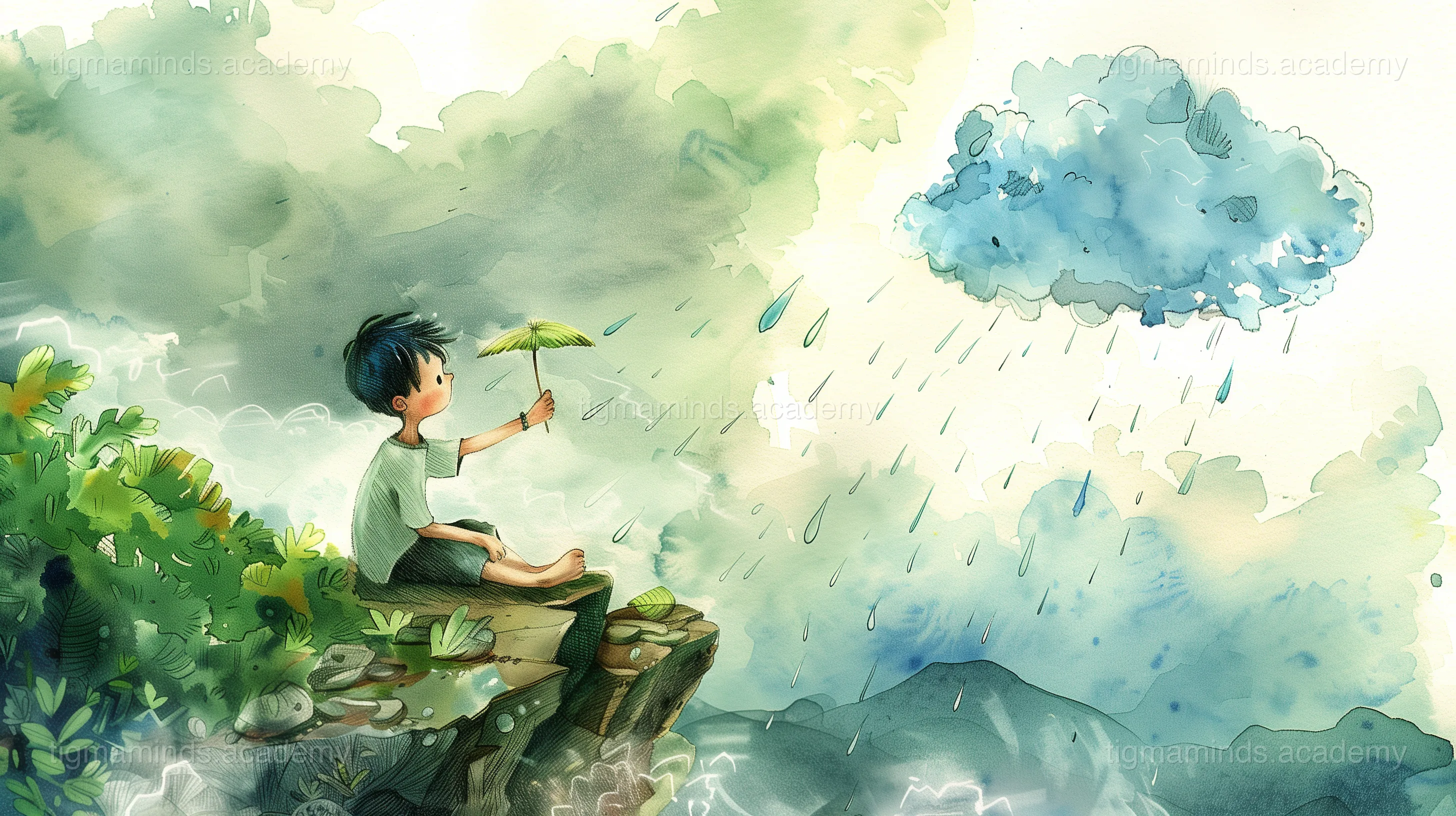
In Cherrapunji, where it rains more than anywhere on Earth, a boy discovers why clouds are always giving.
The Wettest Place on Earth
Mawsynram, in the Khasi Hills of Meghalaya, holds the record for the wettest place on earth. It rains there more than anywhere else — not just drizzle, but great, dramatic, earth-shaking rain that turns every path into a river and every hillside into a waterfall. The people of the Khasi Hills have more words for rain than most people have for anything.
In Mawsynram lived a child named Bah Dawan, who was eight years old and fascinated not by the rain but by what came before it: the clouds.
The Naming Begins
While other children ran from the rain or played in it, Dawan sat on the stone wall behind his house and watched the clouds gather. He watched them every day, and he noticed that no two clouds were alike.
There were fat, slow clouds that moved like lazy buffalo across the sky. There were thin, wispy clouds that raced like scared rabbits. There were dark, angry clouds that growled with thunder, and small, white, innocent clouds that wouldn't hurt a fly but somehow always brought the heaviest rain.
"That one looks grumpy," Dawan said one morning, pointing at a dark mass building over the valley.
"That's just a rain cloud," said his mother.
"His name is Bah Rum," said Dawan. "He's grumpy because the wind woke him up too early. He'll rain hard for an hour and then fall asleep."
His mother laughed. But an hour later, Bah Rum poured rain on the village for exactly one hour, then drifted away and dissolved into a sunny afternoon. Dawan nodded as if this were perfectly obvious.
The Cloud Family
Over the following months, Dawan named dozens of clouds. He kept a notebook — a battered school exercise book — in which he drew each cloud and wrote its name and personality.
Kong Lynshing was a wide, flat cloud that always arrived from the south. She brought gentle, steady rain that was good for the rice paddies. Bah Bneng was a tall, towering cloud that came in the afternoon and brought thunder and lightning but very little rain — all noise and no water, like an uncle who talks too much at dinner.
Ka Lum was a tiny, bright white cloud that appeared on clear days. She was shy and always stayed at the edge of the sky. But whenever she appeared, Dawan knew that big rain was coming within two days — because Ka Lum was a scout, sent ahead by the storm to check if the valley was ready.
"How do you know all this?" asked his schoolteacher, amazed when Dawan correctly predicted three days of rain followed by two days of sunshine.
"The clouds told me," said Dawan. "You just have to learn their names."
The Village Weather Predictor
Word spread through the village. Farmers began asking Dawan when to plant and when to harvest. Fishermen asked him when the river would flood. Mothers asked him when to hang out washing.
Dawan would look at the sky, study the clouds, and give his answer — not in scientific terms, but in the language of his cloud family. "Kong Lynshing is coming tomorrow, so the rice fields will be happy. But Bah Bneng might visit in the evening, so bring the washing in by four."
He was right more often than the radio forecast. The radio talked about pressure systems and fronts. Dawan talked about clouds as if they were neighbours, and somehow that worked better.
The Secret
One day, a weather scientist from Shillong visited the village. She had heard about the child who predicted weather better than satellites and wanted to understand how.
Dawan showed her his notebook. Page after page of cloud drawings, each with a name, a personality, and notes about what kind of rain it brought. The scientist studied them carefully.
"You know," she said slowly, "what you've done is create a classification system. These 'personalities' you've given the clouds match real meteorological patterns. Your 'grumpy' clouds are cumulonimbus formations. Your 'shy scouts' are early convection indicators. You've been doing science without knowing it."
"I've been paying attention," said Dawan. "That's not the same as science. Science looks at the sky and sees data. I look at the sky and see friends."
The scientist smiled. "Maybe," she said, "the best science starts with friendship."
The Clouds Remember
Dawan grew up in Mawsynram, where it still rains more than anywhere on earth. He never became a scientist or a meteorologist. He became a farmer, like his parents, planting his crops by the rhythm of the clouds he had named as a child.
And every morning, he still sits on the stone wall behind his house and watches the sky. When a familiar shape appears on the horizon, he smiles and says, "Good morning, Kong Lynshing," or "Ah, Bah Rum, back so soon?"
The clouds, of course, don't answer. But Dawan is certain they appreciate being noticed. After all, how would you feel if you crossed the whole sky and nobody even looked up?
The end.
Choose your level. Everyone starts with the story — the code gets deeper as you go.
Here is a taste of what Level 1 looks like for this lesson:
# How much water is hiding in a cloud?
# Let's calculate the mass of a cumulus cloud
cloud_volume_m3 = 1e9 # 1 cubic kilometre = 1 billion m³
droplet_density = 0.3e-3 # 0.3 grams of water per m³ of cloud
water_mass_kg = cloud_volume_m3 * droplet_density / 1000
print(f"Cloud volume: {cloud_volume_m3:.0e} m³")
print(f"Water mass: {water_mass_kg:,.0f} kg")
print(f"That's {water_mass_kg / 1000:,.0f} tonnes!")
print(f"Or about {water_mass_kg / 2500:.0f} Olympic pools")
# Why doesn't it fall? Because each droplet is
# only 10-20 micrometres across — so light that
# a gentle breeze of 1 cm/s keeps it floating.This is just the first of 6 coding exercises in Level 1. By Level 4, you will build: Build a Weather Station.
By Level 4, enrolled students build: Build a Weather Station
Free
Level 0: Listener
Stories, science concepts, diagrams, quizzes. No coding.
You are here
Level 0 is always free. Coding levels (1-4) are part of our 12-Month Curriculum.
Why does Cherrapunji get 12,000mm of rain per year? How do clouds form, travel, and release water? This lesson explores weather science through the wettest place on Earth.
The big idea: "The Boy Who Talked to Clouds" teaches us about Meteorology & Climate — and you don't need to write a single line of code to understand it.
Dawan watched clouds every day in Mawsynram. But where did they come from? Let’s build the answer from the ground up — starting with a puddle. After rain, you see puddles on the road. A few hours later, the puddles are gone. Nobody mopped them up. The water didn’t sink into the tarmac. It evaporated — the sun’s heat gave the water molecules enough energy to break free from the liquid surface and float into the air as water vapour, which is completely invisible. You cannot see water vapour. If you can see it, it’s not vapour — it’s already tiny droplets.
Now, warm air rises (you feel this when hot air balloons go up, or when heat shimmers above a road). As this vapour-laden air rises, it enters regions of lower pressure, so it expands and cools. Here’s the key number: air cools about 6.5°C for every 1 000 metres it climbs. Eventually, the air cools to a temperature called the dew point — the temperature where the air simply cannot hold its moisture as invisible vapour any more. Try to predict: On a humid day versus a dry day, which will have a lower cloud base — and why? (Hint: think about when the air reaches its dew point.)
At the dew point, the vapour is ready to condense. But it needs a surface to condense on. These surfaces are tiny particles floating in the air — dust, pollen, sea salt, even pollution — called condensation nuclei. The vapour latches onto these specks and forms minuscule water droplets, each only about 10–20 micrometres across (one-tenth the width of a hair). Billions of these droplets together make a visible cloud. Check yourself: A cloud that weighs 500 000 kg is floating in the sky. How? Because each droplet is so tiny that even the gentlest upward breeze keeps it suspended. Rain only forms when droplets collide and merge until they’re about 100 times bigger — heavy enough to fall.
Key idea: Clouds form when the sun evaporates water, the vapour rises and cools to its dew point, and condenses on tiny dust particles into billions of droplets too small to fall.
Dawan named his clouds by personality: "grumpy Bah Rum," "shy scout Ka Lum." Scientists do something similar — they classify clouds by shape and height, using Latin names invented by Luke Howard in 1802. The four families you need to know are:
Prediction exercise: Right now (or next time you’re outside), look at the sky. Can you identify which family the clouds belong to? Here’s a quick test: If cumulus clouds are growing taller as the afternoon goes on, what weather might follow by evening?
The weather scientist who visited Dawan was amazed because his "personalities" matched real meteorological categories. He had independently invented a classification system through pure observation. This is exactly how science works — before instruments, farmers and sailors worldwide developed cloud-reading skills that kept them alive. Modern meteorology uses the same core observations; the difference is scale and precision, not principle.
Key idea: Cirrus (high, wispy) warns of rain in 1–2 days. Cumulus (puffy) means fair weather unless it grows tall. Stratus (flat sheet) brings drizzle. Cumulonimbus (towering) means storms.
Access all 130+ lessons, quizzes, interactive tools, and offline activities
Clouds are not a one-time event — they’re part of a continuous engine that has been running for billions of years. Here’s the full loop, step by step:...
Dawan predicted weather better than the radio. How? He observed the same sky every day for months, building a personal database of patterns. Modern fo...