
A village boy with no books builds a bamboo library that changes his village forever.
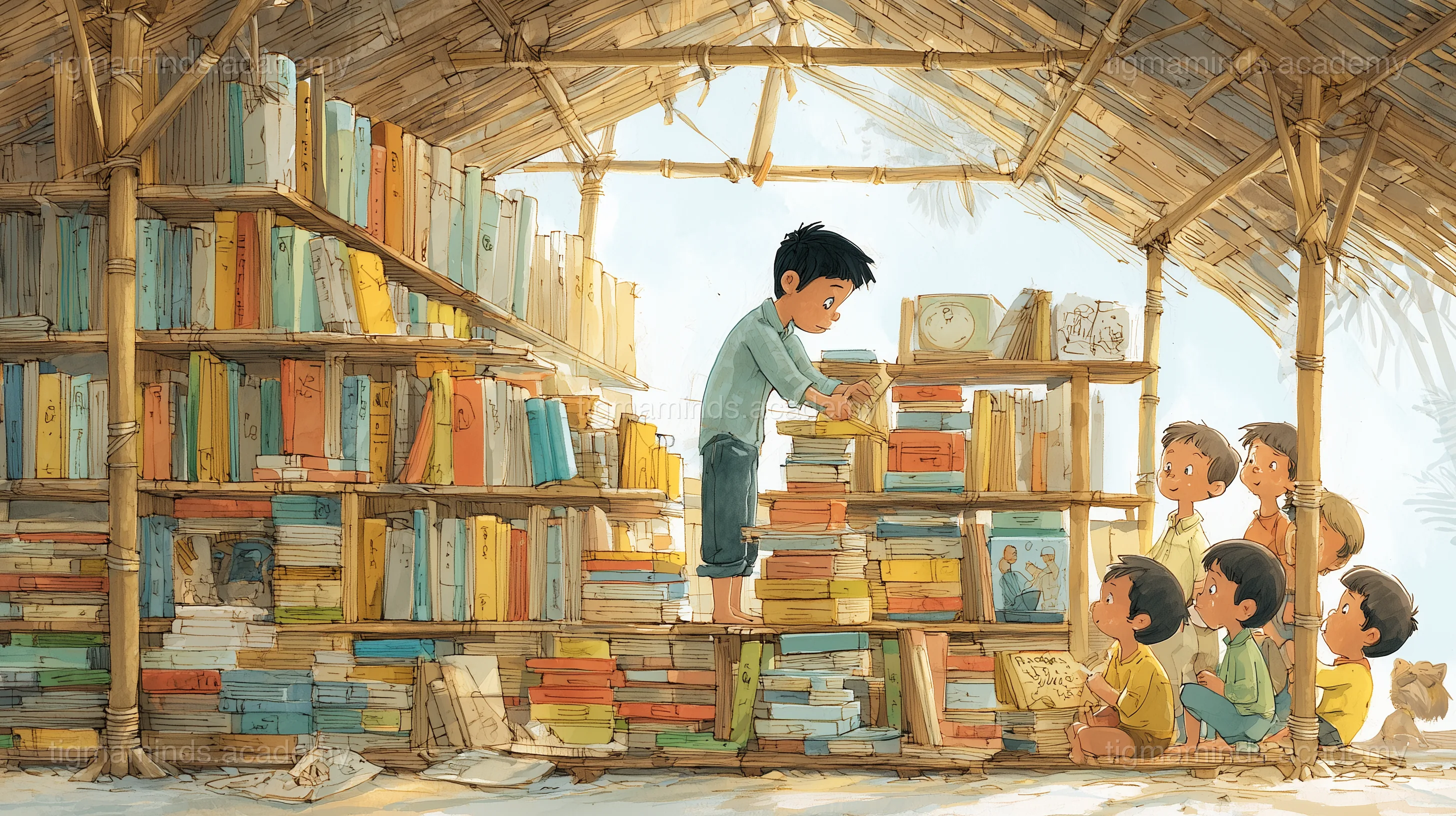
The Empty Shelf
In a village called Bhalukpara, tucked between tea gardens and rice paddies in lower Assam, there lived a boy named Dipankar who loved reading more than anything in the world. The problem was, he had nothing to read.
His school had one textbook per class, shared among forty students. There was no library, no bookshop, not even a newspaper that reached Bhalukpara regularly. The nearest proper library was in Bongaigaon, two bus rides away.
Dipankar had built a shelf from bamboo strips and hung it on the wall of his room. It was perfectly made — smooth, level, with little carved notches to hold books upright. But the shelf was empty.
"One day," Dipankar told himself every morning, "I will fill that shelf."
The City Trip
When Dipankar was twelve, his uncle took him to Guwahati for a cousin's wedding. The city was loud and overwhelming, but Dipankar only had eyes for one thing: books. They were everywhere — in shops, in stalls, stacked on pavements, stuffed in rubbish bins.
Rubbish bins. Dipankar stopped. Outside a college hostel, a bin overflowed with old textbooks, dog-eared novels, and torn magazines. Students were throwing them away — moving out, making space, discarding what they no longer needed.
Dipankar's heart hammered. "Uncle," he said, "can I have a big bag?"
For three days, while his family celebrated the wedding, Dipankar walked the streets of Guwahati with a jute sack. He collected books from bins, from pavement stalls that sold old stock by weight, from a kind librarian at Cotton University who gave him a box of deaccessioned novels. By the time the wedding was over, Dipankar had sixty-three books and two very sore shoulders.
The Bamboo Library
Back in Bhalukpara, Dipankar didn't just fill his shelf. He had too many books for one shelf. He had too many for one room. So he decided to build a library.
His father helped him cut bamboo from the grove behind their house. His mother stitched old cloth into curtains to keep out the rain. His grandmother donated a tin trunk for storage. Together, they built a small structure — open on one side like a chang ghor — next to the village path where everyone walked to the market.
Dipankar arranged the books by colour, since many had lost their covers and he couldn't always sort by author. He wrote a sign in neat handwriting: "Bhalukpara Pustok Ghor — Take a book, bring it back, tell a friend."
On the first day, nobody came. On the second day, a girl named Rina stopped and picked up a book of Assamese folktales. On the third day, three children came. By the end of the month, the bamboo library had fourteen regular readers.
The Growing Collection
Word spread. A teacher in Bongaigaon heard about the bamboo library and sent a carton of old textbooks. A journalist from Kokrajhar wrote a small story in the local paper. A college student read the story and mailed twenty paperback novels. Slowly, the sixty-three books became a hundred, then two hundred.
Dipankar kept meticulous records in a notebook — who borrowed what, when it was returned, which books were most popular. The folktales were always first to go. The science books took longer but came back with more questions.
The Full Shelf
By the time Dipankar was fifteen, the bamboo library had over five hundred books, a reading corner with a jute mat, and a waiting list. Children from two neighbouring villages walked through the tea gardens to borrow books. Rina, the first reader, had become the assistant librarian.
One evening, Dipankar stood in his room and looked at the bamboo shelf on his wall — the one he had built when he had nothing. It was still there, still perfectly made, still holding books upright with its little carved notches. But it was no longer the most important shelf in the village.
"I didn't really build a library," Dipankar told his mother. "The books were thrown away by other people. The bamboo was already growing. Rina does half the work now."
His mother smiled. "You didn't build it from nothing, Dipankar. You built it from caring. That's harder than bamboo."
The end.
Choose your level. Everyone starts with the story — the code gets deeper as you go.
Here is a taste of what Level 1 looks like for this lesson:
<!-- Your first web page! Save as index.html and open in a browser -->
<html>
<body>
<h1>Bhalukpara Pustok Ghor</h1>
<p>Take a book, bring it back, tell a friend.</p>
<ul>
<li>Folktales of Assam</li>
<li>Science Class 8</li>
</ul>
<button>Search Books</button>
</body>
</html>This is just the first of 6 coding exercises in Level 1. By Level 4, you will build: Build a Community Library App.
By Level 4, enrolled students build: Build a Community Library App
Free
Level 0: Listener
Stories, science concepts, diagrams, quizzes. No coding.
You are here
Level 0 is always free. Coding levels (1-4) are part of our 24-Week Bootcamp.
Dipankar built a physical library from discarded materials. You'll build a digital one — a full web application that catalogs books, tracks readers, and grows with its community.
The big idea: "The Boy Who Built a Library" teaches us about Web Development & Databases — and you don't need to write a single line of code to understand it.
When Dipankar built his bamboo library, he needed three things: a structure (the bamboo shelves), a style (the cloth curtains and hand-painted sign), and behaviour (the rules — take a book, bring it back, tell a friend). Websites work exactly the same way, except the three things are three languages that every browser on Earth understands.
HTML (HyperText Markup Language) is the structure. It tells the browser what is on the page: headings, paragraphs, images, buttons, lists. You write it using "tags" — little labels wrapped in angle brackets. For example, `
Take a book, bring it back.
` creates a paragraph.CSS (Cascading Style Sheets) is the style. It tells the browser how things look: what colour the heading is, how much space there is between the shelves, what font the sign uses. CSS does not change the content — it changes the appearance.
JavaScript is the behaviour. It makes things happen: when you click the "Search" button, JavaScript filters the book list. When you type in the search bar, JavaScript updates results as you type. Without JavaScript, websites would be static posters.
Key idea: Every website uses three languages: HTML for structure (what is on the page), CSS for style (how it looks), and JavaScript for behaviour (what happens when you click).
Dipankar kept a notebook tracking who borrowed which book and when. That notebook was a database — organized information you can search and update. A digital database works the same way, but a computer can search millions of entries in milliseconds.
Think of a database as a collection of tables, where each table is dedicated to one type of thing. A "Books" table has one row per book, with columns for title, author, genre, and availability. A "Borrowers" table has one row per reader. A "Loans" table connects them: book_id, borrower_id, borrow date, return date.
The power is in the connections. If Rina borrows "Folktales of Assam," the Loans table stores her borrower_id and the book's book_id. Now the system can answer any question: "Which books has Rina borrowed?" "Who currently has the science textbook?" "Which genre is most popular?"
Prediction: If Dipankar had 500 books and 47 readers, roughly how many rows would the Loans table have after one year? The Loans table grows much faster than the other two — it records every single transaction.
Key idea: A database organizes data into connected tables — one per "thing" (books, readers, loans). Connections between tables let you answer complex questions without duplicating information.
Access all 130+ lessons, quizzes, interactive tools, and offline activities
When you visit a website, your browser never talks to the database directly. That would be like letting restaurant customers walk into the kitchen. In...
Dipankar did not just collect books — he built a **system**. A sign, a notebook for tracking loans, a physical layout sorted by colour. Every one of t...