
A boy on a bicycle tries to outrun the mightiest river in the Northeast.
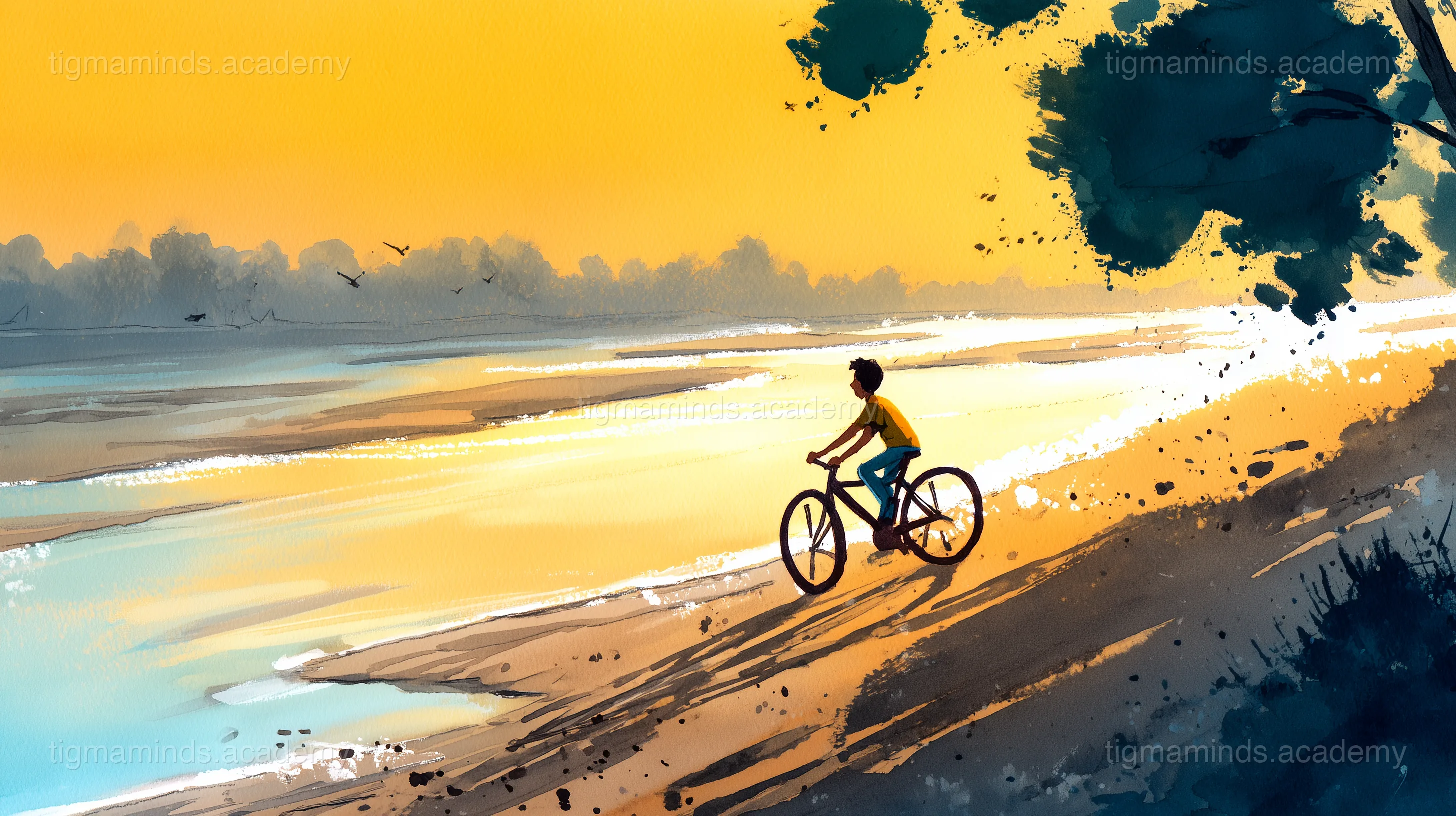
The Boy Who Raced the Brahmaputra
The Challenge
The trouble started with a bet. Rupam, who was thirteen and thought he was the fastest cyclist in Tezpur, told his friends he could beat the Brahmaputra.
"You can't race a river," said his friend Biren.
"Watch me," said Rupam.
The plan was simple: Rupam would ride his bicycle along the river road from the Kolia Bhomora Bridge to the Saraighat Bridge in Guwahati — roughly one hundred and eighty kilometres. The Brahmaputra would flow the same distance. Whoever got to Saraighat first would win.
"The river doesn't even know it's racing," said Biren.
"That's my advantage," said Rupam, grinning.
The First Fifty Kilometres
Rupam started at dawn. The river road was flat and smooth, lined with paddy fields still wet from the night's dew. He pedalled hard, his legs pumping like pistons, the wind in his hair and the Brahmaputra glinting silver to his left.
For the first hour, he felt like he was winning. The river seemed slow — a lazy brown giant, barely moving. Rupam whooped and pedalled faster.
But the Brahmaputra has a secret. It looks slow because it is wide. The current near the surface barely moves, but underneath — where the water is deep and dark — it flows with enormous, silent power. The river was not racing. It was strolling. And it was still keeping up.
The Middle
By noon, Rupam's legs were burning. He had covered eighty kilometres, but the sun was brutal, his water bottle was empty, and the road had turned from smooth tar to broken gravel. He stopped at a roadside tea stall and drank three cups of red tea while staring at the river.
The Brahmaputra hadn't stopped. It hadn't rested. It hadn't drunk tea. It just flowed — steady, unhurried, unstoppable.
"You're losing," said the tea-stall owner, who had been watching Rupam's slow progress. "The river passed here an hour ago."
"The river is always here," Rupam said, confused.
"Exactly," said the old man, pouring another cup. "The river is always everywhere along its length. You can't outrun something that's already where you're going."
The Last Push
Rupam pedalled on, slower now. His grand race had become a long, humble ride. The road followed the river through villages where children waved, past temples where bells rang for evening prayers, through stretches of wild forest where monkeys watched from the trees.
He reached the outskirts of Guwahati at sunset. The Saraighat Bridge appeared in the distance, its steel arches glowing orange in the dying light. The Brahmaputra flowed beneath it, wide and calm, as if it had been waiting there all day.
Rupam leaned his bicycle against the bridge railing and looked down at the water. He had lost. The river had won — not by being faster, but by being constant. It didn't sprint. It didn't stop. It just flowed, all day, every day, forever.
What Rupam Won
Rupam rode home on the bus, his bicycle strapped to the roof. He was sunburned, exhausted, and his legs ached for a week. But he had seen things he'd never noticed before — the way the river changed colour from blue to brown to gold as the day passed. The villages that lived and breathed by its rhythm. The fishermen who knew the river's moods the way a friend knows your face.
"Did you win?" asked Biren when Rupam got home.
"No," said Rupam. "The river won. But I saw a hundred and eighty kilometres of Assam that I'd never seen before. I met people. I drank tea at places I didn't know existed. I watched the sunset from the Saraighat Bridge."
He paused. "I lost the race, but I think I won the ride."
Among the people of Assam, the Brahmaputra is not just a river. It is a teacher. And sometimes the best lesson it teaches is this: you don't have to be the fastest. You just have to keep flowing.
The end.
Choose your level. Everyone starts with the story — the code gets deeper as you go.
Here is a taste of what Level 1 looks like for this lesson:
import numpy as np
import matplotlib.pyplot as plt
# Your first data analysis with Python
data = [45, 52, 38, 67, 41, 55, 48] # measurements
mean = np.mean(data)
plt.bar(range(len(data)), data)
plt.axhline(mean, color='red', linestyle='--', label=f'Mean: {mean:.1f}')
plt.xlabel("Sample")
plt.ylabel("Value")
plt.title("Biomechanics & River Physics — Sample Data")
plt.legend()
plt.show()This is just the first of 6 coding exercises in Level 1. By Level 4, you will build: Race Simulation: Cyclist vs River.
Free
Level 0: Listener
Stories, science concepts, diagrams, quizzes. No coding.
You are here
Level 0 is always free. Coding levels (1-4) are part of our 12-Month Curriculum.
The science of human-powered motion versus natural forces — cycling biomechanics and river flow.
The big idea: "The Boy Who Raced the Brahmaputra" teaches us about Biomechanics & River Physics — and you don't need to write a single line of code to understand it.
When Rupam pedals his bicycle, his body converts chemical energy stored in food (glucose and fat) into mechanical energy through muscle contractions. The major muscles involved in cycling are the quadriceps (front of the thigh, which push the pedal down), hamstrings (back of the thigh, which pull the pedal up), gluteal muscles (buttocks, which provide power at the top of the stroke), and calf muscles (which stabilize the ankle). Together, these muscles work in a coordinated cycle, each activating at a specific point in the pedal rotation.
The bicycle is an ingenious force multiplier. The pedal cranks, chain, and gears form a system of levers and pulleys that converts the relatively slow, powerful motion of the legs into the faster rotation of the rear wheel. In a typical gear ratio, one full turn of the pedals produces about 2-3 turns of the rear wheel. The wheel's circumference then translates this rotation into forward distance. A cyclist can sustain roughly 75-100 watts of power output — enough to maintain 20-25 km/h on flat road.
The human body is remarkably efficient at cycling — about 25% of the energy from food is converted to mechanical work at the pedals, with the rest lost as heat. This 25% efficiency is actually quite good compared to a car engine (20-30%). However, there is a crucial limit: fatigue. As muscles work, they accumulate metabolic byproducts (lactate, hydrogen ions) and deplete glycogen stores. Over a 180 km ride, Rupam's power output would steadily decline — perhaps starting at 100 watts and dropping to 50-60 watts by the final hours. This is why the tea-stall owner was right: the river doesn't fatigue, but the cyclist does.
Key idea: Cycling converts food energy to motion through coordinated muscle groups and the bicycle's lever-and-gear system. Humans can sustain about 75-100 watts, with 25% efficiency — but fatigue steadily reduces output over long distances, a limitation the river does not share.
The Brahmaputra between Tezpur and Guwahati flows with an average surface velocity of roughly 2-4 meters per second during the monsoon (7-14 km/h). This might seem slow compared to Rupam's cycling speed of 20-25 km/h, but the tea-stall owner identified the critical difference: the river never stops. It flows 24 hours a day, 365 days a year, with no rest breaks, no fatigue, and no need for tea.
The river's power comes from gravity. The Brahmaputra drops roughly 30-50 meters in elevation between Tezpur and Guwahati (a gradient of about 0.02%, or 20 cm per kilometer). Gravity continuously pulls the water downhill, converting potential energy into kinetic energy. The total kinetic energy of the Brahmaputra's flow is staggering: with a discharge of about 20,000 m³/s (during monsoon) and a velocity of 3 m/s, the kinetic energy flow is approximately 90 million watts — equivalent to about 90 large wind turbines running simultaneously.
The difference between Rupam and the river is the difference between a battery and a power plant. Rupam carries a limited store of energy (the food he ate) and must ration it over 180 km, with declining efficiency as he tires. The river draws from an effectively limitless energy source (gravity acting on the water flowing in from its enormous watershed) and never diminishes. Over a full day, the river's consistent 3 m/s = 10.8 km/h flow covers about 260 km — easily beating a fatiguing cyclist's effective average of perhaps 15 km/h over the same period, especially when accounting for rest stops, eating, and sleeping.
Key idea: The Brahmaputra flows at 2-4 m/s powered by gravity acting on its vast watershed, with total kinetic energy equivalent to 90 million watts. Unlike a cyclist who fatigues, the river never stops — consistent slow speed beats intermittent fast speed over long distances.
Access all 130+ lessons, quizzes, interactive tools, and offline activities
Rupam's race illustrates a fundamental principle of endurance science: **consistent moderate effort outperforms inconsistent maximum effort** over lon...
The Antagonist Pair