The Bodhi Tree That Never Dies
Plant Biology & Cloning

The Bodhi Tree That Never Dies

A sacred fig tree, a branch carried across the sea, and the science of making life identical.
Plant Biology & Cloning12-Month Curriculum 10h

The Story

The Tree of Awakening

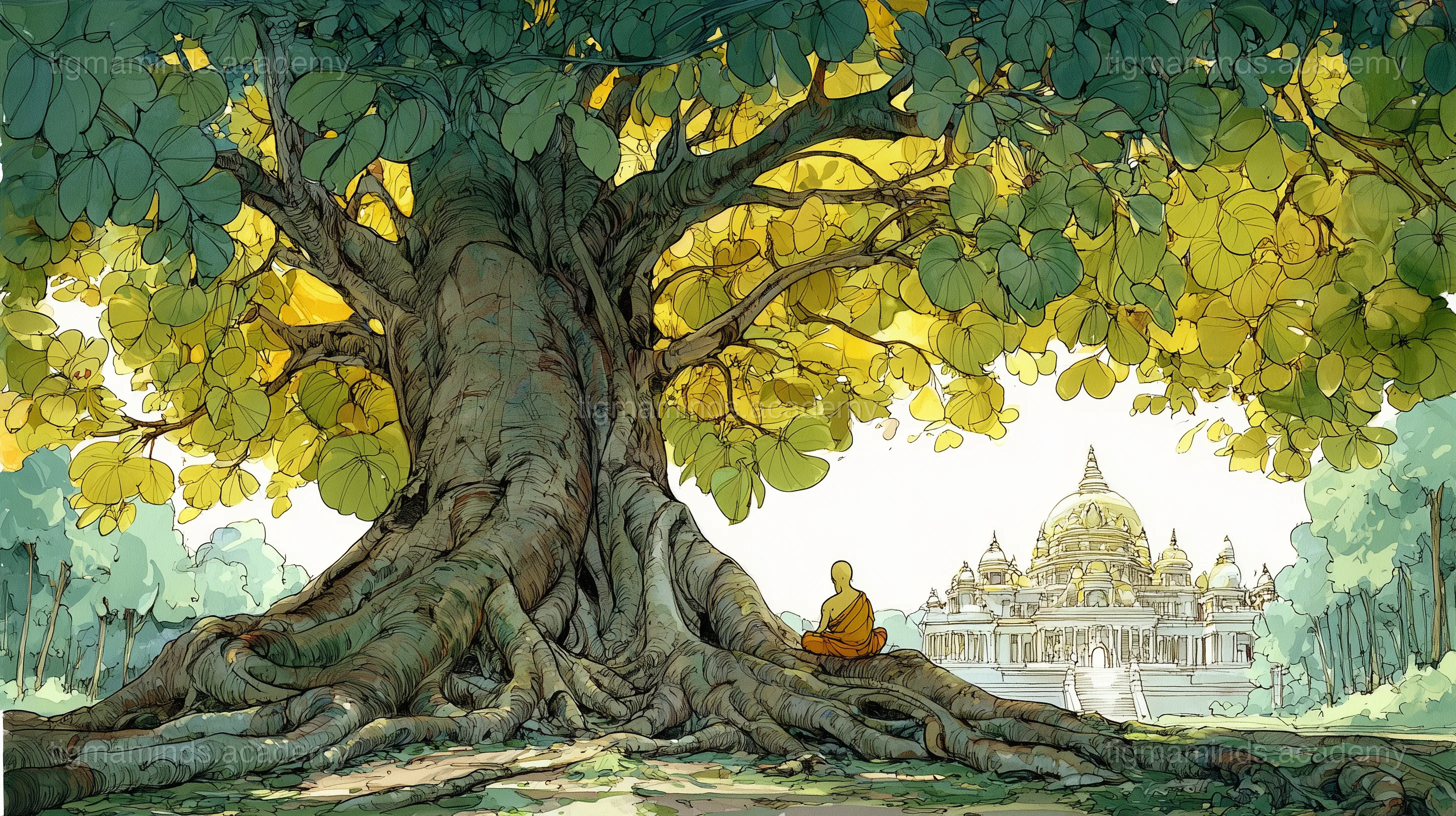
In the year 528 BCE, in a town called Bodh Gaya in northern India, a man named Siddhartha Gautama sat down beneath a large fig tree. He had been wandering for six years, searching for an end to suffering. He had tried fasting until his ribs showed. He had tried meditation until his mind went silent. Nothing had worked.

That night, under the spreading branches of a Ficus religiosa — a sacred fig — he sat in stillness and vowed not to rise until he understood the nature of existence. By dawn, he had attained enlightenment. He became the Buddha, the Awakened One. And the tree became the Bodhi Tree — the tree of awakening.

For centuries, the Bodhi Tree stood in Bodh Gaya. Pilgrims came from across Asia to meditate beneath its branches. It was not just a symbol — it was a living connection to that dawn of understanding.

But trees do not live forever. Storms come. Droughts come. Wars come. And the people who loved the Bodhi Tree knew they could not trust fate to preserve it.

The Branch That Crossed the Sea

In the 3rd century BCE, about 250 years after the Buddha's enlightenment, Emperor Ashoka of India sent his daughter Sanghamitta on a mission to Sri Lanka. She was a Buddhist nun, and she carried with her something more precious than gold: a cutting from the Bodhi Tree.

Not a seed. A cutting — a living branch, carefully wrapped and kept moist during the long sea journey from India to the island of Sri Lanka.

Why a cutting instead of a seed? Because a seed is a gamble. A seed carries genes from two parents, mixed and recombined. The tree that grows from a seed is a new individual — similar to its parents but not identical. It might be taller, shorter, more or less resistant to drought. It is its own self.

A cutting is different. A cutting is a piece of the original tree. When you plant it and it grows roots and new leaves, every cell in the new tree carries exactly the same DNA as the parent. The new tree is not the child of the Bodhi Tree. It is the Bodhi Tree — the same genetic individual, growing in a new place.

Sanghamitta knew this, in the way that ancient farmers knew it long before the word DNA existed. When you want the exact same mango — the same sweetness, the same size — you do not plant a seed. You take a branch and graft it. You take a cutting and root it. You clone it.

The Sri Maha Bodhi

The cutting was planted in the ancient capital of Anuradhapura in Sri Lanka. It took root and grew into a magnificent tree. Today, over 2,300 years later, it is known as the Sri Maha Bodhi, and it is considered the oldest living tree planted by a human being with a known planting date.

Generations of monks have tended it. When branches fell in storms, they planted those fallen branches — more cuttings, more clones. When the original Bodhi Tree in Bodh Gaya was destroyed (it was cut down at least three times over the centuries — by enemies of Buddhism, by storms, by neglect), cuttings from the Sri Lanka tree were sent back to India to replace it.

Think about that. The tree in Bodh Gaya today is a clone of a clone. It grew from a cutting taken from the Sri Lanka tree, which grew from a cutting taken from the original tree beneath which the Buddha sat. The DNA is the same. The genes that shaped the leaves, the bark, the roots, the pattern of branching — all identical to the tree of 528 BCE.

The Science in the Story

Every banana you eat is a clone. Every Granny Smith apple is a clone. Every navel orange, every Alphonso mango, every wine grape — clones, propagated by cuttings and grafts for decades or centuries. The Cavendish banana that fills supermarket shelves worldwide is a single genetic individual, reproduced billions of times without a seed ever being planted.

The Bodhi Tree lineage is one of the oldest documented examples of this practice. The monks of Anuradhapura were doing biotechnology 2,300 years before the word was invented.

And the science behind it raises profound questions: What does it mean for two trees, separated by an ocean and twenty-three centuries, to carry the same DNA? Is the tree in Sri Lanka the "same" tree as the one in Bodh Gaya? If you clone a tree, have you preserved it or merely copied it?

These are not just botanical questions. They are the questions of our age — the age of CRISPR, gene editing, and the possibility of cloning animals and even rewriting the code of life itself.

The Bodhi Tree offers no easy answers. But it has been asking the right questions for 2,500 years.

The end.

Try It Yourself

Choose your level. Everyone starts with the story — the code gets deeper as you go.

Story Progress

0%

Ready to Start Coding?

Here is a taste of what Level 1 looks like for this lesson:

Level 1: Explorer — Python
# Clone vs Seed Simulator
import random

# Parent tree DNA (simplified: 10 genes)
parent_dna = ['A1', 'B2', 'C1', 'D2', 'E1', 'F2', 'G1', 'H2', 'I1', 'J2']

# Clone: exact copy
clone_dna = parent_dna.copy()

# Seed: mix of two parents
parent_b = ['A2', 'B1', 'C2', 'D1', 'E2', 'F1', 'G2', 'H1', 'I2', 'J1']
seed_dna = [random.choice([parent_dna[i], parent_b[i]]) for i in range(10)]

print("Parent DNA:", parent_dna)
print("Clone DNA: ", clone_dna)
print("Seed DNA:  ", seed_dna)
print()
print(f"Clone matches parent: {sum(c == p for c, p in zip(clone_dna, parent_dna))}/10 genes")
print(f"Seed matches parent:  {sum(s == p for s, p in zip(seed_dna, parent_dna))}/10 genes")
# Run this multiple times -- the clone always matches 10/10.
# The seed varies every time. That's the difference.

This is just the first of 6 coding exercises in Level 1. By Level 4, you will build: Build a Plant Growth Simulator.

By Level 4, enrolled students build: Build a Plant Growth Simulator

Free

Level 0: Listener

Stories, science concepts, diagrams, quizzes. No coding.

You are here

Enrolled

Levels 1-4

Python, NumPy, Matplotlib, real projects, mentorship.

Sign Up Free

Stay Updated

Join Waitlist

Get notified when enrollment opens for your area.

Notify Me

Level 0 is always free. Coding levels (1-4) are part of our 12-Month Curriculum.