Why Bamboo Grows So Fast
Plant Growth Hormones & Cell Biology

Why Bamboo Grows So Fast

91cm per day — the fastest-growing plant on Earth.
Plant Growth Hormones & Cell Biology12-Month Curriculum 12h

The Story

The Argument

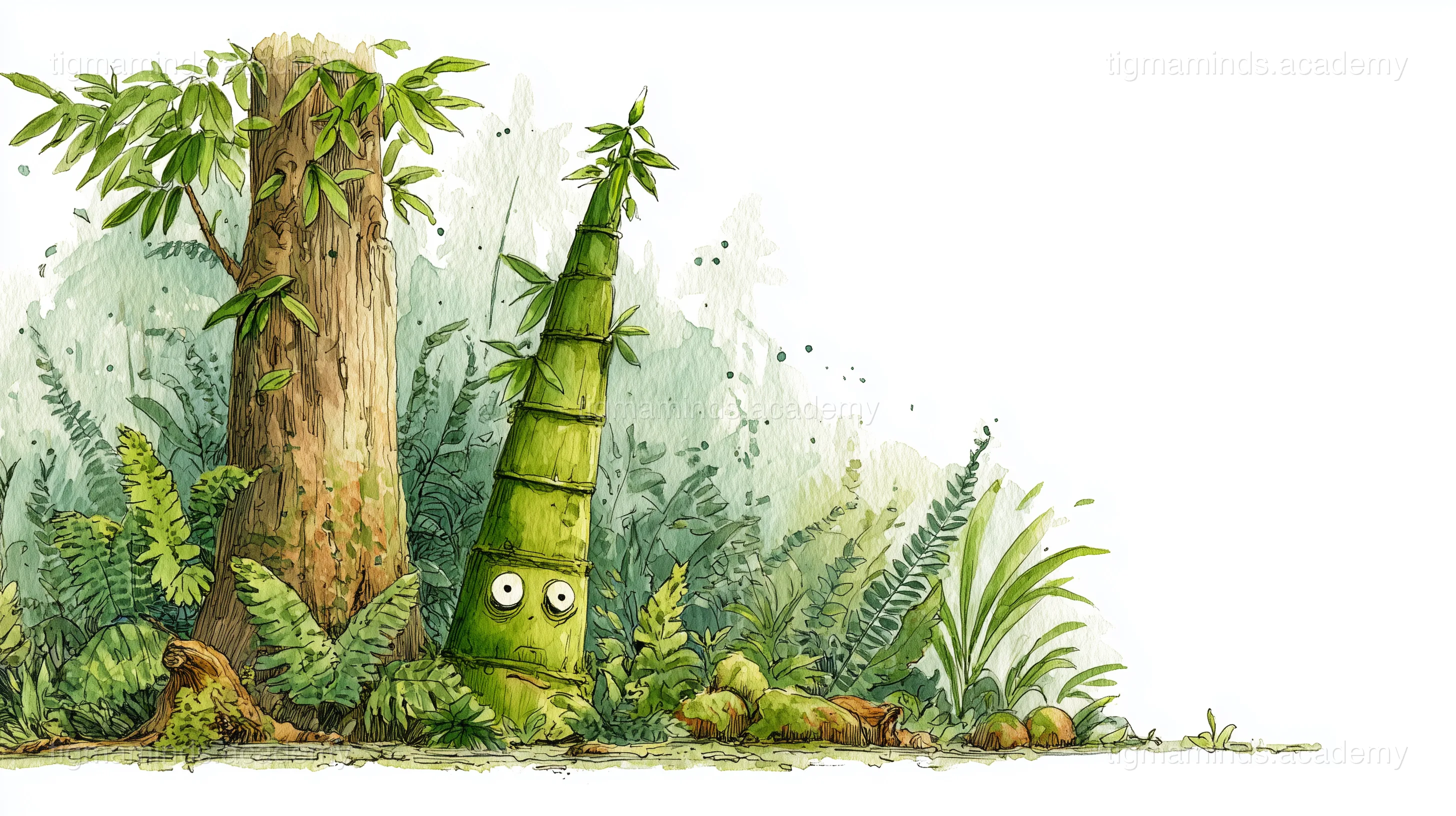
Long ago, when the forests of Northeast India were still young and the trees were still deciding what kind of tree to be, two seedlings sprouted side by side on a hillside in Assam. One was Bamboo. The other was Teak.

They grew together through the first rains, sharing the same soil, the same sun, the same monsoon water. But by the second year, they had a disagreement.

"You're growing too fast," said Teak, who had barely reached knee-height. "Your wood is thin and hollow. A strong wind will snap you in half."

"And you're growing too slow," said Bamboo, who was already taller than a man. "By the time you're useful, I'll have a whole family."

"Slow means strong," said Teak.

"Fast means free," said Bamboo.

The Bet

The old banyan tree on the hilltop, who had been listening to this argument for weeks, finally spoke up.

"Instead of arguing," said the banyan, "why don't you each grow in your own way for twenty years? At the end, we'll see which way was better."

Both agreed.

Teak went deep. She pushed her roots into the earth like anchors, growing slowly, adding one thick ring of wood each year. Her trunk grew dense and hard, her grain tight and oily, her heartwood so strong that termites couldn't eat it and rain couldn't rot it. After twenty years, she was a magnificent tree — tall, broad, and solid as stone.

Bamboo went wide. He grew fast — some days, nearly a metre in a single day. His stems were hollow but springy. When the wind blew, he bent almost to the ground and sprang back without breaking. He sent out runners underground, and within five years, he wasn't one bamboo — he was a grove, a whole community of bamboo stems, connected at the roots, supporting each other.

The Storm

In the twentieth year, a cyclone came up from the Bay of Bengal. The worst storm anyone could remember. Winds that tore tin roofs off houses and turned rivers into raging brown floods.

Teak stood firm. Her thick trunk barely moved. Her deep roots gripped the earth. When the storm passed, she had lost some branches but was otherwise untouched. She stood proud and solid, a testament to patience.

Bamboo bent. He bent so far that his tips touched the mud. The wind howled through his grove, and every stem curved like a bow being drawn. It looked, for a terrible moment, like he would snap.

But he didn't. When the wind stopped, every bamboo stem sprang back upright, shaking off the water like a dog after a bath. Not a single stem had broken.

The Banyan's Verdict

"Well?" said Bamboo. "I survived."

"So did I," said Teak.

They both looked at the old banyan tree, waiting for a verdict.

The banyan laughed — a deep, creaking sound that shook his aerial roots. "You both survived. That's the answer."

"But who won?" they asked together.

"Nobody. And everybody. Teak, you survived by being strong. You stood your ground and the storm couldn't move you. Bamboo, you survived by being flexible. You gave way to the storm and the storm couldn't break you. You chose different strategies, and both worked."

The Lesson of the Forest

From that day forward, Teak and Bamboo stopped arguing. They grew side by side on the hills of Assam, each doing what it did best. The people of Assam used teak for things that needed to last forever — bridges, houses, boats. And they used bamboo for things that needed to be built quickly and cleverly — fences, baskets, fishing rods, flutes, scaffolding, even entire homes.

And when the children of the village asked, "Which is the better tree — bamboo or teak?" the elders would smile and say, "That's like asking which is better, breathing in or breathing out. The forest needs both. And so do you. Sometimes, be strong and stand your ground. Other times, be flexible and bend with the wind. The trick is knowing which one the moment requires."

Bamboo still grows faster than almost any plant on Earth. And teak still grows slower than almost any tree in the forest. Both of them are still right.

The end.

Try It Yourself

Choose your level. Everyone starts with the story — the code gets deeper as you go.

Story Progress

0%

Ready to Start Coding?

Here is a taste of what Level 1 looks like for this lesson:

Level 1: Explorer — Python
import matplotlib.pyplot as plt
import numpy as np

# Bamboo intercalary growth: 60 nodes growing at once!
days = np.arange(0, 90)
# Logistic growth curve: fast middle, slow start/end
max_height = 30  # meters
rate = 0.08
midpoint = 40
height = max_height / (1 + np.exp(-rate * (days - midpoint)))

plt.figure(figsize=(10, 5))
plt.plot(days, height, linewidth=2, color="green")
plt.axhline(y=30, color="gray", linestyle="--", label="Max height (30m)")
plt.xlabel("Days after shoot emerges")
plt.ylabel("Height (meters)")
plt.title("Bamboo Growth: 0 to 30m in 90 Days")
plt.legend()
plt.show()  # On which day is growth fastest?

This is just the first of 6 coding exercises in Level 1. By Level 4, you will build: Track and Model Plant Growth Rates.

By Level 4, enrolled students build: Track and Model Plant Growth Rates

Free

Level 0: Listener

Stories, science concepts, diagrams, quizzes. No coding.

You are here

Enrolled

Levels 1-4

Python, NumPy, Matplotlib, real projects, mentorship.

Sign Up Free

Stay Updated

Join Waitlist

Get notified when enrollment opens for your area.

Notify Me

Level 0 is always free. Coding levels (1-4) are part of our 12-Month Curriculum.