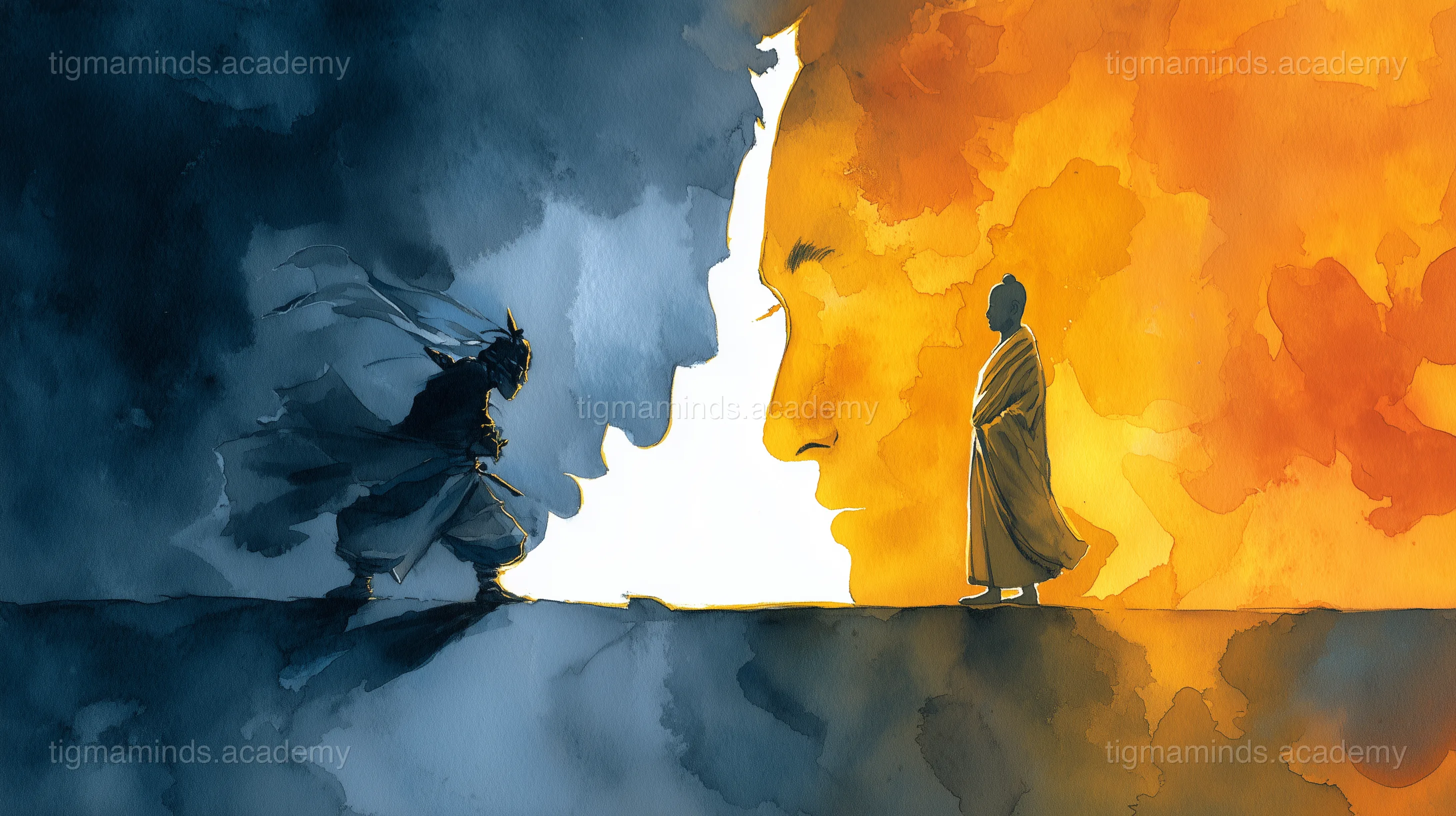
A murderer becomes a saint — the neuroscience of transformation hidden in an ancient Buddhist parable.
The Finger Necklace
In the kingdom of Kosala, during the time of the Buddha, there lived a young man named Ahimsaka — a name that meant "the harmless one." He was brilliant. His parents sent him to study under a renowned guru in Taxila, and he became the teacher’s finest student.
But brilliance can attract envy. The other students, jealous of Ahimsaka’s talent, whispered lies to the guru: "Ahimsaka plans to overthrow you. He says he is smarter than you. He mocks you to others." The lies were persistent and specific, and the guru — a proud and insecure man — believed them.
Rather than confront Ahimsaka directly, the guru devised a cruel test. "To complete your education," he told Ahimsaka, "you must bring me a garland of one thousand human fingers. Only then will I grant you your final teaching."
The guru expected Ahimsaka to refuse — or to be killed in the attempt. Either way, the "threat" would be eliminated.
But Ahimsaka’s devotion to his teacher was absolute. He had been trained to obey without question. And so, with a mind twisted by obedience to a corrupted authority, Ahimsaka walked into the forests of Kosala and began to kill.
He wore the fingers around his neck. People fled their villages when they heard his name. He became Angulimala — "finger necklace" — the most feared bandit in the kingdom. Soldiers were sent to capture him but returned empty-handed. His own mother, hearing he was nearby, set out to find him and beg him to stop.
By the time the Buddha heard of Angulimala, the necklace held 999 fingers. One more, and the task would be complete.
The Encounter
The Buddha walked alone along the forest road where Angulimala hunted. His monks begged him not to go. "The king’s soldiers cannot stop him," they said. "What can one unarmed monk do?"
The Buddha walked on.
Angulimala saw the monk approaching and drew his sword. He charged toward the Buddha at full speed. But something strange happened. No matter how fast Angulimala ran, the Buddha — walking at a calm, even pace — stayed ahead of him. Angulimala sprinted. The Buddha walked. The distance did not close.
Finally, gasping, Angulimala shouted: "Stop, monk! Stand still!"
The Buddha turned and said: "I have stopped, Angulimala. It is you who have not stopped."
The words hit like a physical force. "I have stopped causing harm," the Buddha continued. "I have stopped acting from anger, from fear, from blind obedience. Can you say the same?"
Angulimala stood frozen. For the first time in months, the fog of violence lifted enough for him to hear. He looked at the necklace around his neck. He looked at his own blood-stained hands. And something inside him broke open.
He threw down his sword and fell at the Buddha’s feet.
The Transformation
The Buddha did not reject him. He did not lecture, punish, or condemn. He said: "Come." And Angulimala followed.
The transformation was not instant. Angulimala became a monk, but the villagers threw stones at him when he went begging for food. His body bore scars from the rocks. His mind bore scars from what he had done. The guilt was immense.
But the Buddha gave him a practice: walk slowly through the village, and for every person you see, silently wish them well. "May you be safe. May you be happy. May you be free from suffering." Every day. Every person. No exceptions.
Day after day, Angulimala walked and wished. At first it felt hollow — his mind screamed that he had no right to wish anyone well. But the practice was not about feeling worthy. It was about rewiring. Each repetition laid down a new neural pathway. Each silent blessing weakened the old pathways of violence. Each day, the grooves of compassion deepened by one imperceptible layer.
Months passed. Then years. The villagers noticed. The man who had terrorised them now healed their sick and comforted their grieving. Slowly, grudgingly, they stopped throwing stones.
The End of Angulimala
Angulimala spent the rest of his life as a peaceful monk. The man who had killed 999 people died quietly in meditation, harming no one.
The story was preserved because the Buddha used it to teach a radical idea: no one is beyond change. The mind is not fixed. The brain is not a stone tablet with permanent inscriptions. It is more like clay — shaped by every action, every thought, every repeated practice. What Angulimala proved, 2,500 years before neuroscience confirmed it, is that the organ inside your skull is plastic — capable of profound, fundamental, physical reorganisation.
The murderer became a saint. Not through magic. Through practice.
The end.
Choose your level. Everyone starts with the story — the code gets deeper as you go.
Here is a taste of what Level 1 looks like for this lesson:
# Simple Neuron Model
def neuron(inputs, weights, threshold):
"""Fire if weighted sum exceeds threshold."""
total = sum(i * w for i, w in zip(inputs, weights))
return total >= threshold, total
# Before: aggression dominates
weights_before = [0.9, 0.1] # [aggression, compassion]
fires, total = neuron([1, 1], weights_before, 0.5)
print(f"Before: signal={total:.1f}, fires={fires}")
# After: compassion dominates
weights_after = [0.1, 0.9]
fires, total = neuron([1, 1], weights_after, 0.5)
print(f"After: signal={total:.1f}, fires={fires}")
# Same inputs, different weights = different personThis is just the first of 6 coding exercises in Level 1. By Level 4, you will build: Build a Neuroplasticity Simulator.
By Level 4, enrolled students build: Build a Neuroplasticity Simulator
Free
Level 0: Listener
Stories, science concepts, diagrams, quizzes. No coding.
You are here
Level 0 is always free. Coding levels (1-4) are part of our 12-Month Curriculum.
The science of brain change — how neural pathways rewire, habits form and break, fMRI reveals the thinking brain, and AI copies the process.
The big idea: "Angulimala and the Power of Change" teaches us about Neuroplasticity & Psychology — and you don't need to write a single line of code to understand it.
For most of history, scientists believed the adult brain was like a machine: once assembled, the parts did not change. If a brain region was damaged, it was lost forever. If a person developed a habit, it was permanent. The brain you had at 25 was the brain you would die with.
This turned out to be spectacularly wrong. In the 1960s, researchers discovered that the brains of rats raised in enriched environments (toys, tunnels, other rats) were physically different from those raised in bare cages — thicker cortex, more synaptic connections, more blood vessels. The brain grew in response to experience.
In the 1990s, brain scanners confirmed it in humans. London taxi drivers, who spend years memorising the city’s 25,000 streets, have a measurably larger hippocampus (the brain’s map-making region) than bus drivers who follow fixed routes. Musicians who practise for decades have a thicker motor cortex in the areas controlling their fingers. Blind people who learn Braille show expansion of the sensory cortex that processes touch.
This ability of the brain to physically change its structure in response to experience is called neuroplasticity. "Neuro" means brain. "Plastic" means mouldable. Your brain is not a stone tablet — it is clay, constantly reshaped by what you do, think, and practise.
Check yourself: If you practised juggling for one hour every day for a month, what would change in your brain? (Answer: the regions controlling hand-eye coordination and visual tracking would show measurable thickening — this exact experiment was done by Draganski et al. in 2004.)
Key idea: Neuroplasticity means the brain physically changes its structure in response to experience. Practise a skill and the relevant brain regions grow. Stop practising and they shrink. Your brain is shaped by your daily actions.
Try to remember the first time you tied your shoelaces. It was probably hard — you had to think about every loop and tuck. Now you do it without thinking, often while talking to someone else. What changed? The behaviour moved from your prefrontal cortex (conscious thinking) to your basal ganglia (automatic habits).
Every habit follows a three-step loop, discovered by MIT researchers studying rats in mazes. Step 1: Cue — a trigger that tells the brain to switch to autopilot. For Angulimala, the cue was seeing a traveller. Step 2: Routine — the behaviour itself. For Angulimala, this was violence. Step 3: Reward — the payoff that tells the brain "remember this loop." For Angulimala, this was a sense of power.
The critical insight: you cannot delete a habit. But you can change the routine while keeping the same cue and reward. The cue (seeing a person) stayed the same. The reward (a feeling of fulfilment) stayed the same. Only the routine changed: from violence to wishing them well. This is exactly what the Buddha prescribed.
The brain’s reward chemical is dopamine. When a routine produces an unexpected positive result, dopamine surges, telling the basal ganglia: "Save this loop! Do it again!" Over time, the loop becomes so automatic that the dopamine surge shifts from the reward to the cue itself — you start salivating before the food arrives, not after.
Think about this: What is one habit you do every day without thinking? Can you identify the cue, routine, and reward? (Example: Cue = feeling bored. Routine = pick up phone. Reward = stimulation from scrolling.)
Key idea: Habits are automatic cue-routine-reward loops stored in the basal ganglia. You cannot erase old habits, but you can overwrite the routine. Dopamine is the chemical that stamps habits into the brain.
Access all 130+ lessons, quizzes, interactive tools, and offline activities
How do we know which brain regions are active during meditation, fear, or compassion? Through a technology called **fMRI** (functional Magnetic Resona...
Everything the brain does when forming habits — try an action, get a reward, strengthen the pathway — has been copied into AI. The field is called **r...